
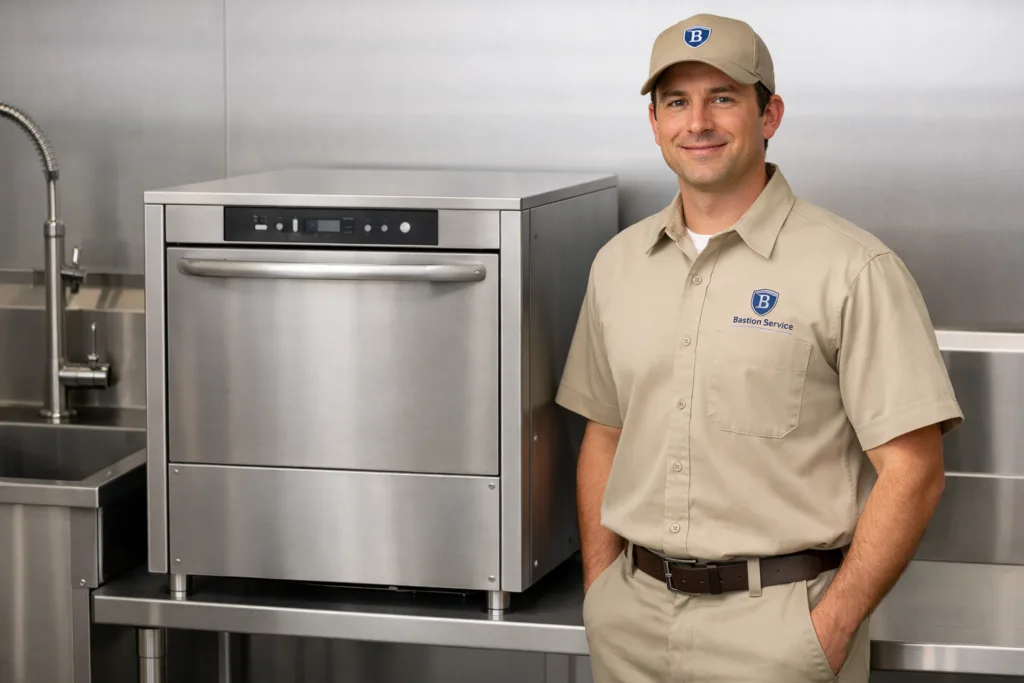




When Hobart warewashing equipment starts disrupting dish flow, staff usually feel it immediately through slower turns, rewash volume, and uncertainty about whether results are consistent enough for daily operations. For businesses in Torrance, repair service is most helpful when it does more than identify a failed part. It should also clarify whether the machine can stay in use, how urgent the problem is, and what repair timing makes sense for the workload. Bastion Service provides Hobart warewashing equipment repair for businesses that need fast symptom-based troubleshooting and a service plan built around downtime impact.
For specific equipment paths in Torrance, review Hobart Dishwasher Repair in Torrance and Commercial Appliance Repair in Torrance.
Symptoms that usually mean service should be scheduled
Warewashing equipment often gives warning signs before a full shutdown. A machine may still power on and run cycles while showing performance problems that point to developing mechanical, electrical, or control-related faults. In many kitchens and food-service settings, those early symptoms matter because even partial performance loss can affect sanitation routines and labor efficiency.
Common reasons to schedule service include:
- Dishware, utensils, or trays coming out with residue, film, or spotting
- Slow fill, no fill, overfilling, or inconsistent water levels
- Drain failures, standing water, or interrupted cycles
- Low rinse temperature or sanitizing concerns
- Leaks at the door, underneath the unit, or around connected lines
- Error displays, unresponsive controls, or machines that stop mid-cycle
- Unusual pump noise, vibration, humming, or grinding sounds
When these symptoms begin repeating, it is usually better to have the unit evaluated before the problem spreads into a full outage during service hours.
Wash performance problems and poor cleaning results
If a Hobart dishwasher is no longer producing clean, consistent results, the issue may involve spray action, pump performance, water circulation, rinse function, temperature, or sensing and timing problems. Poor cleaning is often treated as a detergent or loading issue at first, but when results stay inconsistent across multiple cycles, equipment diagnosis becomes the more practical next step.
Signs that point to a repair need include food residue left behind, cloudy glassware, uneven rinsing, repeat rewashing, or loads that seem clean one cycle and not the next. For a business, that kind of inconsistency slows the entire operation because staff lose confidence in the machine and begin adding manual workarounds.
When poor results are more than a routine adjustment
A small change in performance can become a larger throughput issue quickly. If wash arms are not moving correctly, water flow is restricted, or the unit is not hitting expected cycle conditions, the machine may still appear to be working while failing in a way that affects output. That is why poor wash quality should be treated as a service symptom, not only a convenience issue.
Fill and drain issues that interfere with normal cycles
Fill and drain problems are among the most disruptive warewashing faults because they directly affect whether a cycle can start, complete, or reset properly for the next rack. A unit that fills too slowly, does not fill at all, or fills beyond normal level may be dealing with a valve problem, sensor issue, blockage, or control fault. On the drain side, standing water or incomplete draining can point to pump trouble, clogs, drain path restrictions, or cycle-control problems.
Common signs of fill-related trouble
- Long delays before wash begins
- Water level that appears too low for proper circulation
- Water entering continuously or at the wrong time
- Cycle faults tied to level sensing or fill timing
Common signs of drain-related trouble
- Water left in the tank after the cycle ends
- Machine stopping before completion
- Drain pump noise without normal water removal
- Overflow risk or dirty water remaining in circulation
If the machine is backing up, stopping mid-process, or creating uncertainty about tank conditions between loads, service should not be delayed. Continued use can make the problem harder on pumps, controls, and connected components.
Leaks, overflow, and water around the machine
Visible water around warewashing equipment should always be taken seriously. What looks like a minor drip can come from a door seal, hose connection, fill system issue, pump seal, drain component, or internal failure that only shows itself during certain parts of the cycle. The source is not always obvious from outside the machine.
Leaks create more than cleanup problems. They can interrupt workflow, increase slip risk, affect nearby equipment, and signal wear that worsens each time the unit runs. Overflow is especially important because it can point to level-control problems that may become more severe without repair.
If staff are seeing recurring puddles, moisture beneath the unit, or signs that water is escaping during operation, scheduling diagnosis is the right next move rather than waiting for a larger shutdown.
Rinse temperature and sanitation concerns
Temperature-related complaints deserve prompt attention because they affect more than cycle speed. If the machine is not reaching expected rinse conditions, businesses may notice longer cycles, inconsistent final results, or concern about whether the unit is operating at proper sanitizing performance. These issues can involve heating components, temperature sensing, relays, controls, or related electrical failures.
A unit with temperature trouble may continue running while underperforming, which can make the issue easy to overlook until dish flow slows or staff begin questioning output quality. Service is especially important when the machine repeatedly falls short, shows heating-related errors, or seems to have lost normal cycle consistency.
Control faults, shutdowns, and erratic cycle behavior
Some Hobart warewashing equipment problems are less about water movement and more about how the machine starts, responds, and completes programmed functions. Control faults may show up as random stoppages, buttons that do not respond normally, cycles that fail to advance, repeated resets, or error indications that keep returning.
These symptoms can be difficult to judge from the outside because the machine may operate correctly once and fail the next time. Intermittent faults are still repair issues, especially when the pattern is getting worse or forcing staff to restart the unit repeatedly. Electrical and control-related problems rarely improve with continued use, and they often create the most scheduling disruption because they are unpredictable.
Noise, vibration, and other warning signs of developing failure
Abnormal sound is often one of the clearest indicators that a repair should be scheduled soon. Grinding, rattling, strong humming, or vibration can suggest pump wear, motor strain, obstructions, loose internal parts, or a component beginning to fail under load. When the sound is new, louder than usual, or tied to specific cycle stages, it helps narrow the source of the problem.
Operators in Torrance should pay attention when unusual noise appears together with weaker cleaning, slow draining, leaks, or intermittent shutdowns. A combination of symptoms usually means the issue is affecting more than one part of the machine’s normal operating sequence.
How repair decisions are usually prioritized
Not every symptom carries the same urgency. Some machines can be scheduled for service during a planned window, while others should be pulled from normal use until the fault is confirmed. The key factors usually include:
- Whether the unit is still completing cycles consistently
- Whether dishware is coming out clean and properly rinsed
- Whether there is active leaking or overflow risk
- Whether drainage problems are creating unsanitary conditions
- Whether heating or control faults are affecting reliable operation
- Whether continued use could increase repair scope
A machine that still runs but shows declining performance may allow for short-term scheduling. A machine that leaks heavily, will not drain, shuts down repeatedly, or cannot maintain normal rinse performance should usually be treated as a priority service issue.
What a service visit should help you confirm
For businesses evaluating repair options, the most useful diagnosis answers operating questions as well as technical ones. That includes whether the unit should remain in service, whether the fault appears isolated or system-wide, whether parts replacement is likely, and whether the machine’s recent history suggests a straightforward repair or a pattern of repeated breakdowns.
This matters when managers are balancing labor, dish volume, and timing. A symptom-based evaluation helps determine whether the problem is limited to one failing area or whether multiple issues are stacking up at once, such as low wash performance combined with drainage trouble or control faults combined with temperature loss.
Repair support for Torrance businesses using Hobart warewashing equipment
If your Hobart warewashing equipment is not cleaning properly, is filling or draining incorrectly, is leaking, is missing expected rinse temperature, or is showing control-related faults, the best next step is to schedule service before the disruption spreads further through the day. For Torrance businesses, timely repair helps restore dish flow, reduce rewash pressure, and clarify whether the machine can stay in rotation or should be taken offline until repairs are completed.


