
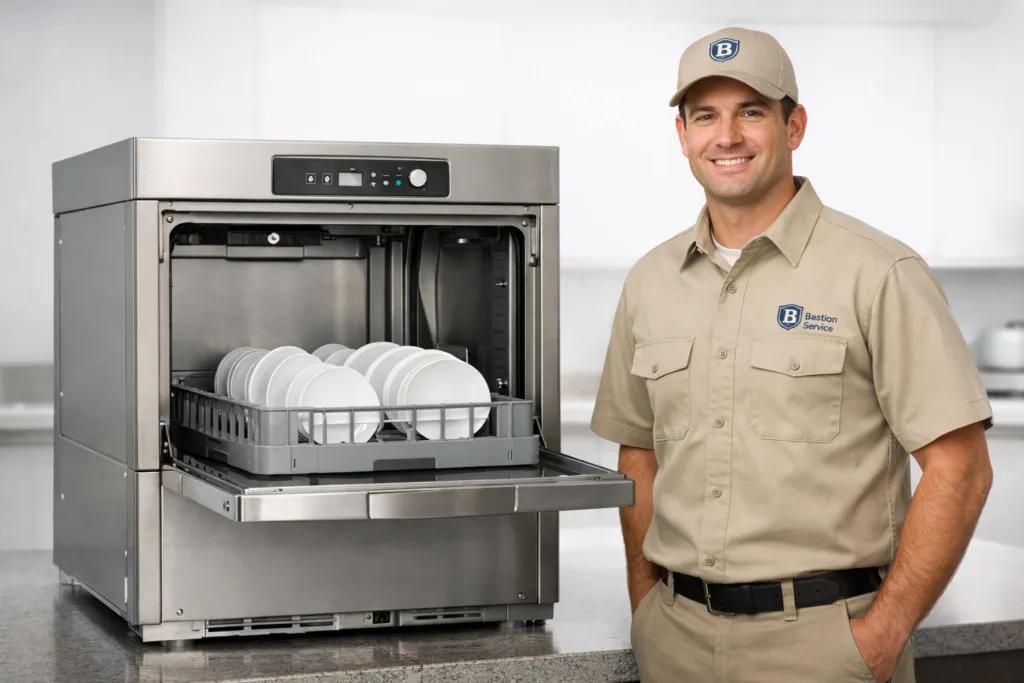




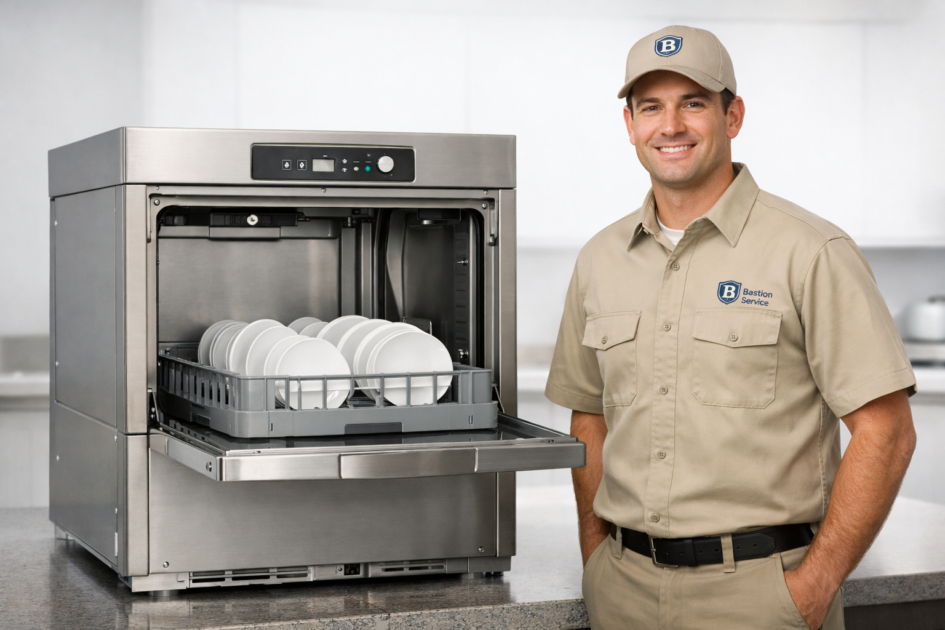
When Hobart warewashing equipment starts affecting dish flow, labor pacing, or sanitation routines in Rancho Palos Verdes, the best next step is to get the symptom pattern evaluated before a smaller problem turns into a full shutdown. Bastion Service provides repair support for businesses that need to understand what is failing, whether the unit should remain in use, and how quickly repair should be scheduled to limit downtime.
For specific equipment paths in Rancho Palos Verdes, review Hobart Dishwasher Repair in Rancho Palos Verdes and Commercial Appliance Repair in Rancho Palos Verdes.
Warewashing problems do not all point to the same cause. A machine that leaves residue may have a very different issue than one that will not fill, overheats, leaks, or stops mid-cycle. That is why service decisions are usually based on what the machine is doing during operation, how often the symptom appears, and whether the problem is creating immediate risk for sanitation, workflow, or safety.
What symptoms usually mean repair should be scheduled
Businesses in Rancho Palos Verdes often call for service when the equipment is still running but no longer running correctly. That stage matters because it can be the window where repair is still more manageable than waiting for complete failure during active service.
- Poor wash results or repeated rewash
- Slow filling, no fill, or inconsistent water levels
- Drain problems or standing water left in the tank
- Water leaking at the door, underneath, or around connections
- Low rinse temperature or sanitation-related concerns
- Cycle interruptions, fault codes, or controls that do not respond normally
- Unusual noises from pumps, motors, or moving wash components
- Longer cycle times or unpredictable shutdowns
Any one of these can reduce output. In a busy kitchen, even intermittent issues can force staff to slow down, sort around failed loads, or stop and restart the machine repeatedly.
Wash performance problems and why they should not be ignored
Residue, spotting, or items coming out unclean
If dishes, utensils, or racks are coming out with food residue, film, or inconsistent final results, the problem may involve wash arm movement, pump performance, filter blockage, detergent delivery, rinse action, heating, or scale restricting circulation. Similar-looking wash complaints can come from very different failures, which is why symptoms during the cycle matter as much as the final result.
When wash quality drops, the cost is not limited to the machine. Rewash volume increases, labor gets redirected, and service flow starts backing up. If staff are already compensating by rerunning loads or hand-finishing items, repair planning should move up in priority.
Weak spray or uneven cleaning
Uneven cleaning often shows up as one section of a rack washing differently than another, or one cycle appearing acceptable while the next is not. That can point to circulation issues, partial blockages, pressure loss, or components that are working inconsistently under load. Intermittent wash results are especially important because they can be misread as operator error when the machine is actually losing performance.
Fill and drain issues that disrupt the next load
Slow fill, overfill, or failure to fill
When a Hobart unit is slow to fill, does not reach the expected level, or appears to overfill, the issue may involve the water inlet side, controls, float-related components, sensors, or a fault that is affecting cycle sequencing. These problems often show up as delayed starts, unusual pauses, or cycles that behave differently from normal operation.
Fill issues matter because the machine may still appear usable while wash quality and cycle consistency are already being affected. A unit that does not fill correctly may also create secondary strain on heating and circulation functions.
Standing water or incomplete draining
Drain faults can leave water behind at the end of the cycle, create overflow concerns, or prevent the next load from running properly. Common causes include blockages, pump problems, drain restrictions, sensor faults, or control issues that prevent the drain sequence from completing. If water remains in the machine regularly, service should be scheduled before the condition leads to odor, backup, or a larger interruption.
Standing water is also a warning sign that operators may begin working around the problem rather than solving it. In most business settings, that only increases labor time and raises the chance of a full stoppage during a peak period.
Leaks, moisture, and signs the machine should be checked promptly
Leaks around warewashing equipment should be treated as more than a housekeeping issue. Water at the front of the unit, underneath the body, or near supply and drain connections can indicate worn seals, overfill conditions, plumbing problems, drain trouble, or internal component failure. The source is not always obvious from where the water appears on the floor.
Even a small leak can create slip risk, damage nearby surfaces, and signal a condition that worsens under continued use. If the amount of water changes from cycle to cycle, or if leaks increase during rinse or drain stages, that detail is useful when repair is scheduled.
Rinse temperature and sanitation concerns
Temperature complaints are a major reason warewashing equipment gets pulled into service review. If rinse temperature is not reaching expected levels, items may not be finishing properly, cycles may be inconsistent, or staff may notice the machine taking longer to recover between loads. Temperature-related symptoms can involve heating components, controls, sensors, incoming water conditions, or related electrical faults.
Low temperature performance should not be treated as a minor inconvenience. For businesses in Rancho Palos Verdes, sanitation concerns can quickly become an operations issue when staff lose confidence in the machine and start changing workflow to compensate. If temperature readings appear inconsistent, or if the machine is showing signs of heat-related faults, it makes sense to have it evaluated before use continues through a busy stretch.
Control faults, cycle interruptions, and shutdown behavior
Machine will not start or stops during operation
If the unit does not power on, stalls partway through a cycle, or trips faults repeatedly, the problem may be in the control system, switches, sensors, electrical components, or a mechanical failure that is triggering protective shutdown behavior. A machine that works only after resets, repeated attempts, or manual intervention is already affecting labor efficiency even if it has not failed completely.
Buttons, displays, or cycle selection problems
Control complaints can also show up as unresponsive inputs, incorrect cycle behavior, inconsistent timing, or displays that do not match what the machine is doing. These symptoms often make staff unsure whether the problem is user-related or equipment-related. If controls are no longer behaving predictably, service is usually more useful than continued trial and error during active operation.
How businesses can describe the problem before a service visit
A good symptom description can help move repair in the right direction faster. Before scheduling, it helps to note:
- Whether the problem happens on every cycle or only sometimes
- If the issue affects wash, rinse, fill, drain, or startup
- Whether the machine is leaking and from what general area
- If staff have noticed unusual noise, odor, or heat changes
- Whether there are fault messages, resets, or shutdowns
- If performance changed gradually or failed suddenly
That information helps determine urgency and whether the equipment may need to be taken out of use until repairs are completed.
When continued use can increase downtime
Some warewashing problems seem manageable for a few shifts, but continued operation can make the eventual repair more disruptive. Running a unit with drain trouble, leak conditions, unstable temperatures, or repeated control faults may increase wear on pumps, motors, heaters, and related systems. It can also create a badly timed shutdown when the machine is needed most.
If staff are already monitoring each cycle, adjusting around weak results, or cleaning up recurring water on the floor, the equipment is no longer operating normally. At that point, scheduling repair is usually the better decision than stretching use until complete failure forces an emergency response.
Repair decisions based on the actual condition of the machine
Not every service call leads to the same recommendation. Some Hobart warewashing issues come down to a targeted repair with a straightforward path back to stable operation. Others involve multiple worn components, recurring failures, or broader decline that affects confidence in the unit. The purpose of diagnosis is to identify what the symptom pattern is really saying and whether repair remains the practical path for the business.
For kitchens in Rancho Palos Verdes, that decision is usually tied to uptime, staffing pressure, sanitation expectations, and how much disruption the current machine is already causing. A repair plan should reflect those operating realities, not just the fact that the machine still powers on.
If your Hobart warewashing equipment is showing wash performance problems, fill or drain issues, leaks, temperature concerns, sanitation complaints, or control faults, scheduling service is the practical next step. A timely evaluation helps determine whether the unit can stay in use, what repair path makes sense, and how to reduce further disruption to daily operations in Rancho Palos Verdes.


