
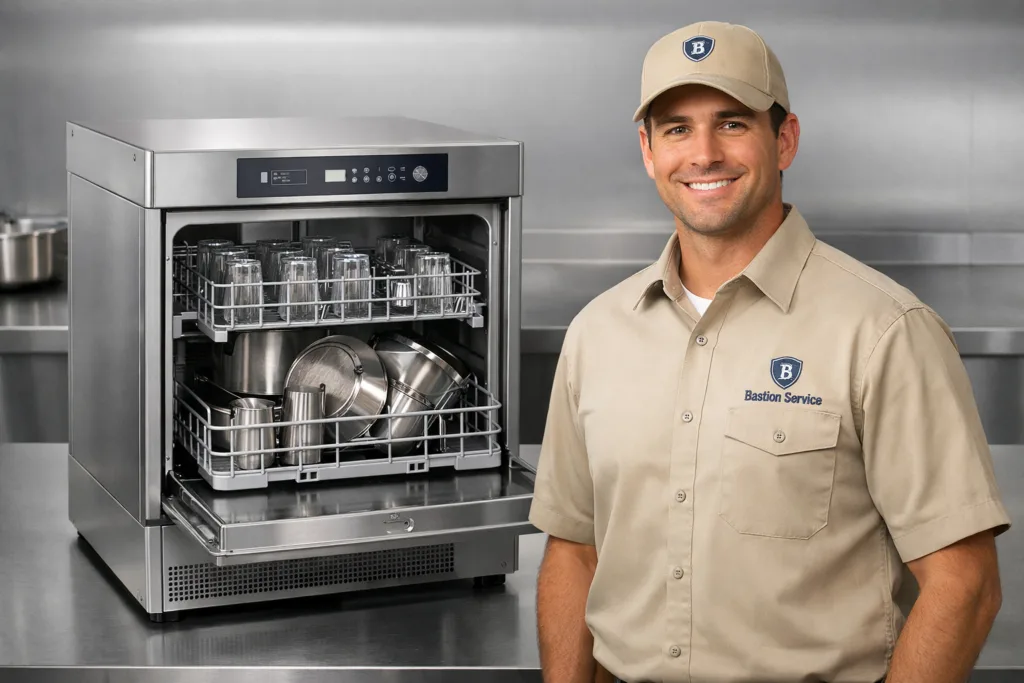




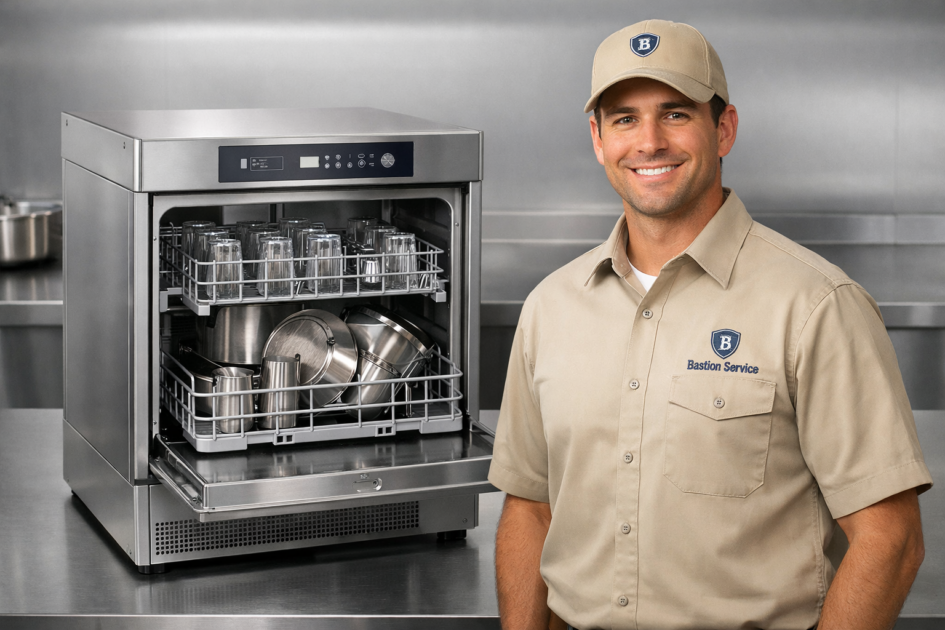
When a Hobart warewashing machine starts slowing dish flow, leaving residue behind, leaking, or stopping mid-cycle, the repair decision affects more than one piece of equipment. It affects labor, sanitation consistency, service speed, and the ability to keep kitchen operations moving without workarounds. For businesses in Inglewood, an on-site service visit helps determine whether the issue is tied to wash action, water movement, temperature, controls, or wear that could lead to a larger shutdown if ignored.
For specific equipment paths in Inglewood, review Hobart Dishwasher Repair in Inglewood and Commercial Appliance Repair in Inglewood.
Bastion Service provides Hobart warewashing equipment repair support for businesses in Inglewood that need timely troubleshooting, repair scheduling, and a realistic plan based on the actual symptom pattern. Whether the machine is still running poorly or has stopped altogether, the goal is to identify the source of the fault, assess operating risk, and move toward repair with as little disruption as possible.
What Hobart warewashing equipment problems do you troubleshoot?
Most service calls begin with one of a few operating complaints: dishes are not coming out clean, the machine will not fill or drain correctly, rinse temperature seems off, water is appearing around the unit, or the controls are acting unpredictably. Those symptoms can come from very different causes, which is why symptom-based diagnosis matters before parts are approved or the machine is pushed through another busy shift.
- Poor wash performance, residue, spotting, or repeat rewashing
- Slow fill, no fill, draining problems, or standing water
- Low rinse temperature, heating faults, or sanitation concerns
- Leaks around the door, underneath the machine, or near fittings
- Cycle interruptions, shutdowns, error conditions, or control issues
- Unusual noise, pump strain, or inconsistent operation from one load to the next
In a business setting, even a machine that still powers on can be creating hidden downtime through slower throughput, extra labor, and repeated rewash loads. That is often the point where service becomes more cost-effective than continuing to operate around the problem.
Wash performance problems and unfinished results
If wares are coming out with food soil, film, spotting, or inconsistent cleaning, the underlying issue may involve wash arms, spray delivery, pump performance, water pressure, scale buildup, or temperature-related problems. Sometimes the complaint sounds simple, but the effect on operations is significant because staff begin sorting acceptable loads from failed loads and rerunning racks that should have been finished the first time.
Common signs that wash performance needs service include:
- Loads that look different from one cycle to the next
- Cloudy glassware or residue on dishes and utensils
- Longer cycle completion without better results
- Wash action that sounds weak or uneven
- Repeated complaints from kitchen staff about output quality
These symptoms do not always point to a single failed part. A proper inspection helps separate repairable component issues from water delivery restrictions, buildup, or broader system wear affecting how the machine cleans during active use.
Fill and drain issues that interrupt kitchen flow
Few warewashing faults create backup faster than a unit that will not fill, drains slowly, or stops with water still inside. Fill and drain symptoms can involve valves, pumps, hoses, drain assemblies, float or level sensing components, or control-related failures. The machine may pause unexpectedly, refuse to begin a cycle, or require repeated resets before it runs again.
In many kitchens, these issues show up before a complete failure. Staff may notice slower starts, partial draining, water left in the tank, or an increasing need to monitor the machine between loads. That pattern usually means the condition is already affecting workflow and should be evaluated before it turns into a full stoppage during service hours.
Rinse temperature problems and sanitation concerns
Heating and sanitizing issues deserve quick attention because the machine can appear operational while still failing to deliver consistent final results. If rinse temperature is not reaching expected levels, if tank heat is unstable, or if loads are not finishing as expected, the problem may involve heating elements, thermostatic controls, relays, sensors, wiring, or related electrical faults.
Warning signs often include:
- Inconsistent final rinse temperature
- Cycles that seem normal but produce poor drying or cleaning results
- Longer recovery times between loads
- Temperature-related alarms or intermittent shutdowns
- Staff concerns about sanitation consistency
Because warewashing performance affects both output quality and operating standards, temperature complaints should be treated as repair issues rather than routine inconvenience.
Leaks, noise, and visible wear
Water on the floor, drips during operation, worn door components, or unusual sounds are often early indicators of a broader mechanical problem. A leak may come from a hose, seal, pump area, fitting, or an internal component under stress. Noise can point to obstruction, loose hardware, pump problems, or wear that gets worse as the machine continues running under load.
These symptoms matter for two reasons. First, they can grow into larger part failures if the machine stays in service without inspection. Second, they often create secondary problems such as slip hazards, water damage, or unreliable operation that slows the kitchen even before the dishwasher stops working completely.
Control faults and intermittent shutdowns
Some Hobart warewashing issues are less about one obvious mechanical failure and more about erratic operation. The machine may start and stop unpredictably, fail to complete cycles, display fault conditions, or respond inconsistently to operator input. Intermittent problems are especially disruptive because they are easy to dismiss as temporary until they begin affecting every shift.
A control-related service visit may involve checking switches, sensors, boards, relays, wiring conditions, and operating sequences to determine whether the fault is isolated or part of a larger wear pattern. For businesses in Inglewood, this kind of troubleshooting is important when staff are losing time to restarts, incomplete cycles, or machines that cannot be trusted during peak demand.
When to stop using the machine until it is inspected
Some symptom patterns suggest that continued operation could increase damage or create avoidable disruption. It is usually wise to pause use and schedule repair if the machine is leaking heavily, failing to drain, tripping power, overheating, producing sharp mechanical noise, or no longer maintaining acceptable wash or rinse performance.
Even when the unit still runs, continued use may lead to:
- Higher rewash volume and labor loss
- Worsening component damage
- Unexpected shutdown during active service
- Water spread around the work area
- More complicated repair needs if the fault progresses
If staff are already adapting around the same problem every day, the downtime cost is usually no longer theoretical. Service becomes the practical next step.
How a service diagnosis helps with repair planning
Repair planning for warewashing equipment is not only about identifying a failed part. It also helps answer operational questions that matter to business owners and managers: whether the machine should remain in limited use, whether the fault appears isolated or part of broader wear, whether one visit is likely to resolve the issue, and how scheduling should be handled to reduce disruption.
That matters for businesses in Inglewood where dish turnaround directly affects staffing pace and kitchen output. A structured inspection gives decision-makers better information about repair urgency, expected downtime, and whether the current symptom points to a manageable repair or a more extensive equipment condition.
Repair versus replacement considerations
Many Hobart warewashing problems are repairable, especially when the issue is limited to a worn component, a water movement problem, a heating fault, or a control-related failure that has not led to extensive secondary damage. Replacement usually enters the conversation when the machine has repeated major breakdowns, severe wear, escalating repair frequency, or a condition that no longer matches the value of further repair.
The most useful approach is to base that decision on actual inspection findings rather than age alone. Looking at symptom severity, operating condition, downtime history, and current repair scope gives a more realistic picture than assuming every major complaint means the machine is finished.
Scheduling Hobart warewashing repair in Inglewood
When wash quality drops, drain problems begin, temperatures become unreliable, or the machine starts leaking or shutting down, scheduling service early usually protects both uptime and repair options. For businesses in Inglewood, the next step is to have the symptom pattern evaluated so the fault can be identified, operating risk can be assessed, and repair can be scheduled around the realities of daily kitchen use. Timely warewashing equipment service is often the difference between a contained repair and a larger interruption that affects the whole operation.





