
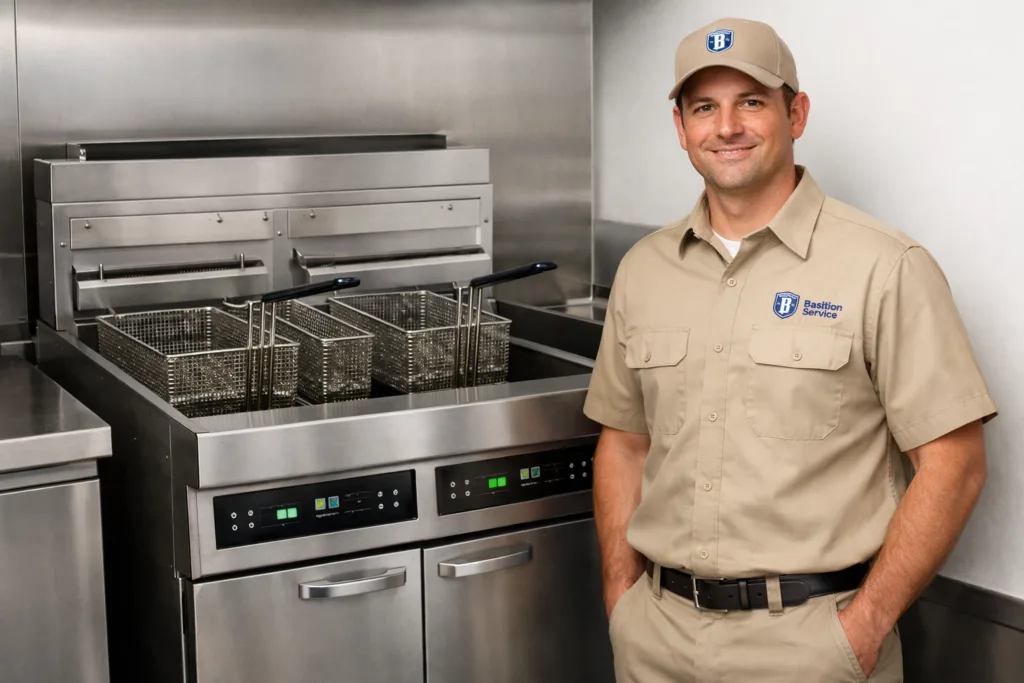




When Frymaster cooking equipment begins slowing production, missing set temperatures, or dropping out during service in West Los Angeles, the best next step is to move quickly from symptom spotting to repair planning. Bastion Service works with businesses that need the problem identified, the risk to daily operations understood, and service scheduled around real kitchen demands rather than trial-and-error part replacement.
For specific equipment paths in West Los Angeles, review Frymaster Fryer Repair in West Los Angeles and Commercial Appliance Repair in West Los Angeles.
For many operators, the issue starts with one fryer acting inconsistently and then spreads into longer ticket times, uneven product, staff workarounds, and strain on the rest of the line. Whether the equipment shows heat loss, ignition trouble, control errors, leaks, or repeated shutdowns, service decisions are easier when the symptom pattern is evaluated in the context of actual usage, equipment condition, and downtime impact.
Frymaster cooking equipment problems that commonly need repair
Frymaster equipment is built for high-output kitchens, but repeated heat cycles, daily use, and heavy production can eventually lead to faults that interrupt normal operation. Some failures are sudden, while others show up as slower recovery, unstable temperatures, unreliable startup, or controls that no longer respond the way staff expects.
Businesses in West Los Angeles often schedule repair when they notice problems such as:
- Slow heat-up at opening or between batches
- Oil temperature running too high or too low
- Recovery problems during busy periods
- Ignition failures or delayed burner startup
- Burners cycling irregularly or dropping out
- Error displays, control lockouts, or unresponsive controls
- Unexpected shutdowns during production
- Oil leaks or signs of stress around fryer components
- Inconsistent cooking results from one shift to the next
These symptoms matter because they affect more than the appliance itself. They can reduce output, increase waste, disrupt timing, and make it harder for kitchen staff to maintain consistent service.
Temperature problems that affect food quality and throughput
Slow heat-up and weak recovery
If a fryer takes too long to come up to temperature or cannot recover fast enough between loads, the problem may involve burner performance, gas-related components, temperature sensing, control response, or wear affecting overall heat transfer. In day-to-day operations, weak recovery often shows up as longer cook cycles, crowding at the line, and product consistency issues that become more obvious during peak demand.
When a unit falls behind production, staff may try to compensate by changing timing or reducing batch size. That can keep service moving for a while, but it does not solve the underlying equipment fault. If recovery has become noticeably worse, repair is usually worth scheduling before the issue turns into a full outage.
Temperature swings and inaccurate readings
Oil that overshoots, runs cold, or fluctuates without warning can point to probe issues, thermostat or control problems, calibration drift, or faults in related temperature management components. Operators may first notice this as uneven product color, inconsistent cook times, or differences between what the display shows and what the fryer actually does.
Temperature instability is especially important to address early because it affects both product quality and operating confidence. If staff cannot trust the unit to hold a stable temperature, the fryer becomes difficult to use efficiently even before it fully fails.
Ignition and burner issues that interrupt service
Startup problems are among the most disruptive cooking equipment faults because they can appear intermittent at first. A fryer may ignite only after repeated attempts, fail to light consistently, lose flame during operation, or stop heating even though the rest of the unit appears powered on. These symptoms can involve ignition components, flame sensing, burner assemblies, controls, or safety-related shutdown conditions.
Intermittent burner behavior often causes more disruption than a complete failure because the equipment seems usable until it drops out in the middle of service. For kitchens in West Los Angeles, that kind of unreliability can force menu adjustments, slow order flow, and create avoidable stress on staff trying to work around a unit that may stop again at any time.
Repeated ignition failure is usually a sign that the fryer should be evaluated before it is relied on for another busy shift.
Control faults, lockouts, and shutdown behavior
Modern Frymaster cooking equipment depends on controls, sensors, and safety circuits to manage heating performance and protect the unit. When the interface behaves unpredictably, the display shows errors, settings do not respond correctly, or the equipment shuts down without a clear explanation, the problem may extend beyond a simple reset.
Control-related issues can include:
- Buttons or keypad functions not responding properly
- Error codes that return after reset attempts
- Unexpected lockouts during normal use
- Erratic display behavior
- Heating commands that do not match actual fryer operation
- Shutdowns tied to sensor or safety circuit faults
These situations usually need diagnosis before parts are changed, because similar symptoms can come from different causes. What appears to be a control board issue may also involve wiring, sensor problems, safety devices, or heat-related wear elsewhere in the equipment.
Leaks, stress symptoms, and signs the fryer should not be ignored
Not every fryer problem begins with a no-heat condition. In some cases, the warning signs are leaks, unusual smells, overheating concerns, repeated safety trips, or visible signs that the unit is under strain. Those symptoms may indicate that continued operation could worsen damage or create a more expensive repair situation.
Businesses should take a closer look when they notice:
- Oil where it should not be collecting
- Frequent overheating or high-limit trips
- Shutoffs that happen during normal cooking loads
- Uneven heat performance across the workday
- Recurring faults that return after temporary resets
In these situations, the operational question is not just whether the fryer still powers on. It is whether the equipment can be used predictably without creating more downtime, safety concerns, or secondary component damage.
How repair decisions are usually made
For business operators, the repair decision often comes down to three practical factors: how severe the current symptom is, how much downtime the issue is causing, and whether the equipment condition still supports a worthwhile fix. Many Frymaster problems can be resolved with targeted repair when the core unit remains in solid working shape. In other cases, repeated failures, multiple overlapping faults, or advanced wear may change the conversation.
A useful assessment generally looks at:
- Whether the problem is isolated or part of a larger pattern
- How the fault affects safe operation and production
- Whether the equipment can remain in limited use before repair
- The likelihood of related component damage
- The value of repair compared with ongoing disruption
This approach helps separate a manageable service issue from a unit that is becoming a recurring source of operational loss.
Repair support for businesses in West Los Angeles
When Frymaster cooking equipment starts affecting output, timing, or line reliability, service should lead to an actionable repair plan rather than more uncertainty. If your fryer is showing temperature problems, ignition faults, burner issues, control errors, leaks, or repeated shutdowns, scheduling service in West Los Angeles is the practical next step to identify the cause, review repair options, and decide how to restore dependable operation with as little disruption as possible.


