
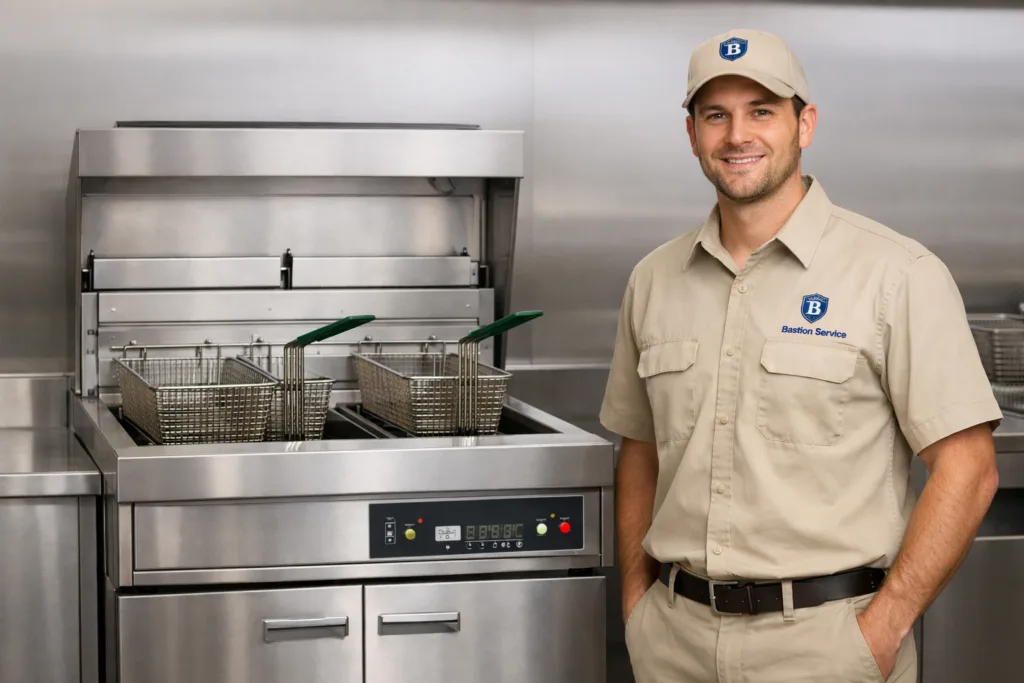





When Frymaster cooking equipment starts missing temperature, recovering too slowly, or dropping out during a rush, the priority is restoring stable kitchen output without wasting time on guesswork. For restaurants and food-service businesses in Brentwood, a service visit is most valuable when it connects the symptom pattern to the actual failed component or system, then maps out the next step for repair scheduling, continued operation, or temporary removal from service.
For specific equipment paths in Brentwood, review Frymaster Fryer Repair in Brentwood and Commercial Appliance Repair in Brentwood.
Bastion Service helps businesses evaluate Frymaster equipment problems that interfere with ticket times, food quality, staffing flow, and daily production. Whether the issue appears as weak heat, ignition trouble, repeated lockouts, or unpredictable controller behavior, the goal is to identify what is failing, how urgent the problem is, and what repair path best supports operations.
What Frymaster cooking equipment problems do you troubleshoot?
Most calls center on fryer-related performance issues, but the underlying complaint is usually broader than a single part failure. Operators often report that equipment is heating inconsistently, taking too long to recover, shutting down during use, showing burner or control problems, or creating delays that affect the whole line. These symptoms can point to issues with gas delivery, ignition components, sensors, high-limit devices, controls, power supply, wiring, or heat-transfer performance.
Common problems include:
- Temperature running too low or too high
- Slow recovery between batches
- Failure to ignite or delayed ignition
- Burner dropout during operation
- Random shutdowns or lockouts
- Controls that do not respond correctly
- Error codes or resets that keep returning
- Uneven cooking results and inconsistent output
- Oil leaks or signs of fluid loss around the unit
- Performance changes that worsen during peak demand
How fryer symptoms usually show up in daily service
Cooking equipment problems rarely begin as a total outage. More often, staff notice changes in performance first. Product may come out lighter than expected, darker than expected, or inconsistent from batch to batch. Cook times may stretch longer than normal. The fryer may seem usable early in the day and then become unstable once the kitchen is busy. These patterns matter because they usually point to a problem that is already affecting output, even before the unit fully stops working.
Temperature control problems
If a fryer does not hold its set temperature, cycles erratically, or drifts during use, the fault may involve the temperature probe, thermostat function, control board, contactor, high-limit system, or burner performance. In practical terms, this can show up as undercooked batches, scorched product, repeated manual adjustments, or staff losing confidence in cook timing. Temperature problems should be checked early because continued operation can lead to food-quality losses and added strain on other kitchen stations.
Ignition and burner issues
Ignition trouble often appears as clicking without lighting, delayed startup, intermittent flame, or a fryer that lights and then drops out. These symptoms may be tied to ignitors, flame sensing, gas valves, burner assembly condition, airflow disruption, or electrical interruptions. Because burner instability can quickly turn into a no-heat condition, repeated ignition failure is usually a sign to schedule repair before the next busy service window.
Slow recovery between loads
When a fryer cannot return to cooking temperature fast enough, throughput drops and product consistency suffers. Slow recovery may come from weak burner output, scaling or buildup that affects heat transfer, control faults, sensor drift, or fuel-supply problems. This issue is especially important in high-volume kitchens, where one lagging fryer can create a chain reaction of delays across the line.
Shutdowns, resets, and control faults
Unexpected shutdowns are among the most disruptive symptoms because they create uncertainty during active production. A fryer that needs to be reset, shows unstable display behavior, loses settings, or trips safety limits may have an electronic control issue, a thermal protection problem, or an intermittent power fault. If resets seem to restore operation only temporarily, the equipment usually needs diagnosis rather than continued trial-and-error use.
What certain symptom patterns can indicate
Operators can often help speed service by noting when the problem occurs and whether it happens consistently. A fryer that works when cold but fails after heating up may have a component that becomes unstable under load. A unit that only struggles during high-volume periods may be dealing with recovery or fuel-delivery limitations. If one vat is affected while another performs normally, that often points to a localized control, burner, or sensing issue rather than a kitchen-wide utility problem.
Useful details to share when scheduling service include:
- Whether the equipment fails at startup or later in the shift
- If the problem affects one vat or multiple units
- Any error messages, alarms, or blinking indicators
- Whether staff have noticed unusual smells, noises, or flame behavior
- If performance changes after resetting the equipment
- How the issue is affecting food output, timing, or workflow
When a repair call makes sense
Scheduling service is usually the right move when equipment is already affecting production, consistency, or labor efficiency, even if it still turns on. Waiting for a complete failure often means the worst possible timing: a breakdown during prep, lunch, dinner, or a staffed event. If the fryer is heating unevenly, losing flame, recovering too slowly, leaking, or shutting down without warning, those are all strong indicators that repair should be evaluated promptly.
Service also becomes more urgent when safety devices are tripping repeatedly, ignition is unreliable, or staff have to keep working around the same malfunction. In those cases, the question is not just whether the unit can run, but whether it can run predictably enough to support kitchen operations.
Repair versus replacement for aging equipment
Not every Frymaster issue points to replacement. Many problems are still worth repairing when the fault is limited to a specific control, ignition, heating, or sensor-related system and the rest of the equipment remains in workable condition. On the other hand, replacement planning may be more practical when the unit has a long repeat-failure history, multiple systems declining at once, or downtime costs that are becoming harder to absorb.
A useful service assessment should help clarify whether the repair addresses the root problem or only delays a larger decision. For business operators in Brentwood, that distinction matters because downtime, staffing pressure, and output demands all affect whether a repair remains the best investment.
What to expect from service-focused diagnosis
A productive visit should do more than confirm that the equipment is malfunctioning. It should narrow down the source of the problem, determine whether the unit should remain in use, identify what repair is likely to restore normal performance, and help set realistic expectations for scheduling. That matters most when kitchens are trying to minimize disruption rather than simply react to a full shutdown.
If your Frymaster cooking equipment is showing temperature issues, ignition problems, slow recovery, leaks, control faults, or repeat shutdowns, the practical next step is to schedule diagnosis and repair planning based on how the equipment is actually failing in service. That gives your Brentwood operation a clearer path to restoring stable output and reducing avoidable downtime.


