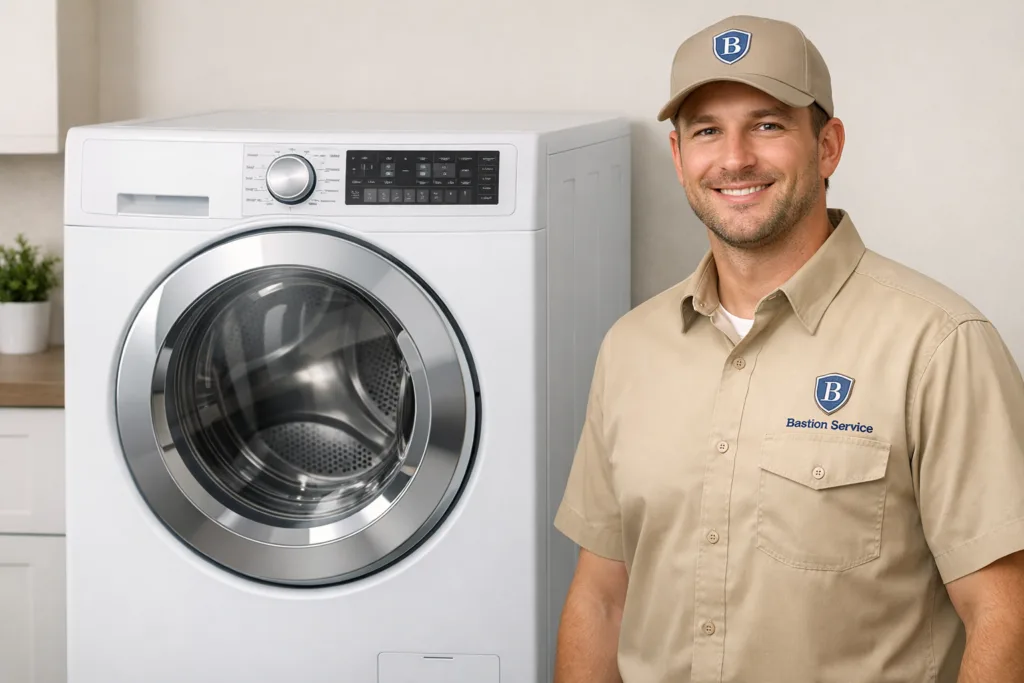
Dryer problems often look simple at first, but the symptom alone does not always reveal the failed part. A load that comes out damp may point to restricted airflow, weak heat, a sensor issue, or a control problem. A machine that stops mid-cycle may be overheating, losing power, or reacting to a fault in a safety circuit. With Electrolux dryers, it helps to look at the full pattern before deciding what repair makes sense.
Electrolux dryer symptoms homeowners in Hawthorne commonly see
Most dryer issues show up in day-to-day laundry: towels still wet after one cycle, clothes that feel too hot, a drum that turns without drying, or a machine that has become noisier over time. Noticing exactly how the dryer behaves can make the repair path much clearer.
No heat or very little heat
If the drum turns but clothes stay wet, the problem may involve the heating circuit, thermostat, thermal fuse, gas ignition components on gas units, or the incoming power supply. In many cases, vent restriction also needs to be ruled out. A dryer can appear to be running normally while still failing to produce the heat needed for proper drying.
Long dry times
When loads need two or three cycles, airflow is one of the first things to consider. Moist air has to leave the drum efficiently for clothes to dry. If it cannot, the dryer may run longer, get hotter than intended, and still leave fabrics damp. Long cycles can also be tied to weak heating performance or moisture-sensing problems.
Will not start
A no-start complaint can come from something as straightforward as a door switch or fuse, but it can also involve the start circuit, control board, or electrical supply. On electric dryers especially, partial power problems can create confusing symptoms where some functions respond but the machine will not run as expected.
Noise, thumping, or scraping
Dryers contain several wear parts that support the drum and belt system. Rollers, glides, idler pulleys, and belts can wear down gradually, leading to squealing, rumbling, or scraping sounds. Coins, buttons, and other small objects can also get trapped and create noise that sounds more serious than it is. The key is not to ignore a sound that is getting worse.
Shuts off too soon or behaves unpredictably
If an Electrolux dryer stops early, runs for only a few minutes, or changes behavior from one load to the next, the issue may involve moisture sensing, airflow, overheating protection, or an electronic control fault. These symptoms are easy to misread without testing because several different failures can produce similar results.
Why airflow matters more than many homeowners expect
Dryers need both heat and air movement. When the vent path is restricted, moisture stays in the system longer, drying performance drops, and internal temperatures can rise beyond normal operating range. That added heat stress can affect fuses, thermostats, heating components, and controls.
Common signs of an airflow problem include:
- Clothes taking much longer than normal to dry
- The dryer cabinet feeling unusually hot
- A burning or overheated smell
- Loads that are hot but still damp
- The dryer shutting down before the cycle should end
When venting is part of the problem, replacing a failed part without addressing the airflow issue may lead to another breakdown later.
Symptom-based repair guidance for common household situations
Clothes are warm but still wet
This usually means the dryer is producing at least some heat, but moisture is not being removed effectively. Restricted venting is a common cause, though blower issues and sensor problems can create similar results. If the dryer seems hot yet laundry stays damp, the issue is not always the heating element itself.
The dryer hums but the drum does not turn
A broken belt, seized roller, failed idler pulley, or motor problem may be involved. Some units will hum when the motor tries to start but cannot move the drum. Repeatedly pressing start in this condition can put extra strain on the motor.
The dryer starts, then stops after a few minutes
This may point to overheating, airflow restriction, a weak motor, or a control-related issue. If the machine works again after cooling down, that often suggests a heat-related shutdown rather than a simple no-power condition.
Small loads dry, normal loads do not
That pattern often shows up when airflow is limited or heating performance has weakened. A small load may finish because there is less moisture to remove, while a full family load exposes the problem more clearly.
The dryer suddenly lost heat
When a dryer was working normally and then stops heating from one load to the next, a blown thermal fuse, failed element, thermostat issue, or gas-heating fault may be involved. Sudden heat loss usually deserves prompt service instead of continued trial runs.
When continued use can make the problem worse
Some dryer issues are mostly inconvenient. Others can accelerate wear quickly. It is smart to stop using the machine and schedule service if you notice any of the following:
- Scraping, grinding, or loud thumping noises
- A hot exterior cabinet or overly hot clothing
- A burning odor during operation
- Repeated mid-cycle shutdowns
- The dryer tripping breakers or failing to start reliably
- Very long dry times that are getting worse
Running the dryer under those conditions can turn a single failed part into broader damage involving the belt system, motor, heater, or control components.
Repair or replace: how to think through the decision
For many households in Hawthorne, replacement is not automatically the best move. An Electrolux dryer is often worth repairing when the issue is limited to a serviceable component such as a belt, roller, fuse, igniter, sensor, switch, or heating part. If the cabinet, drum, and main drive system are still in good shape, a focused repair may restore normal operation without much uncertainty.
Replacement becomes more likely when several major systems are failing at once, the dryer shows heavy overall wear, or the cost of repair starts approaching the value of a reliable newer machine. Age matters, but overall condition matters just as much. A well-kept dryer with one confirmed failure is very different from a machine with a history of overheating, repeated breakdowns, and multiple worn mechanical parts.
What helps make a dryer diagnosis more accurate
Before service, it can help to note exactly what the dryer is doing. Details like these are useful:
- Whether the drum turns
- Whether the dryer heats at all
- If the problem affects every cycle or only certain settings
- Whether the machine stops on its own
- What kind of sound it makes and when the sound starts
- Whether dry times changed gradually or all at once
Those observations can help separate airflow issues from heating failures, no-start conditions from power problems, and normal wear from larger system faults.
Residential service needs to fit real laundry use
In a busy home, dryer trouble does not just delay one load. It affects school clothes, bedding, towels, work uniforms, and the normal rhythm of the week. That is why the most useful next step is a practical repair plan based on the exact symptom, the condition of the machine, and whether the fix is likely to hold. For Hawthorne homeowners, that keeps the decision grounded in how the dryer actually performs at home rather than in guesswork or unnecessary part swapping.