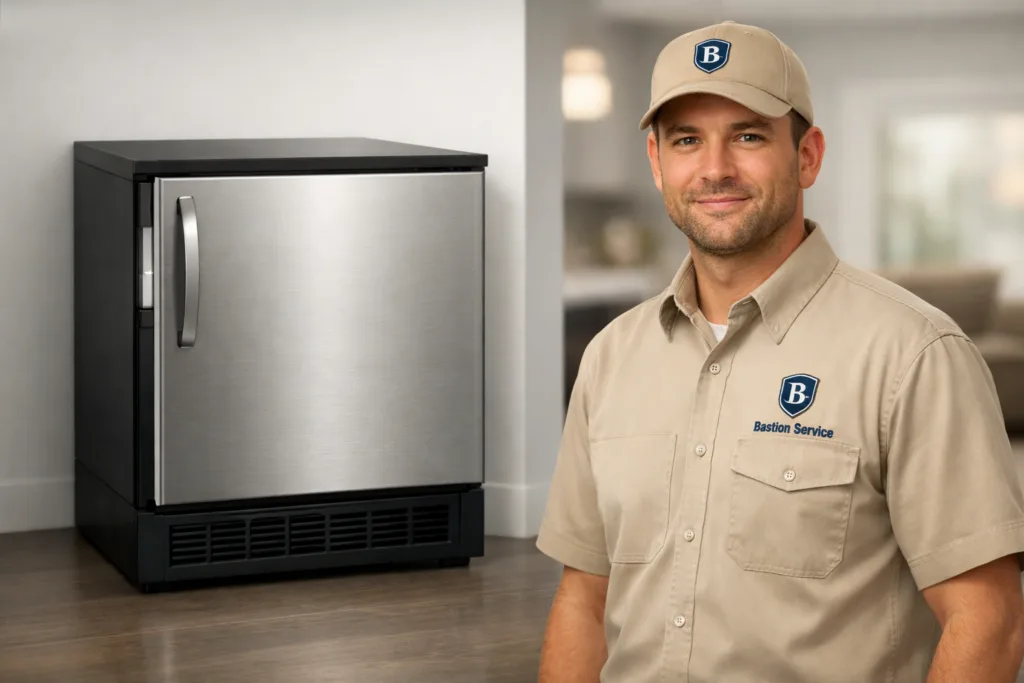
EdgeStar ice makers can fail in a few different ways, and the symptoms often overlap. A unit that stops making ice may have a water supply problem, a temperature problem, a drain issue, or a control fault. One that leaks may not have a broken line at all, but instead an overflow, blocked drain path, or fill problem. Sorting out the pattern early helps prevent unnecessary parts replacement and gives homeowners a better sense of whether repair makes financial sense.
Common EdgeStar ice maker symptoms in Mid-Wilshire homes
Most ice makers show warning signs before they quit completely. Paying attention to how the machine behaves from one cycle to the next can help narrow the likely cause.
No ice production
If the machine powers on but never drops ice, the problem could be a closed or restricted water supply, low incoming pressure, a failing inlet valve, a sensor issue, internal icing that blocks water flow, or a problem in the freeze-and-harvest sequence. In some cases, the unit sounds normal but never completes a full cycle.
Slow production or smaller batches
When output drops gradually, the issue is often tied to cooling efficiency or water fill performance. Limited airflow, dust around the condenser area, mineral buildup, partial restrictions in the water path, or a weakening pump can all reduce production. Households usually notice this first when the machine can no longer keep up with everyday use.
Clumped, wet, or melting ice
Ice that forms but does not stay firm in the bin can point to temperature fluctuation, sealing problems, insulation loss, or irregular cycling. If cubes partially melt and refreeze together, the storage area may be warming between batches or the machine may not be maintaining a stable internal temperature.
Water leaking around the unit
Leaks should be addressed quickly, especially on kitchen flooring or near finished cabinetry. Common causes include loose supply fittings, cracked tubing, fill overflow, drain restrictions, internal water path damage, or a drainage problem during operation. Even a small leak can lead to larger damage if the unit keeps running.
Unusual noise during operation
Buzzing, clicking, rattling, or grinding can come from a struggling pump, fan interference, loose mounting hardware, compressor strain, or a harvest-cycle issue. The sound alone does not confirm the failed component, but it does help identify where to start testing.
Why symptom patterns matter with EdgeStar units
EdgeStar ice makers combine refrigeration, water delivery, draining, and electronic controls in a compact appliance. Because those systems work together, one symptom can have several possible causes. For example, no ice does not always mean the cooling system has failed, and a leak does not always mean a line has ruptured.
That is why EdgeStar ice maker repair in Mid-Wilshire usually starts with checking temperature, fill behavior, circulation, drainage, sensor response, and the harvest cycle. A structured evaluation helps separate a repairable single-part issue from broader wear that may make replacement the better option.
Signs the problem is getting worse
Some issues start as a minor annoyance and then become harder or more expensive to fix. It is smart to stop waiting and have the unit checked when you notice any of the following:
- The machine has gone more than a short cycle without producing ice
- Ice is smaller, softer, hollow, or inconsistent from batch to batch
- Water is collecting under the unit or inside the cabinet area
- The machine runs for long periods without normal output
- New noises keep returning during the same point in the cycle
- Cleaning improves performance only briefly or not at all
Continuing to run an ice maker with a fill problem, drain restriction, or cooling issue can place added stress on other components. A simple repair can turn into a more involved one if the machine keeps cycling under the wrong conditions.
What homeowners can check before scheduling repair
A few basic observations can make service more efficient. Confirm that the unit has power, the water supply is on, and the shutoff valve has not been moved. Check whether the leak appears at the front, rear, or underneath. Notice whether the bin area feels warmer than usual or whether the machine seems to start but never finish a cycle.
If the ice maker is installed in cabinetry, poor ventilation can also reduce performance. Restricted airflow may cause slow production, weak freezing, or repeated cycling problems. These checks are useful, but internal issues such as valve failure, sensor faults, pump trouble, or drain problems still require hands-on diagnosis.
Repair or replace an EdgeStar ice maker?
The answer usually depends on the age of the unit, the overall condition of the appliance, the type of failed component, and whether the problem is isolated or part of a larger pattern. Repair is often reasonable when the issue is limited to a valve, pump, fan, drain component, sensor, or control-related part and the rest of the machine is in good shape.
Replacement becomes more likely when the unit has major cooling system trouble, repeated breakdowns, corrosion, or repair costs that are close to the value of the appliance. For many Mid-Wilshire homeowners, the best next step is a practical repair plan based on what has actually failed rather than guessing from the surface symptom alone.
Household-focused service for Mid-Wilshire
In residential kitchens, bars, and entertainment spaces, an underperforming ice maker is more than an inconvenience when it starts leaking, cycling constantly, or producing unusable ice. A symptom-based approach helps identify whether the issue involves water delivery, temperature control, drainage, or a worn component that is no longer operating correctly.
When an EdgeStar ice maker is evaluated carefully, it becomes much easier to decide whether a targeted repair will restore normal performance or whether replacement is the smarter move for the home.