






EdgeStar appliances are often chosen for compact refrigeration, specialty cooling, and supplemental storage, so problems tend to become noticeable in everyday routines very quickly. A refrigerator that runs warm, a freezer that starts frosting over, an ice maker that slows down, or a wine cooler that drifts off temperature can all point to different underlying faults. What matters most is the symptom pattern: whether performance has declined gradually, changed suddenly, or comes and goes.
For homeowners in Rancho Park, that pattern helps separate a minor maintenance issue from a repair that should be scheduled soon. Cooling appliances usually give some warning before complete failure. New noise, longer run times, moisture, frost, or inconsistent temperatures are all signs that one part of the system is no longer working the way it should.
What homeowners usually notice first
Most EdgeStar service concerns begin with one practical sign:
- Food or drinks are not staying cold enough
- Frost is building up where it did not before
- Ice production has slowed down or stopped
- Water is collecting inside the unit or on the floor
- The appliance is running constantly or making new sounds
These symptoms can overlap, but they do not always come from the same cause. A warm refrigerator might have an airflow problem, a failing fan, a defrost issue, or a control problem. A leak could be related to drainage, condensation, door sealing, or a water supply issue. Looking at the full behavior of the appliance is usually more useful than focusing on one symptom in isolation.
EdgeStar refrigerator problems and what they often mean
Refrigerator not cooling well
If the refrigerator section is running but not reaching a safe temperature, possible causes include dirty condenser areas, blocked airflow, evaporator fan trouble, frost restricting circulation, or a control component that is not responding correctly. In some cases, the unit may still sound normal even while temperatures rise. That can make the problem easy to miss until food starts spoiling.
When cooling becomes uneven, check whether the issue is affecting the entire cabinet or only certain shelves. Uneven cooling often points to airflow or sensor-related faults rather than a total system shutdown.
Water inside or under the refrigerator
Water leaks are commonly tied to clogged drain passages, excess condensation, or warm air entering through a weak door seal. If leaking happens repeatedly, it should not be dismissed as a one-time spill. Persistent moisture can damage flooring, create odors, and sometimes signals a larger cooling issue that is causing ice to melt in the wrong place.
Constant running or unusual noise
An EdgeStar refrigerator that seems to run without stopping may be struggling to maintain its set temperature. That can happen when warm air is entering the cabinet, when coils cannot shed heat efficiently, or when internal airflow is restricted. Clicking, buzzing, rattling, or louder-than-usual fan noise can help narrow down what is happening. Noise alone is not always serious, but noise paired with weak cooling usually deserves attention.
EdgeStar freezer symptoms worth addressing early
Frost buildup on walls, shelves, or around the door
Heavy frost is usually a sign that moisture is getting into the freezer or that the defrost system is not clearing frost as intended. A worn gasket, poor door closure, or defrost component failure can all create the same visible result. As frost builds, airflow drops and temperature control becomes less reliable.
If drawers get harder to open, vents look blocked, or the back panel develops a thick layer of ice, the freezer may already be losing circulation.
Frozen food softening or partially thawing
Partial thawing often means the freezer has not stopped cooling altogether, but it is no longer holding a stable temperature. That can happen with fan problems, sensor faults, blocked vents, or a sealed-system performance decline. A fluctuating freezer should be checked sooner rather than later, since thaw-and-refreeze cycles can affect food quality even before everything fully defrosts.
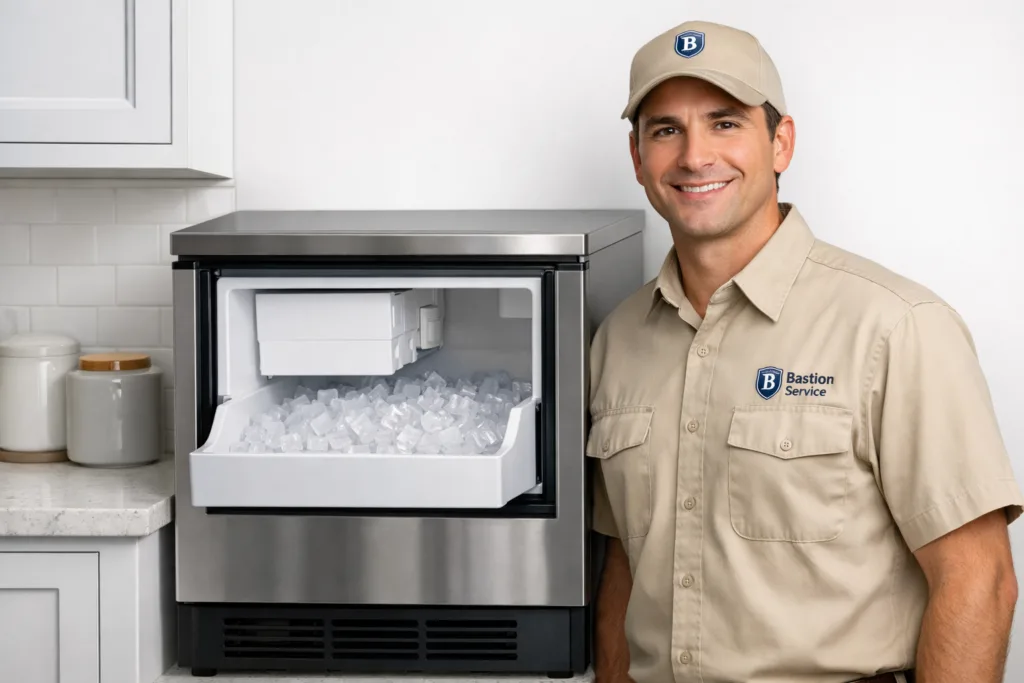
EdgeStar ice maker issues and likely causes
No ice production
When an ice maker stops making ice, the fault may be in the water supply, inlet valve, fill path, sensor, harvest cycle, or control board. Some units still power on and appear normal from the outside, which makes the problem look simpler than it is. If the bin remains empty after basic checks of settings and water supply, the issue is often internal to the production cycle.
Small cubes, slow batches, or leaking
Small or hollow cubes usually suggest that the ice maker is not receiving the right amount of water or is freezing unevenly. Slow production may indicate a temperature issue, scaling, restricted water flow, or a component that is no longer cycling correctly. Leaks should be handled quickly because water from an ice maker can travel beyond the appliance footprint and damage nearby surfaces.
EdgeStar wine cooler performance problems
Temperature drift and uneven cooling
Wine coolers depend on steady temperature control, so even mild drift matters. If bottles feel warmer than expected, the unit may have a thermostat issue, fan circulation problem, door seal wear, or cooling-system strain. Because wine storage is more sensitive to fluctuations than general food storage, a unit that is only slightly off may still need service.
Condensation, frequent cycling, or new sound changes
Moisture on the glass or around the door often points to sealing problems or humidity entering the cabinet. Constant cycling can mean the cooler is having trouble reaching or holding the set range. If the sound profile changes noticeably, especially along with temperature inconsistency, the unit may be compensating for a problem rather than operating normally.
How to tell whether the problem is urgent
Some appliance symptoms can wait a short time for evaluation, while others should move up the priority list. Service is usually more urgent when:
- Food temperatures are clearly unsafe
- Frozen items are softening
- Water is leaking onto flooring
- Frost returns quickly after being cleared
- The appliance runs nonstop without recovering temperature
- A previously quiet unit starts clicking, buzzing, or grinding
Intermittent problems also deserve attention. A refrigerator that cools well one day and struggles the next, or an ice maker that works only occasionally, may be dealing with a failing sensor, control, fan, or other component that has not failed completely yet. Those are often the issues that become more expensive if ignored.
Repair or replace?
The right decision depends on the appliance type, age, overall condition, and the failed part. Many EdgeStar problems are still worth repairing when the issue is limited to a fan motor, valve, drain blockage, gasket, sensor-related component, or other targeted part. Repair becomes less attractive when the appliance has repeated cooling problems, multiple worn parts, cabinet deterioration, or a major sealed-system failure.
For many Rancho Park households, the most practical approach is to identify the fault first and then weigh the cost against the appliance’s condition and expected remaining life. That keeps the decision based on the actual problem rather than on guesswork.
What a useful diagnosis should answer
A good diagnosis should explain which component or system is failing, how that fault connects to the symptoms you are seeing, whether continued use risks food loss or water damage, and whether repair is likely to be cost-effective. That is especially important with refrigerators, freezers, ice makers, and wine coolers because similar symptoms can come from very different causes.
When the problem is defined clearly, it becomes much easier to decide on the next step, whether that is a straightforward repair, closer monitoring of a minor issue, or replacement planning for an older unit that is no longer worth the investment.


