
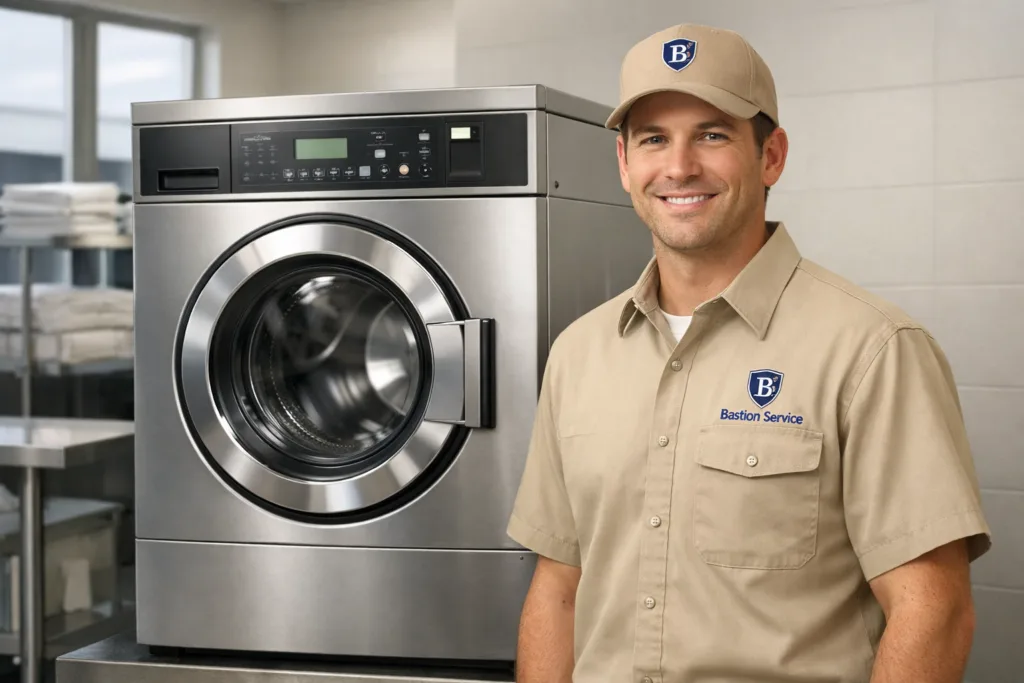




Commercial washers support daily throughput for apartments, hospitality properties, care facilities, salons, gyms, and other businesses that rely on dependable laundry cycles. When one unit starts failing, the effect is rarely isolated to a single load. Delays can spread into staffing, linen availability, turnover schedules, and customer-facing service.
Related commercial equipment paths in Beverly Hills include Speed Queen Washer Repair in Beverly Hills and Wascomat Washer Repair in Beverly Hills.
Commercial washer issues that commonly interrupt business operations
A washer that will not start may have a power supply problem, a failed door or lid lock, a control fault, or a user-interface issue. If the machine fills but does not agitate or advance, the cause may involve the motor, belt, drive components, capacitor, or control system. Units that stop mid-cycle can point to overheating, drainage restrictions, sensor faults, or intermittent electrical failures that only appear under load.
Leaks are another frequent concern in commercial settings. Water may come from fill hoses, drain connections, pump assemblies, door boots, inlet valves, cracked components, or oversudsing conditions that mimic a hardware failure. Slow draining and standing water often trace back to clogged pump paths, damaged drain parts, or installation issues affecting flow. Excessive vibration during extraction can suggest worn suspension parts, mounting problems, balance issues, or internal drum and bearing wear.
What different washer symptoms can mean
Washer not starting
When a commercial washer does not respond at all, diagnosis usually begins with incoming power, switches, door-lock operation, and control communication. If the machine powers on but will not accept or begin a cycle, the problem may be tied to the control board, selector interface, or a safety interlock that prevents operation until the system reads conditions correctly.
Won’t drain, won’t spin, or leaves loads too wet
A no-spin complaint is often more complex than it first appears. Many commercial washers will not enter high-speed extraction if they detect standing water, an out-of-balance condition, or a door-lock fault. In practice, that means a drain problem, a sensor issue, or a control-related interruption can create the same end result as a failed drive component.
If damp loads are creating a bottleneck after washing, the laundry workflow may also need attention on the drying side. When garments or linens remain wet even after extraction problems are addressed, Commercial Dryer Repair in Beverly Hills may be the better next step for the paired equipment.
Stops mid-cycle or needs repeated resets
Repeated restarts usually indicate an unresolved fault rather than a one-time glitch. Some machines shut down because they cannot drain within the expected time. Others pause because of overheating motors, unstable power, board failures, or communication errors between control components. Resetting the unit may restore temporary operation, but it rarely addresses the underlying cause.
Noise, shaking, or movement during operation
Grinding, roaring, scraping, or hard banging should be taken seriously in a commercial environment. These sounds can be associated with bearings, supports, drive parts, loose hardware, drum contact, or structural wear that worsens under heavy loads. If the washer is walking, striking nearby surfaces, or vibrating more during spin than during wash, continued use can increase internal damage and create safety concerns around the equipment area.
Leaks, fill problems, and water temperature issues
Water-related faults are easiest to narrow down when the timing is clear. A leak during fill suggests different causes than a leak during drain or extraction. Weak fill, delayed fill, or inconsistent water temperature can involve inlet valves, clogged screens, supply restrictions, pressure issues, or controls that are not activating the correct stages of the cycle.
Why symptom-based diagnosis matters
Many commercial washer complaints sound similar at first but come from very different failures. A machine that will not spin may actually be stopping because it cannot drain. A front-area leak might come from a hose, a pump, a seal, or a soap-related overflow rather than the tub itself. A washer that seems dead may have a lock issue instead of a failed main control.
That is why effective service starts with testing rather than assumptions. Symptom-based diagnosis helps determine whether the issue is isolated, whether multiple worn parts are involved, and whether the unit is still a sensible candidate for repair based on condition, downtime history, and expected workload.
When washer problems should be addressed right away
Prompt service is usually the right move when the machine is leaking, failing to drain, tripping breakers, producing a burning smell, stopping with water inside, or making new mechanical noise. In commercial use, these are not minor inconveniences. They can lead to lost throughput, wet-load backup, flooring damage, and additional wear on pumps, motors, and controls.
If staff are avoiding certain cycle settings, redistributing loads to force completion, or running repeat cycles just to get acceptable extraction, the washer is already signaling a performance problem that affects productivity. In Beverly Hills operations where turnover and presentation matter, those workarounds tend to cost more time than they save.
Repair versus replacement considerations
Not every commercial washer failure points to replacement. Many calls involve a specific component issue that is reasonable to correct when the machine is otherwise structurally sound and still fits the site’s production needs. Pumps, valves, locks, some drive-related parts, and certain control faults may be serviceable without turning the repair into a larger equipment decision.
Replacement becomes more likely when there is major bearing wear, significant structural deterioration, repeated downtime across multiple systems, or a combination of mechanical and control failures that makes continued reliability uncertain. Age matters, but condition and usage history usually matter more. A newer washer with unresolved recurring faults may be a weaker candidate than an older unit with a single isolated failure.
Helpful details to gather before service
Before scheduling service, it helps to note the exact symptom, whether an error code appears, which part of the cycle fails, whether the problem affects every load, and whether the issue changes with heavier or lighter loads. It is also useful to document visible leaks, unusual sounds, breaker trips, or any recent changes in water supply, detergent use, or machine placement.
For businesses operating multiple laundry machines, knowing whether the problem is isolated to one washer or appearing across several units can help narrow the cause. Good information at the start often shortens diagnosis time and helps focus the repair plan on the fault that is actually interrupting operations.
Commercial washer service for Beverly Hills businesses
Commercial washer repair in Beverly Hills is ultimately about restoring reliable operation without guesswork. Whether the issue involves draining, filling, cycle completion, extraction, leaks, or mechanical noise, the most useful path is to identify the failure accurately, assess the condition of the machine as a whole, and determine the repair that best supports ongoing business use.


