
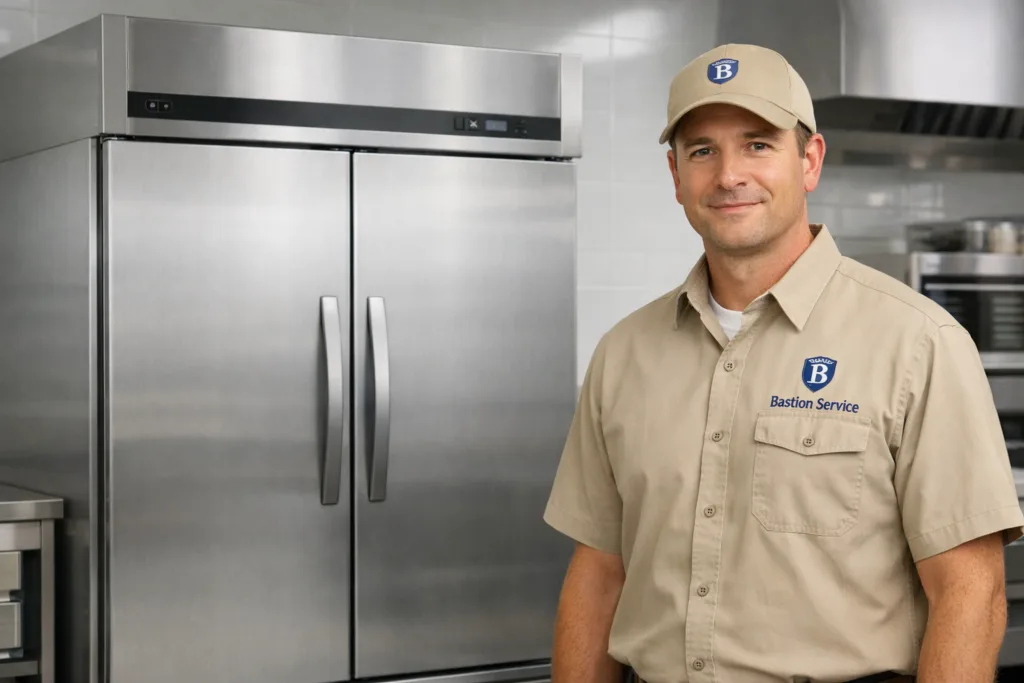




Temperature drift in a commercial refrigerator can create immediate risk for inventory, prep schedules, and compliance. What matters first is not just that the cabinet feels warm, but how the symptom shows up during the workday. A unit that loses temperature after repeated door openings points to a different problem than one that runs constantly overnight, develops frost on the back wall, or cools unevenly from shelf to shelf.
Related commercial equipment paths in Century City include Beverage-Air Fridge Repair in Century City.
Common commercial refrigerator issues businesses notice first
Warm product, inconsistent cabinet temperatures, and slow recovery after the door closes are among the most common service calls in Century City. These symptoms can come from restricted condenser airflow, evaporator fan problems, worn door gaskets, sensor faults, control issues, or sealed-system performance loss. In busy kitchens, offices, retail spaces, and hospitality environments, the operating pattern usually reveals as much as the headline complaint.
Noise can also be a useful warning sign. Rattling panels, fan scraping, clicking at startup, buzzing near the compressor area, or unusually loud run cycles may indicate loose hardware, motor wear, dirty coils causing strain, or electrical components failing under load. Even when cooling has not fully stopped, those sounds often mean the refrigerator is working harder than normal.
Water inside the cabinet or on the floor should not be ignored. Drain line blockages, excess condensation, icing near the evaporator section, and gasket failure can all lead to leaks. In a commercial setting, even a small amount of water can become both a sanitation concern and a sign that airflow or defrost performance is no longer stable.
Why the symptom pattern matters
Two refrigerators can both be described as “not cooling,” yet require very different repair paths. One may have heavy product load, frequent door traffic, or blocked interior airflow. Another may have a faulty thermostat, a fan motor that stops intermittently, or coils packed with grease and dust. Looking at the timing of the problem, the temperature swing range, and whether the issue affects the whole cabinet or only part of it helps narrow the cause quickly.
Frost buildup is a good example. Light frost from occasional humidity exposure is different from thick ice that blocks airflow and keeps the cabinet from recovering. If cooling problems are concentrated in the freezer compartment or involve severe frost and poor low-temperature holding, Commercial Freezer Repair in Century City may be the more relevant service path.
Signs service should be scheduled promptly
- Cabinet temperatures rise above target and do not recover normally
- The unit runs constantly or short cycles throughout the day
- Fans stop moving air or airflow feels weak in parts of the cabinet
- Doors do not seal tightly or gaskets are visibly damaged
- Frost, condensation, or water pooling appears repeatedly
- Alarms, error codes, or manual temperature resets become routine
These are not minor convenience issues in a commercial environment. Continued operation with unstable temperatures can increase energy use, stress motors and compressors, and raise the chance of product loss. Early service is often the best point to correct a manageable fault before it becomes a larger interruption.
How refrigerator problems affect other cold-side equipment
In many facilities, refrigeration issues do not happen in isolation. Shared ventilation conditions, high ambient heat, water supply problems, and cleaning gaps can affect multiple pieces of equipment at once. If staff are dealing with weak ice production, slow harvest cycles, fill problems, or leaks around a connected ice system, Commercial Ice Machine Repair in Century City may be the better place to focus that part of the problem.
This matters because a refrigerator complaint is sometimes reported first even when the broader issue includes airflow restrictions around several machines, inconsistent kitchen temperatures, or utility conditions that affect performance across the lineup. Separating refrigerator-specific faults from building or system-wide contributors helps avoid repeat downtime.
Repair versus replacement considerations
Repair is often worthwhile when the cabinet structure is sound, the refrigeration problem is recent, and the fault is tied to serviceable components such as fans, controls, gaskets, drains, sensors, or accessible electrical parts. Replacement becomes more likely when cooling decline has been ongoing, the unit has a long pattern of breakdowns, or the repair required would not restore dependable operation for the business.
Age alone is not the deciding factor. A well-maintained unit may justify repair, while a newer one with repeated failures, poor temperature stability, or prior major work may deserve a harder look. The practical question is whether the refrigerator can return to reliable service without creating recurring disruption for staff and inventory.
What helps speed up a service call
Before service, it helps to note the actual temperature range, whether the issue affects the whole cabinet or only one section, how long the problem has been happening, and whether doors have been left open more often than usual. Businesses should also note any recent power interruptions, cleaning changes, unusual noises, visible frost, or water accumulation. Those details can make diagnosis more efficient and help separate an airflow problem from a control or component failure.
For Century City businesses, the most useful next step is to address cooling instability before it turns into a larger operational problem. A refrigerator that is running but no longer holding temperature consistently is often at the stage where timely diagnosis can protect uptime, preserve inventory, and reduce the chance of a more disruptive failure.


