
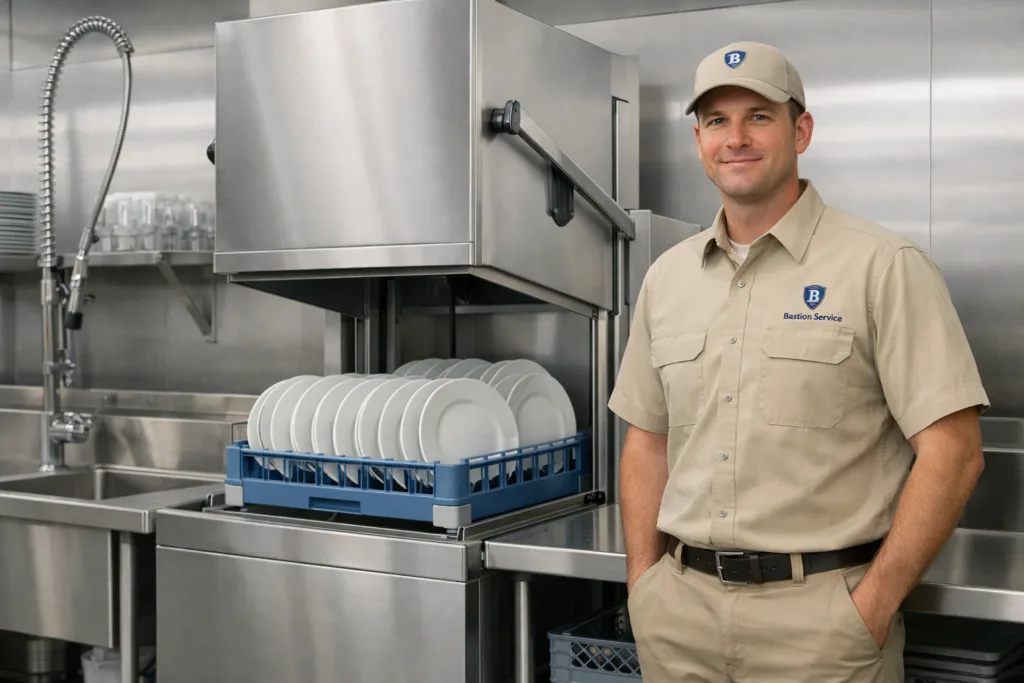




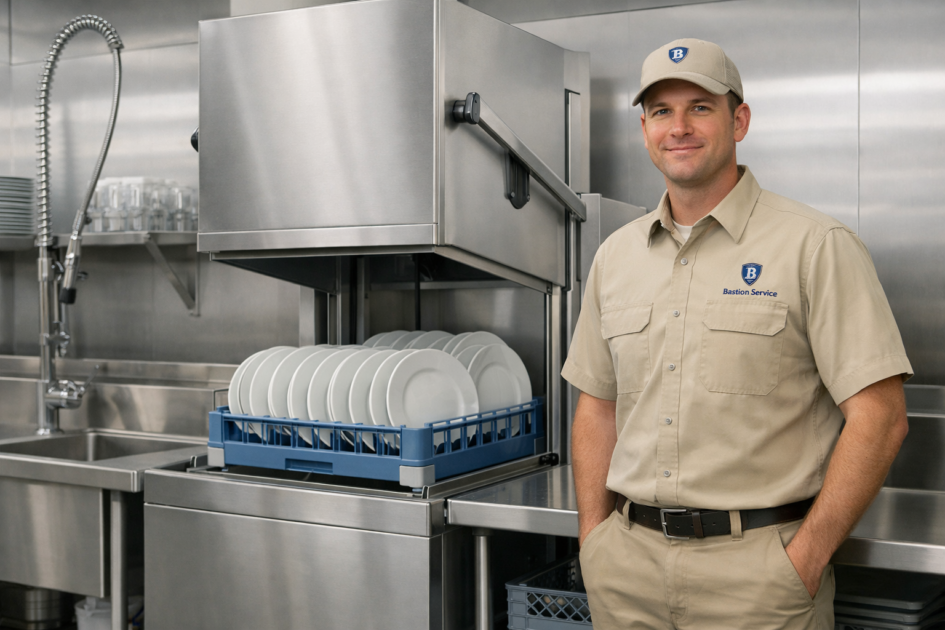
Commercial dishwashers support sanitation, turnaround time, and back-of-house flow. When one starts leaving residue, failing to drain, leaking, or dropping rinse temperature, the impact is usually immediate: more rewashing, slower rack rotation, extra labor, and pressure on the rest of the operation. The most useful next step is to identify the actual fault rather than assume the visible symptom tells the whole story.
Related commercial equipment paths in Mid-City include Commercial Refrigerator Repair in Mid-City, Commercial Freezer Repair in Mid-City, and Hobart Dishwasher Repair in Mid-City.
Common commercial dishwasher problems that interrupt operations
Dish-area issues rarely stay isolated for long. A machine may still power on and complete part of a cycle while overall performance has already dropped below what the business needs. In Mid-City, service calls often begin with one of these operating complaints.
Poor wash results, spotting, or residue
If ware comes out with film, food particles, streaks, or inconsistent cleaning, the cause may involve blocked spray arms, low incoming water pressure, circulation pump trouble, heating loss, scale buildup, or a problem with chemical delivery. What looks like a simple “not cleaning well” complaint can come from several different systems, so symptom-based testing matters.
This issue is especially disruptive because the machine may appear to be running normally while still producing unacceptable results. That creates hidden labor loss through rewashing, manual touch-up, and delayed rack turnover.
Drain problems and standing water
Water left in the tank or cabinet after a cycle often points to a restricted drain path, drain pump failure, debris accumulation, sensor trouble, or a control issue that prevents the machine from finishing its sequence correctly. Continued use can lead to overflow risk, odors, slower cycles, and added strain on related components.
Low rinse temperature or heating failure
When the dishwasher no longer reaches expected wash or rinse temperature, final results suffer quickly. Possible causes include failed heating elements, thermostats, high-limit controls, relays, wiring faults, scale-related heat transfer issues, or board problems. A temperature complaint should be evaluated promptly because it can affect both sanitation performance and production pace.
Leaks, fill issues, and interrupted cycles
Leaks may come from worn door gaskets, split hoses, loose fittings, pump seals, overfill conditions, or internal cracks. Fill problems may be tied to inlet valves, float assemblies, pressure problems, or control faults. If a unit stops mid-cycle, fails to advance, or needs repeated restarts, technicians often look at sensors, timing functions, boards, and electrical connections.
Why the same symptom can have different causes
Commercial dishwashing equipment is a system, not a single component. For example, poor cleaning may relate to water flow, pump operation, heat, drain performance, or control logic. A machine that does not heat may have a failed part, but it can also be reacting to wiring damage, scale buildup, or a safety control shutting the system down.
That is why replacing parts based only on the most obvious symptom often leads to repeat downtime. A strong diagnosis helps determine:
- what has actually failed
- whether related wear is contributing to the complaint
- if continued operation could damage additional components
- whether the equipment remains a sensible repair candidate
Signs it is time to stop normal use and schedule service
Some dishwasher problems can wait until the end of a shift. Others should be addressed before the unit is run again. Service should usually be prioritized when the machine:
- leaks onto the floor or around electrical areas
- fails to drain consistently
- does not reach expected rinse performance
- shows recurring error codes
- stops mid-cycle or will not complete cycles
- trips breakers or loses power during operation
- requires repeated restarts to finish a load
It is also a warning sign when staff have started compensating for the machine. Running racks twice, hand-drying items, cleaning up regular leaks, or reorganizing workflow around unreliable cycle times usually means the dishwasher is no longer supporting efficient commercial use.
Operational impact beyond the dishwasher itself
One failing unit can affect much more than the dish station. Delays in clean wares can slow prep, service, turnover, and sanitation routines. Labor shifts toward manual workarounds, and pressure increases on nearby equipment and staff. In high-volume environments, even a partially functioning dishwasher can create bottlenecks that ripple across the entire operation.
Addressing the problem early helps contain both downtime and secondary damage. A minor leak can affect flooring and surrounding surfaces. A drain issue can overwork the pump system. A heating problem can hide a larger electrical or control fault. Early evaluation is often the most cost-effective response.
Repair versus replacement for commercial units
Not every commercial dishwasher should be replaced after a failure, and not every older machine justifies major repair. The decision usually comes down to equipment condition, repair scope, parts availability, breakdown history, and how essential the unit is to daily throughput.
Repair often makes sense when:
- the fault is limited to one main system or component
- the machine has otherwise been reliable
- parts are available in a reasonable timeframe
- the expected repair cost aligns with remaining service life
Replacement becomes more likely when:
- the unit has frequent repeat failures
- corrosion or internal wear is widespread
- multiple systems are failing at the same time
- repair cost approaches the practical value of the machine
For businesses in Mid-City, the goal is not only to get the dishwasher running again. It is to understand whether the repair is likely to restore stable, usable performance under normal commercial demand.
What a symptom-focused service visit should evaluate
A productive service call usually starts with how the machine is behaving in real operation: whether the problem is constant or intermittent, whether it appeared suddenly or worsened over time, and what staff noticed before the failure became obvious. That pattern helps narrow the fault path more effectively than guessing from the final symptom alone.
Depending on the complaint, evaluation may include checks of:
- water fill and pressure response
- circulation and pump operation
- drain performance
- heating and temperature-related controls
- electrical continuity and power-related faults
- sensors, timers, and control response
- hoses, seals, and visible wear points
This kind of structured assessment gives operators a clearer picture of what failed, what may have contributed to it, and what the next practical repair step should be.
Helpful information to have ready before service
If available, a few basic details can speed up diagnosis and reduce uncertainty during the visit. It helps to note:
- what the machine is doing or failing to do
- whether the issue affects every cycle or only some loads
- when the problem first appeared
- any recent leaks, unusual noises, odors, or error codes
- whether wash quality, drain speed, or heat performance changed gradually
Even simple observations from staff can be valuable. A report such as “fills but never starts washing” or “drains slowly and stops before the rinse stage” is often more useful than a general description that the unit is just “not working.”
Commercial dishwasher repair support for Mid-City operations
Dish-area equipment problems need more than a quick guess because the same complaint can involve water supply, heat, drainage, controls, or wear across multiple systems. Bastion Service helps businesses in Mid-City with commercial dishwasher repair focused on identifying the source of the problem, explaining the operating impact, and recommending the most sensible path forward for uptime.
When poor wash results, drain trouble, leaks, fill problems, pump issues, or cycle failures start affecting daily operations, timely service can help limit disruption and keep the problem from expanding into a larger equipment issue.


