
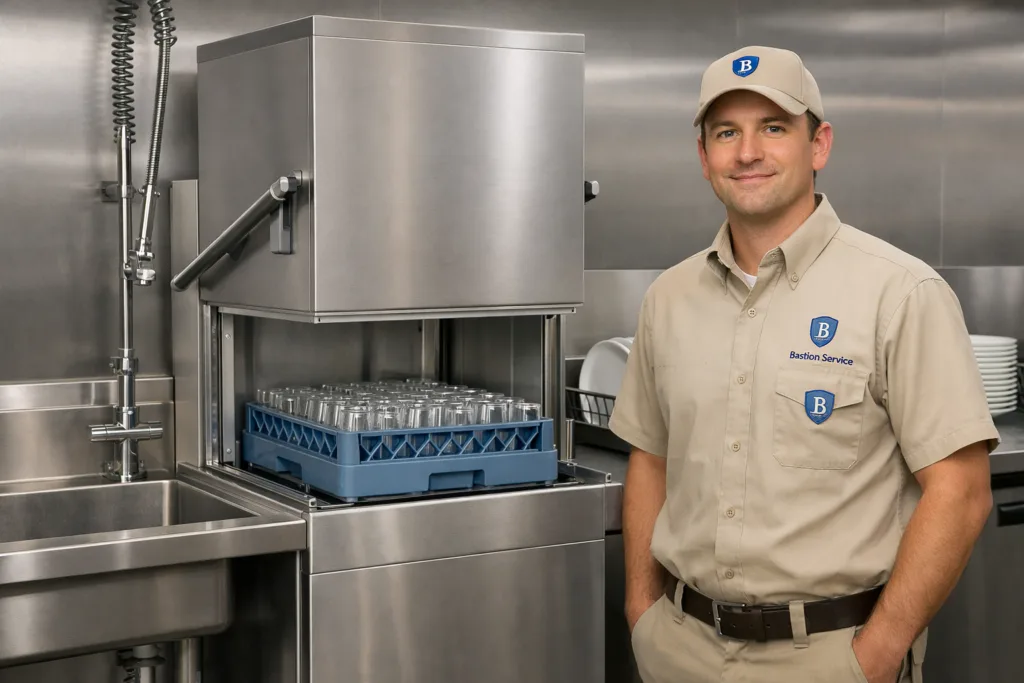








Commercial dishwashers tend to show trouble in ways that directly affect sanitation, labor, and service speed. One rack may come out cloudy, the next still dirty, and then the unit may begin holding water or stopping mid-cycle. Those symptoms usually point to different underlying faults, so the most useful next step is to match what operators are seeing with how the machine is actually failing.
Related commercial equipment paths in Manhattan Beach include Commercial Fridge Repair in Manhattan Beach, Commercial Freezer Repair in Manhattan Beach, and Hobart Dishwasher Repair in Manhattan Beach.
Common signs a commercial dishwasher needs repair
Most service calls begin with a noticeable change in performance rather than a complete shutdown. A machine may still power on and run, but that does not mean it is operating correctly. In a commercial setting, reduced wash quality or unstable cycle performance can be just as disruptive as a full breakdown.
Poor wash results
If dishes, glassware, or utensils are coming out with residue, spotting, film, or stuck-on debris, the problem may involve restricted spray arms, reduced pump pressure, poor fill levels, detergent delivery issues, or water-temperature problems. When operators start rerunning loads to get acceptable results, the dishwasher is already affecting workflow and labor efficiency.
Standing water or slow draining
Water left in the machine after a cycle often points to a blocked drain path, drain pump trouble, a valve problem, or a control issue that interrupts the drain sequence. Even if the unit eventually clears itself, slow drainage can lead to longer turnaround times and increased wear on pumps and related components.
Low rinse temperature or heating problems
When the machine is not reaching proper wash or rinse temperature, it may show up as poor drying, inconsistent sanitizing performance, or extended recovery between cycles. Possible causes include failed heating elements, thermostats, relays, sensors, contactors, or control faults. Temperature issues should be addressed quickly because they affect both results and compliance expectations.
Leaks and moisture around the unit
Water around the base of the dishwasher can come from worn door gaskets, loose fittings, cracked hoses, pump seal failures, or internal overflow conditions. A small leak can become a larger operational problem if it reaches nearby flooring, wall surfaces, or utility connections.
Noise, vibration, or cycle interruptions
Grinding, humming, rattling, or unusual vibration may indicate pump wear, motor strain, loose internal parts, or bearing-related issues. If the dishwasher stops during operation, trips breakers, fails to advance, or behaves intermittently, the cause may be electrical, control-related, or tied to a component that can no longer perform reliably under load.
Why similar symptoms can have different causes
Commercial dishwashers rely on coordinated fill, circulation, heating, draining, and timing. Because these systems work together, one failure can imitate another. A dishwasher that seems to have a wash-pump problem may actually be underfilling. A unit that appears to have a heating issue may be stopping early because of a sensor or control fault. A drainage complaint may begin with an obstruction but continue because a pump has already been damaged.
That is why symptom-based testing matters before approving parts replacement. Replacing the wrong component adds cost, extends downtime, and may leave the original issue unresolved.
Operational issues that should not be ignored
Some problems look manageable at first because the machine still runs. In practice, partial operation often creates bigger problems over time.
- Repeatedly rerunning racks increases labor time and utility use.
- Low wash pressure can leave soils behind and reduce confidence in output.
- Slow draining can turn into complete drain failure during a busy shift.
- Heating problems can affect sanitation and delay rack turnaround.
- Leaks can spread beyond the machine and create facility concerns.
If staff are compensating for the machine by adjusting cycles, washing items twice, or avoiding certain racks or loads, the unit is no longer supporting normal operations.
What a service assessment should look at
A useful commercial dishwasher evaluation should look beyond the first obvious symptom. The machine needs to be checked for how it fills, circulates water, heats, drains, and completes a full cycle under normal operating conditions. That helps determine whether the problem is isolated to one repairable part or whether multiple systems are beginning to decline at the same time.
For businesses in Manhattan Beach, that kind of assessment supports better decisions about timing, repair scope, and whether the equipment is likely to return to stable daily use after service.
When to schedule service right away
Some issues should be treated as urgent because they can escalate quickly or interfere with daily operations:
- Active leaking during or after cycles
- Failure to drain
- Rinse temperature not reaching expected range
- Repeated shutdowns or breaker trips
- Burning smells, harsh noise, or strong vibration
- Cycle times that have become much longer than normal
Prompt service is also wise when results have become inconsistent enough that staff no longer trust the machine to keep up with normal dish-area demand.
Repair versus replacement considerations
Many commercial dishwasher problems are still practical to repair, especially when the issue is limited to pumps, valves, seals, switches, heating components, sensors, or controls. Replacement becomes a more serious consideration when failures are recurring across multiple systems, parts condition is poor overall, or downtime has become routine enough to disrupt the business more than the repair itself.
The decision is rarely about one part price alone. Age, prior repair history, parts availability, current workload, and the effect of another interruption all matter. A focused diagnosis helps clarify whether the current problem is an isolated event or part of broader equipment decline.
Commercial dishwasher repair focused on business continuity
In a commercial kitchen or dish area, dishwasher service is really about maintaining output, sanitation consistency, and staff flow. Bastion Service helps businesses in Manhattan Beach with commercial dishwasher repair by identifying the actual cause of poor wash results, drain problems, leaks, low rinse temperature, pump issues, and cycle failures so the next repair decision is based on equipment condition rather than guesswork.


