
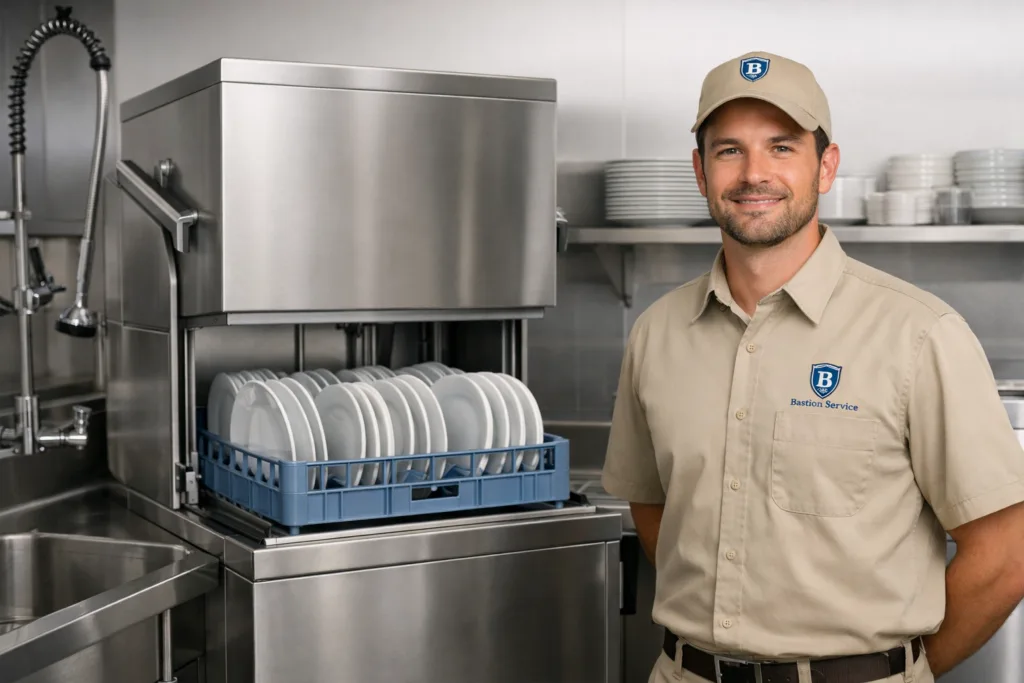




Commercial dishwashing equipment does not fail in just one way. A machine that leaves residue on wares may have a circulation problem, a temperature problem, a fill issue, or a chemical-delivery fault. A unit that stops mid-cycle may point to drainage, controls, safety switches, or an intermittent electrical issue. For Culver City businesses, the important first step is understanding which system is failing and how that failure is affecting sanitation, output, and staff workflow.
Related commercial equipment paths in Culver City include Commercial Refrigerator Repair in Culver City, Commercial Freezer Repair in Culver City, and Hobart Dishwasher Repair in Culver City.
How commercial dishwasher problems usually show up
Many service calls begin with a symptom that seems simple but has several possible causes. Poor wash results, standing water, leaks, low rinse temperature, unusual noise, or a no-start condition can each come from more than one component. Looking only at the visible symptom can lead to unnecessary part replacement while the underlying fault remains.
In a commercial setting, that matters because dish-area slowdowns tend to ripple into the rest of the operation. Rewash cycles, inconsistent rack turnover, and shutdowns during busy periods can affect labor efficiency as much as the equipment itself. A useful diagnosis should identify whether the issue is tied to wash circulation, draining, heating, filling, controls, or mechanical wear.
Common symptoms and what they may indicate
Poor cleaning performance
If glasses, dishes, pans, or utensils are coming out with film, soil, or uneven results, the problem may involve blocked spray arms, weak wash-pump output, clogged filters, low water temperature, incorrect fill volume, or inconsistent detergent and rinse-aid feed. In some cases, the machine is running a full cycle but not moving enough water with enough force to clean properly.
This type of issue often causes repeated rewashing, which increases labor time and puts extra demand on the machine. When wash quality drops suddenly, it is usually worth checking the machine promptly instead of trying to compensate through longer use.
Drain problems and standing water
Water left in the tank after a cycle can point to a blocked drain path, drain-pump failure, a stuck check valve, or a control problem that is not initiating drain functions correctly. Slow draining can also create odor issues and leave the machine ready for the next cycle with poor conditions inside the cabinet or tank.
When drainage problems become consistent, continued use can increase the chance of overflow, interrupted cycles, and unsanitary operating conditions. If staff are noticing repeated pooling or incomplete emptying, the unit should be evaluated before the problem worsens.
Leaks during operation
Commercial dishwasher leaks can come from door gaskets, pump seals, hoses, fittings, overfill conditions, or cracks in internal components. The location of the leak matters because a small drip near the door may have a very different cause than water appearing under the machine during wash or drain action.
Leaks should not be treated as minor just because the machine still runs. Water on the floor creates a slip hazard, and hidden internal leaking can damage adjacent components over time. If leaking increases during fill, wash, or drain stages, that pattern can help narrow the source.
Low rinse temperature or heating issues
When final rinse temperature is too low or wash heat is inconsistent, the machine may complete cycles without reaching expected performance levels. Possible causes include heating elements, thermostats, sensors, relays, wiring faults, or control-board issues. Some machines also present heating-related symptoms when the incoming water conditions or fill sequence are not correct.
Heating problems affect more than convenience. They can reduce throughput, change wash results, and create uncertainty around daily dish-area performance. A machine that runs cold or heats unpredictably usually needs prompt attention.
Fill issues and water-level problems
If the unit does not fill, overfills, or fills inconsistently, the fault may involve inlet valves, float systems, pressure controls, sensors, or board-level commands. Too little water can reduce wash pressure and lead to poor results, while too much water can contribute to leaking and cycle errors.
Fill problems are often mistaken for pump or drain trouble because the machine’s behavior changes across the whole cycle. Watching whether the issue begins at startup, during wash, or near rinse can be helpful when describing the problem.
Cycle failures and no-start conditions
If a machine will not start, stops before completion, or behaves differently from one cycle to the next, the issue may involve the door-latch system, user interface, control board, safety switches, wiring, or another interrupted command path. Intermittent faults are especially disruptive in commercial kitchens because they can appear manageable for a short time and then become a full outage.
When staff have to restart cycles repeatedly or wait for the machine to respond, the actual problem may be progressing even if the unit still occasionally completes a load.
Signs the machine should not stay in regular use
Some performance issues can be monitored briefly, but others should be addressed before the next heavy shift. Service becomes more urgent when the machine is:
- leaking onto the floor or into the base of the unit
- leaving standing water after normal cycles
- making grinding, humming, or unusually loud pump noises
- failing to heat or rinse consistently
- stopping mid-cycle or showing repeat fault behavior
- overfilling, underfilling, or failing to start reliably
- tripping power or shutting down unexpectedly
Operating under these conditions can turn a limited repair into a larger one, particularly when pumps, motors, heaters, and controls are forced to run under abnormal load.
What helps speed up troubleshooting
Before scheduling service, it helps to note how the failure occurs in real operation. Useful details include whether the issue happens every cycle or only sometimes, whether the machine fills and drains normally, whether wash quality dropped before the cycle failures began, and whether any alarms, noises, odors, or leaks appear at a specific stage.
It is also helpful to know whether the problem started after cleaning, descaling, maintenance, relocation, or a power interruption. Even simple observations can help separate a worn component from a setup issue, supply problem, or control fault.
Repair versus replacement considerations
Many commercial dishwasher problems are repairable, especially when they involve pumps, valves, heaters, switches, controls, drain components, seals, or fill-related parts. Replacement becomes a stronger consideration when the machine has extensive corrosion, repeated major failures, poor parts support, or a repair history that suggests reliability will remain a problem.
For a business in Culver City, the decision is usually less about whether a machine can be made to run once more and more about whether it can return to stable daily use. That evaluation should take into account the fault itself, the age and condition of the unit, and whether related wear points are starting to stack up.
Why symptom-based service matters in a commercial kitchen
Commercial dishwasher repair is most effective when the service approach follows the actual operating symptoms instead of assumptions. A machine with weak cleaning, slow draining, low heat, or incomplete cycles may be showing different outward signs of the same core problem. Looking at symptom patterns helps determine the right repair path and reduces the chance of repeated downtime.
Bastion Service helps businesses in Culver City with commercial dishwasher repair focused on the operating issue, the effect on daily output, and the service direction that makes the most sense for the equipment in front of them.


