
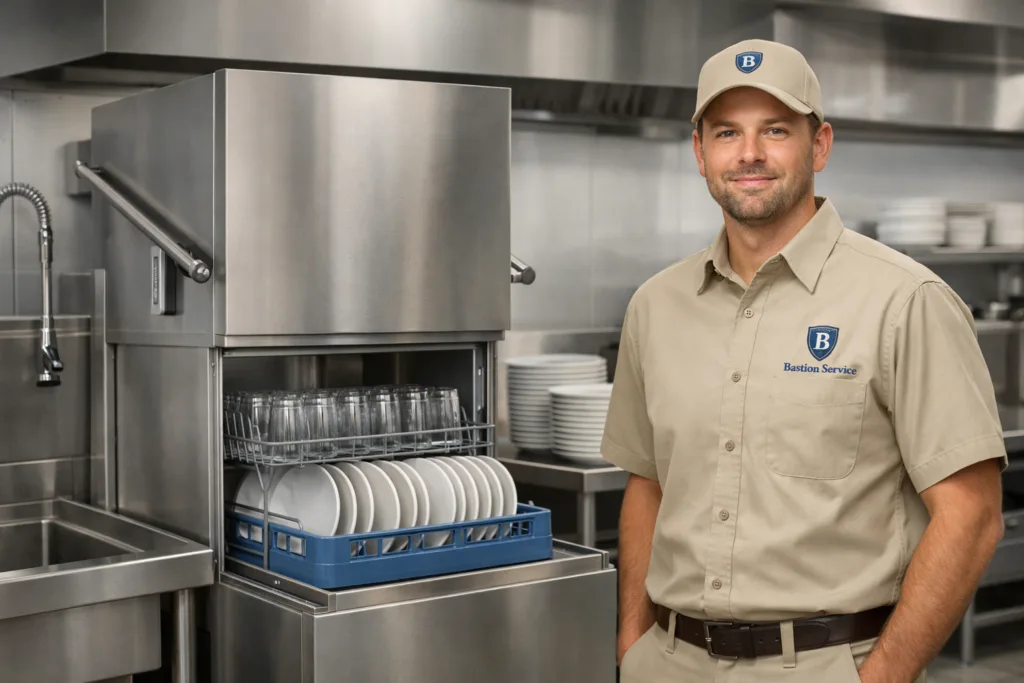






When a commercial dishwasher starts falling behind in a Cheviot Hills operation, the impact usually spreads fast. Racks stack up, staff spend more time rewashing items, and kitchen flow becomes less predictable. In a busy commercial setting, even a machine that still powers on can create sanitation, labor, and timing problems if wash, drain, or rinse performance is no longer consistent.
Related commercial equipment paths in Cheviot Hills include Commercial Refrigerator Repair in Cheviot Hills, Commercial Freezer Repair in Cheviot Hills, and Hobart Dishwasher Repair in Cheviot Hills.
What commercial dishwasher problems usually look like in daily operation
Dish-area issues do not always begin with a full shutdown. Many service calls start with symptoms that seem manageable at first but gradually interrupt normal workflow. A machine may finish cycles but leave residue on dishes, drain slowly between loads, fail to reach proper rinse temperature, or begin leaking during heavier use. Those warning signs matter because they often point to wear in pumps, valves, heating components, controls, seals, or drain assemblies.
For businesses in Cheviot Hills, the key question is whether the dishwasher is still supporting production without creating extra work. If employees are adjusting loads, repeating cycles, manually rinsing wares, or avoiding certain settings just to get through the day, the equipment is already underperforming.
Common symptoms that call for commercial dishwasher repair
Poor wash results
Glasses, utensils, trays, or dishware coming out with film, grease, residue, or stuck-on debris can indicate several different faults. Wash arms may be blocked, water pressure may be reduced, filters may be restricted, or the unit may not be heating water properly. In some cases, the dishwasher is technically running a cycle but not delivering the wash action needed for commercial output.
This kind of problem often leads to immediate labor loss because staff begin rewashing racks or sorting out partially cleaned items. Over time, that slows the entire back-of-house process.
Standing water or slow draining
If water remains in the tank after a cycle or drains out more slowly than normal, the issue may involve a clog, a drain pump problem, a drain line restriction, or a control fault that interrupts the drain sequence. Dirty water left in the machine can affect cleaning quality and put additional stress on internal components.
Drain problems also raise the risk of overflow, leaks, and emergency downtime during a heavier service period.
Low wash or rinse temperature
Temperature problems are especially important in commercial dishwashing. A machine that is not heating correctly may appear to run normally while still failing to deliver expected cleaning or sanitizing performance. Causes can include heater failure, thermostat problems, booster heater issues, high-limit faults, sensor errors, or control-related heating interruptions.
If rinse temperature is inconsistent, the dishwasher may not be meeting the level of performance the operation depends on, even if staff do not notice the issue right away.
Leaks around the unit
Water on the floor can come from worn door gaskets, cracked hoses, loose fittings, pump seal wear, drain issues, or internal overflow conditions. Even a minor recurring leak deserves attention. In a commercial setting, leaks can create slip hazards, affect nearby equipment areas, and turn a repairable problem into a more expensive cleanup or facility issue.
Fill problems
A dishwasher that does not fill correctly, fills too slowly, or overfills may have trouble with inlet valves, float switches, sensors, water supply problems, or control components. Fill issues can cause cycle interruptions, weak wash performance, or overflow conditions that disrupt dish-area operations.
Cycle failures and control issues
If the unit will not start, stops mid-cycle, skips steps, shows inconsistent timing, or has unresponsive controls, the problem may involve door switches, relays, sensors, boards, or electrical faults within the machine. Intermittent control problems can be especially frustrating because the dishwasher may work normally for part of the day and fail when demand is highest.
Pump noise or mechanical strain
Grinding, humming, rattling, or sudden vibration changes may point to pump wear, obstructions, loose internal components, motor trouble, or bearing issues. Noise complaints are often early signs that a moving part is under strain. Continuing to run the machine in that condition can increase the chance of a larger failure.
Why symptom-based diagnosis matters
Commercial dishwasher problems often overlap. Poor cleaning may actually begin with a fill issue. A leak may be caused by a drain restriction rather than a door seal. A cycle failure may be tied to heating or sensing problems rather than the control panel itself. That is why the most useful service approach starts with how the machine behaves during operation instead of assuming one visible symptom tells the whole story.
A proper evaluation should consider water fill, wash action, drain sequence, temperature performance, seals, pumps, and controls together. That helps determine whether the problem is isolated to one component or part of a larger wear pattern.
When to stop using the dishwasher until it is checked
Some issues allow limited operation for a short time, but others should be treated more urgently. If the dishwasher is tripping breakers, leaking heavily, failing to drain, producing a burning smell, or making severe mechanical noise, continued use may worsen the damage or create a safety concern.
Even when the machine still runs, it is smart to schedule service if the staff is compensating for it every shift. Repeat cycles, manual prewashing beyond normal procedure, partial loads, and workarounds on controls are signs that the dishwasher is no longer operating within a dependable range.
Repair or replace?
Many commercial dishwasher issues can be addressed with repair, especially when the machine is otherwise in solid condition and the problem is tied to serviceable parts such as pumps, valves, sensors, heaters, switches, hoses, drain components, or gaskets. Repair is often the practical choice when it can restore stable day-to-day performance without introducing repeated downtime.
Replacement may be worth considering when the unit has extensive corrosion, multiple major system failures, recurring breakdowns, or a history of unreliable operation even after recent service. For a business in Cheviot Hills, the decision usually comes down to whether the machine can return to predictable use without becoming a recurring interruption for the kitchen or dish area.
What businesses should prepare before a service visit
It helps to note what the dishwasher is doing wrong and when the problem appears. Useful details include whether poor cleaning happens on every load or only during peak periods, whether water remains in the machine after the cycle, whether leaks occur during fill or drain, and whether the unit is failing on one specific setting or across all cycles.
- When the problem started
- Whether the issue is constant or intermittent
- Any unusual noises, smells, or visible leaks
- Whether staff has noticed low heat, poor rinse results, or incomplete draining
- Any recent changes in machine performance or cycle time
That kind of information makes it easier to identify the likely fault and determine the most sensible repair path.
Commercial dishwasher repair support in Cheviot Hills
Bastion Service helps businesses in Cheviot Hills with commercial dishwasher repair focused on diagnosing real operating symptoms and recommending the service path that best supports equipment uptime. Whether the problem involves poor wash results, drain issues, leaks, low rinse temperature, fill faults, pump trouble, or cycle failure, the goal is to restore reliable dish-area performance without unnecessary delay or guesswork.


