
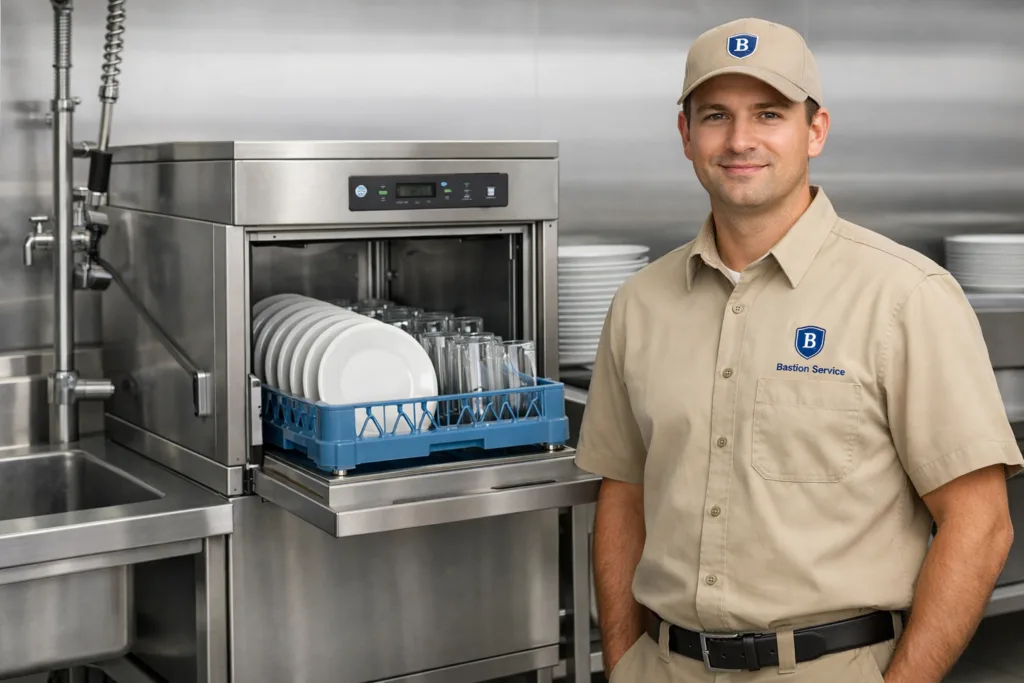




In a commercial kitchen or dish area, dishwasher problems tend to spread beyond the machine itself. Racks back up, rewash volume increases, labor gets redirected, and sanitation routines become harder to keep consistent. The most useful first step is identifying whether the issue is tied to water flow, drainage, heat, controls, or a worn mechanical part, because similar symptoms can come from very different failures.
Related commercial equipment paths in Beverly Hills include Commercial Refrigerator Repair in Beverly Hills, Commercial Freezer Repair in Beverly Hills, and Hobart Dishwasher Repair in Beverly Hills.
What common commercial dishwasher symptoms usually point to
Performance changes often show up before a complete shutdown. Dishes may come out cloudy, cycles may run longer than normal, water may remain in the tank, or the unit may stop partway through operation. Looking at the symptom pattern helps narrow down whether the problem is isolated or part of a larger wear issue affecting the machine.
Poor wash results and repeat cleaning
When dishes, glassware, or utensils are not coming out clean, the root cause may involve reduced wash pressure, blocked spray arms, filter restrictions, detergent delivery issues, scale buildup, pump wear, or a heating problem that prevents proper wash conditions. In a business setting, weak cleaning performance quickly turns into extra labor, slower turnaround, and inconsistent output during busy periods.
If the issue appears gradually, it can be easy to overlook at first. But poor cleaning is often an early warning sign that a pump, circulation path, or heating system is no longer working as intended.
Standing water or incomplete draining
Water left inside the machine after a cycle usually points to a blocked drain path, drain pump trouble, hose restrictions, or a control fault that interrupts the drain sequence. Even if the dishwasher still runs, poor drainage can lead to odors, overflow risk, and additional wear on internal components.
This symptom also matters because it can hide secondary problems. A unit that does not drain correctly may also struggle with cycle completion, refill timing, or final rinse performance.
Leaks around the door or underneath the unit
Commercial dishwasher leaks may come from worn gaskets, cracked hoses, loose fittings, overfilling, drain issues, or internal failures that force water where it should not go. In a work area, even a small leak can create slip hazards, affect nearby surfaces, and signal a condition that may worsen with continued operation.
- Door seal wear can cause leaking during wash action.
- Fill-related problems may cause overflows or irregular water levels.
- Hose or connection failures often show up as steady dripping or pooling underneath the machine.
Low rinse temperature or sanitizing concerns
If the dishwasher is not reaching the required wash or rinse temperature, the problem may involve heating elements, booster components, thermostats, sensors, relays, or control failures. Temperature-related issues are important because they affect more than appearance. They can change cycle results, reduce confidence in sanitation performance, and slow down operations when ware has to be checked or reprocessed.
Unit will not start or stops mid-cycle
A machine that will not power on, trips electrical protection, or shuts down during operation may have a fault in the door switch, controls, wiring, pump or motor circuits, or heating system. Intermittent shutdowns are especially important to address early because they often point to a component that is failing under load rather than a simple on-off issue.
Unusual noises during washing or draining
Grinding, humming, rattling, or unusually loud drain sounds can indicate pump wear, obstructions, motor issues, loose components, or internal strain caused by restricted water movement. Noise changes are often one of the clearest signs that a mechanical part is wearing out before a complete failure occurs.
Why accurate diagnosis matters before replacing parts
Commercial dishwashers rely on multiple systems working together: filling, washing, draining, heating, rinsing, and timing. A single visible symptom does not always reveal the failed part. For example, weak cleaning could be caused by pump wear, low fill, spray blockage, detergent problems, or insufficient heat. Replacing one part without confirming the actual cause can increase downtime and cost without solving the problem.
A structured diagnosis helps determine:
- which component has actually failed,
- whether other parts have been affected,
- how urgent the repair is for current operations, and
- whether the machine is otherwise in serviceable condition.
That matters for businesses trying to balance speed, reliability, and cost control rather than simply getting the machine to restart for the moment.
When continued operation can make the problem worse
Some dishwasher issues leave very little room for delay. Leaks, drain failures, low rinse temperature, power interruptions, burning smells, and repeated mid-cycle stoppages should usually be evaluated promptly. Running the machine in that condition can increase wear on pumps, motors, seals, controls, and surrounding finishes.
Other symptoms may seem manageable at first but still deserve attention, including slow fills, recurring error conditions, inconsistent cleaning, and cycles that become longer over time. In many Beverly Hills businesses, scheduling service before a full failure is far easier than dealing with a sudden outage during peak service hours.
Repair or replacement: how businesses usually evaluate the decision
Repair is often the sensible option when the failure is limited to a specific part and the dishwasher is otherwise in solid operating condition. Pumps, drain components, heating parts, sensors, switches, gaskets, and certain control-related issues can often be addressed without treating the entire machine as a loss.
Replacement becomes a more serious consideration when the unit has multiple active problems, repeated breakdown history, advanced corrosion, major control and mechanical wear at the same time, or performance decline that continues to disrupt workflow. For commercial equipment, the decision is rarely based on one invoice alone. It usually comes down to whether the machine can support daily volume without creating ongoing service interruptions.
What a business-focused service visit should help clarify
For commercial dishwasher repair in Beverly Hills, the immediate goal is usually to restore predictable operation and reduce unnecessary disruption in the dish area. That means identifying the failed system, checking for related wear, and understanding whether the repair is likely to be isolated or part of a broader equipment condition issue.
A useful service outcome should help answer practical questions such as:
- Is the current problem affecting sanitation, throughput, or safety?
- Is the fault limited to one system or showing signs of wider wear?
- Can the unit return to stable operation with targeted repair?
- Would continued repairs likely create more downtime in the near term?
Commercial dishwasher issues that should not be ignored
Some symptoms are especially important because they tend to point to active component stress or operational risk. These include water leaking onto the floor, a tank that will not drain, rinse temperature that stays low, breaker trips, strong electrical smells, and repeated cycle failures. Even if the machine still runs part of the time, these conditions can quickly interfere with business continuity.
Commercial dishwasher repair in Beverly Hills is most effective when decisions are based on the machine’s actual performance, not assumptions from a single symptom. A unit that cleans poorly, drains slowly, leaks, fails to heat, or stops unexpectedly should be assessed with attention to uptime, safety, and the demands of daily service.


