
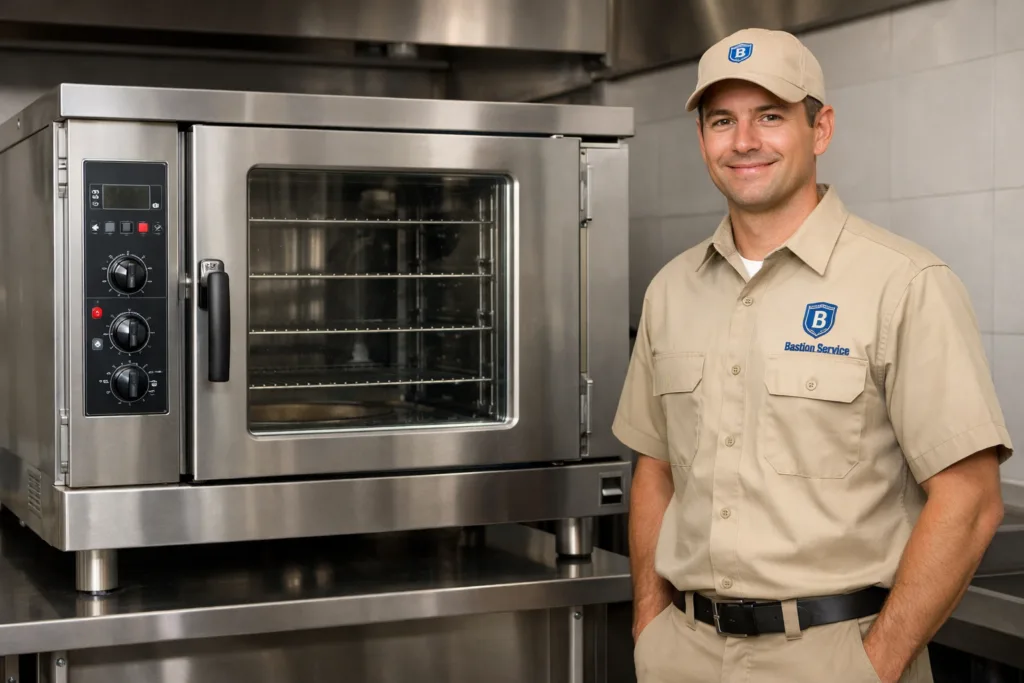




When Blodgett cooking equipment starts missing temperature targets, heating unevenly, or dropping out during service in Brentwood, the first priority is finding the source of the problem before downtime spreads into prep, ticket flow, and product consistency. Bastion Service works with local business operators who need repair scheduling, symptom-based troubleshooting, and a repair plan that matches the actual fault rather than a guess.
For specific equipment paths in Brentwood, review Blodgett Oven Repair in Brentwood and Commercial Appliance Repair in Brentwood.
Common Blodgett Cooking Equipment Problems That Disrupt Daily Operations
Problems with cooking equipment do not always begin with a full failure. Many start as slower heat-up, uneven cooking, ignition hesitation, drifting temperatures, weak recovery between loads, or controls that respond inconsistently. In a busy kitchen, those issues can affect output well before the equipment stops completely.
For Blodgett equipment, symptoms often overlap. What looks like a heating problem may trace back to controls, sensing, airflow, burner performance, electrical faults, or worn door and sealing components. Looking at the pattern of the failure is often the fastest way to decide whether the unit needs immediate repair or can be scheduled around service hours.
Temperature Drift and Uneven Cooking
If an oven is running too hot, too cool, or producing inconsistent results from one batch to the next, the problem may involve temperature sensing, calibration, thermostatic components, relays, control boards, or airflow issues inside the cavity. Uneven browning, inconsistent bake results, and product variation are often early signs that the equipment is no longer holding heat the way it should.
These issues matter because staff often begin compensating manually by changing cook times, rotating pans more often, or increasing set temperatures. That may keep production moving for a short time, but it usually masks a problem that continues to worsen.
Ignition and Burner Problems
Gas-fired Blodgett equipment may show trouble through delayed ignition, inconsistent flame, startup failures, burner dropouts, or difficulty maintaining heat during a cycle. These symptoms can point to igniters, flame sensing components, gas valve behavior, wiring faults, or control-sequence problems.
Ignition complaints should be taken seriously because they affect startup reliability, heat consistency, and safe operation. If the equipment only lights intermittently or struggles to stay lit under normal use, service should be scheduled before the issue causes a longer outage.
Slow Preheat and Slow Recovery Between Loads
Some units still operate, but not at the speed the kitchen needs. If the equipment takes too long to preheat, loses heat after loading, or recovers slowly between batches, production can back up even when the unit appears to be functioning. Weak performance may be tied to heating components, burner efficiency, airflow restrictions, control timing, or heat loss from worn seals and related parts.
Slow recovery is especially costly during peak periods because it reduces throughput without always triggering an obvious error code or shutdown. In practice, that means ticket times stretch out and staff begin working around the equipment rather than relying on it.
Control, Display, and Intermittent Shutdown Issues
Blank displays, keypad problems, unresponsive settings, random shutdowns, or cycles that stop mid-operation often indicate electrical or control-related faults. Loose connections, heat-stressed components, failing boards, or interface problems can all create symptoms that seem unpredictable.
Intermittent failures are often the most disruptive because they can disappear during idle periods and return under production load. Noting whether the issue occurs during preheat, during a long cook cycle, or only after the unit has been running for a while can help narrow the source of the problem.
How Oven Symptoms Affect Kitchen Performance
Blodgett ovens are central to many restaurant and food-service workflows, so even partial performance loss can affect more than one station. A unit that runs inconsistently may slow batch production, reduce holding reliability, create product waste, and force staff to rework timing across the line.
Warning signs that usually justify repair scheduling include:
- Longer-than-normal preheat times
- Hot spots or cold spots in the cooking chamber
- Temperature swings during normal use
- Failure to maintain set temperature
- Delayed ignition or repeated ignition attempts
- Burners cycling abnormally or dropping out
- Unexpected shutdowns mid-cycle
- Display or control panel errors
- Staff needing to adjust settings repeatedly for consistent results
When those symptoms start affecting output, it is usually more cost-effective to diagnose the problem than to keep adapting production around unreliable equipment.
When Repair Should Be Scheduled Promptly
Some issues can wait for a planned service window, but others should move up the schedule. If the equipment is shutting down during use, failing to ignite normally, dropping temperature under load, or showing repeat control faults, the risk of a longer interruption goes up quickly. What begins as a manageable service call can turn into a full production problem if the unit is kept in heavy use without troubleshooting.
Repair should also be prioritized when the same problem keeps returning after resets, when the equipment only works intermittently, or when staff have already changed procedures to compensate. Repeated workarounds usually indicate that the underlying failure is progressing.
What Good Troubleshooting Looks For
Effective troubleshooting focuses on the symptom pattern, not just the most obvious failed function. A temperature complaint may not be a simple heating-component issue. It could involve sensor accuracy, airflow movement, control logic, door sealing, or burner performance under load. In the same way, a startup complaint may be tied to ignition sequence timing rather than a complete gas-delivery failure.
Useful details to document before service include:
- Whether the problem happens at startup, during cooking, or during recovery
- Whether the issue is constant or intermittent
- Whether the fault appears only under full production load
- Any error messages or display behavior
- Whether staff notice unusual sounds, delayed ignition, or heat inconsistency
- How long the issue has been affecting operations
That information helps determine whether the likely repair path involves controls, ignition parts, heating components, wiring, sensing components, or multiple systems.
Repair or Replace?
In many cases, repair makes sense when the equipment is otherwise in solid condition and the fault is limited to serviceable systems such as controls, ignition, sensing, heating, or electrical components. Replacement becomes a more serious discussion when the equipment has repeated failures across multiple systems, when repair needs stack up over time, or when the unit no longer supports the kitchen’s production demands reliably.
The decision is usually less about one symptom and more about the total picture: age, condition, downtime history, parts needs, and how quickly the unit needs to return to steady operation. For many businesses in Brentwood, the most important question is whether repair can restore reliable performance on a timeline that protects daily service.
Service-Focused Next Steps for Brentwood Businesses
If your Blodgett cooking equipment is heating inconsistently, showing ignition trouble, recovering too slowly, or shutting down during operation, the next step is to schedule service based on the symptoms you are seeing in the kitchen. A focused diagnosis helps clarify the fault, define repair scope, and support scheduling decisions that reduce disruption to production rather than extending it.


