
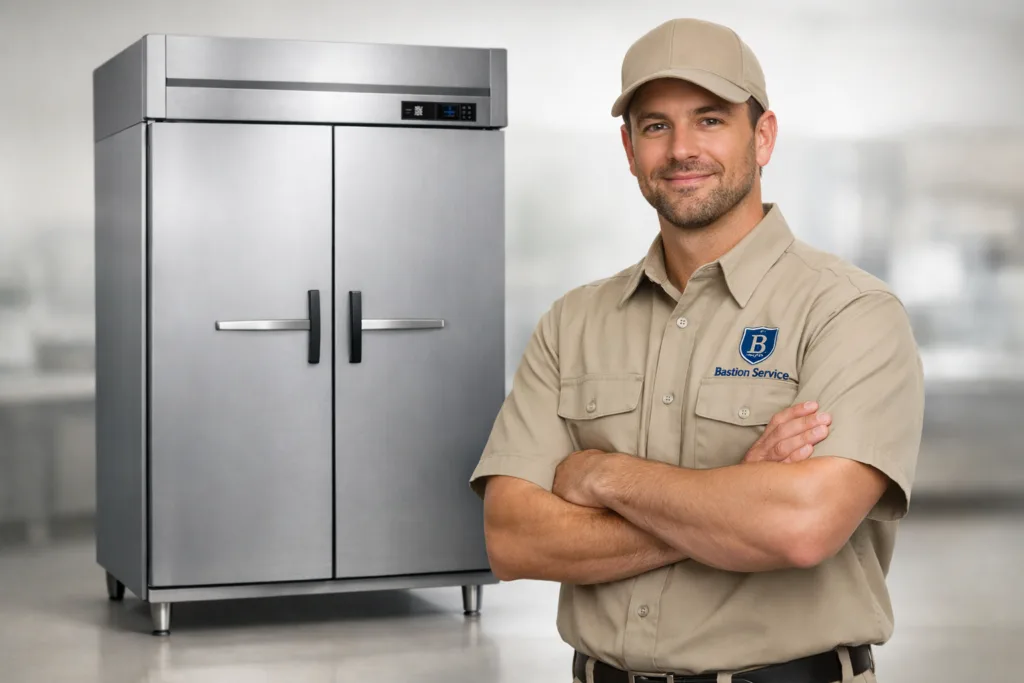





Freezer downtime can disrupt prep schedules, inventory protection, and daily workflow, so service should focus on what the unit is doing now, how urgent the risk is, and what repair path makes sense. Bastion Service provides Beverage-Air freezer repair for businesses in Palms by tracing symptoms back to the actual failure point, whether the issue involves airflow, defrost operation, door sealing, controls, fans, or deeper cooling-system strain.
Related commercial service paths in Palms include Beverage-Air Commercial Repair in Palms, Commercial Freezer Repair in Palms, and Beverage-Air Refrigerator Repair in Palms.
When a freezer begins running warm, collecting frost, leaking water, or making new noises, the symptom itself is only the starting point. Two units can show the same complaint for very different reasons, which is why good service begins with equipment behavior, recent changes in performance, and the effect on product temperatures and recovery times.
Common Beverage-Air Freezer Symptoms and What They Often Mean
Not freezing hard enough
If the cabinet is colder than room temperature but not holding a true freezer range, the problem may be tied to restricted condenser airflow, an evaporator fan issue, a faulty sensor, a control problem, refrigerant loss, or a door that is letting warm air in. In many cases, staff first notice soft product, longer pull-down times, or temperature swings after normal door openings.
This symptom matters because the freezer may still appear to be operating while product protection is already slipping. A unit that runs for long periods without reaching setpoint usually needs prompt inspection before the problem spreads to other components.
Frost buildup on panels, product, or around the evaporator area
Frost usually points to one of two conditions: excess moisture entering the cabinet or a defrost problem that is not clearing ice as designed. Worn gaskets, doors left slightly open, misaligned hinges, failed heaters, bad defrost controls, and low evaporator airflow can all contribute.
Once frost begins to block airflow, temperatures become less stable across the cabinet. One section may seem usable while another warms up, which can make the problem look inconsistent when the root issue is actually getting worse.
Unit runs constantly or struggles to recover
A Beverage-Air freezer that rarely cycles off may be trying to overcome warm air infiltration, dirty coils, a failing motor, inaccurate temperature feedback, or reduced cooling capacity. If the cabinet takes too long to recover after routine openings, that often means the system is operating with very little margin.
- Long run times increase wear on motors and compressor components
- Recovery delays can affect product quality during busy periods
- Higher runtime with poor results usually signals an underlying fault, not normal load
Fan noise, buzzing, clicking, or vibration
Noise complaints can come from evaporator fans, condenser fans, loose mounting hardware, ice contact with moving parts, or compressor-related stress. A clicking noise may reflect a starting problem or a control issue, while rattling may be as simple as a loose panel or as serious as vibration from a strained system.
Noise becomes more important when it appears together with warming temperatures, intermittent shutdowns, or frost buildup. Those combinations often point to a functional problem rather than a harmless sound change.
Water leaks or interior moisture
Water around a freezer can come from blocked drains, defrost drainage issues, door sealing problems, or melting frost caused by unstable airflow. Moisture should not be dismissed as a cleaning issue if it is recurring, especially when it appears alongside temperature inconsistency or visible ice formation.
Why Accurate Diagnosis Matters
Freezer repair decisions are more reliable when the visible symptom is separated from the root cause. For example, an iced evaporator may make it seem like the fan is failing, but the primary problem could be in the defrost circuit. A cabinet that seems to have a weak compressor may actually be suffering from dirty coils or warm air leaking past a damaged gasket. Replacing parts without confirming the failure sequence can lead to repeat downtime and unnecessary expense.
For businesses in Palms, diagnosis also supports immediate operating decisions. Staff often need to know whether the freezer can remain in limited use, whether product should be moved right away, and whether the repair appears isolated or part of a larger decline in performance.
When to Schedule Service Right Away
Some issues can escalate quickly, especially in busy kitchens, storage areas, and food-service environments where doors open often and product loads change throughout the day. Service should be arranged promptly when any of the following appear:
- Product is softening or temperatures are drifting upward
- Frost returns soon after being cleared
- The freezer runs nonstop but does not stabilize
- Fans stop, slow down, or become unusually loud
- Water is pooling under or inside the cabinet
- The unit shuts off unexpectedly or restarts erratically
- Door gaskets are torn, loose, or no longer sealing evenly
These symptoms usually do not resolve on their own. Continued operation may increase component stress, reduce storage reliability, and turn a contained repair into a broader outage.
Door, Airflow, and Defrost Problems Often Overlap
Many freezer complaints are connected rather than isolated. A poor door seal allows warm, humid air into the cabinet. That added moisture creates frost. Frost then restricts airflow across the evaporator. Restricted airflow causes uneven temperatures and longer run times. Over time, staff may report three separate issues when they are all linked to one starting defect.
This is why symptom patterns matter. If a Beverage-Air freezer in Palms has frost near the door, weak air circulation, and delayed recovery, the repair approach should account for all three conditions instead of treating each one as unrelated.
Repair Versus Replacement
Many Beverage-Air freezer issues are repairable when addressed before major damage develops. Fan motors, controls, door hardware, gaskets, drains, and defrost components are often serviceable problems if the cabinet is otherwise in solid condition and the unit still fits the business’s storage needs.
Replacement becomes a more serious consideration when there are repeated major failures, persistent temperature instability after recent work, or signs that the cooling system is no longer supporting consistent operation. The better decision usually depends on downtime history, repair frequency, product risk, and whether the unit is likely to return to stable service after the recommended repair.
How to Prepare for a Freezer Service Visit
A little information from staff can make a freezer diagnosis faster and more useful. Before service, it helps to note:
- Whether the cabinet is warm all the time or only at certain hours
- If frost is appearing in one area or throughout the cabinet
- Any recent noise changes, alarms, or shutdowns
- Whether the door has been difficult to close or seal
- How long the unit has been struggling to recover temperature
- If product temperatures vary by shelf or section
These details can help narrow down whether the problem is linked to controls, airflow, defrost behavior, door sealing, or the cooling system itself.
Service-Focused Next Steps for Businesses in Palms
If a Beverage-Air freezer is no longer holding temperature, building frost, leaking, or showing signs of fan or compressor stress, the most useful next step is to schedule repair before the unit slips into a full outage. For businesses in Palms, timely service helps protect inventory, reduce avoidable downtime, and determine whether the issue is a straightforward component repair or a sign of wider equipment decline.


