
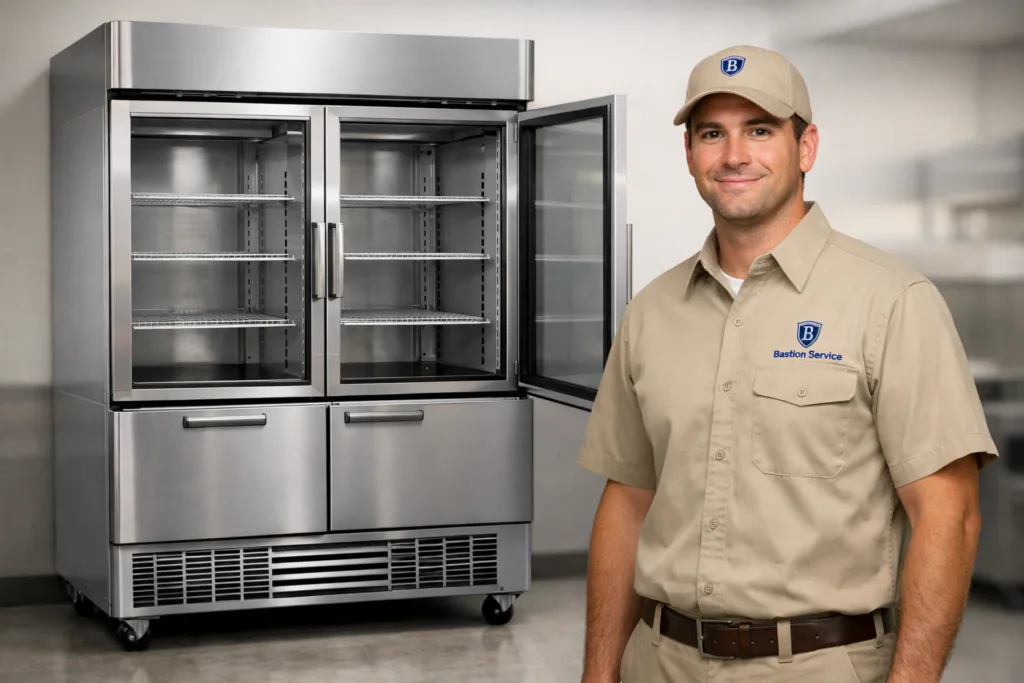




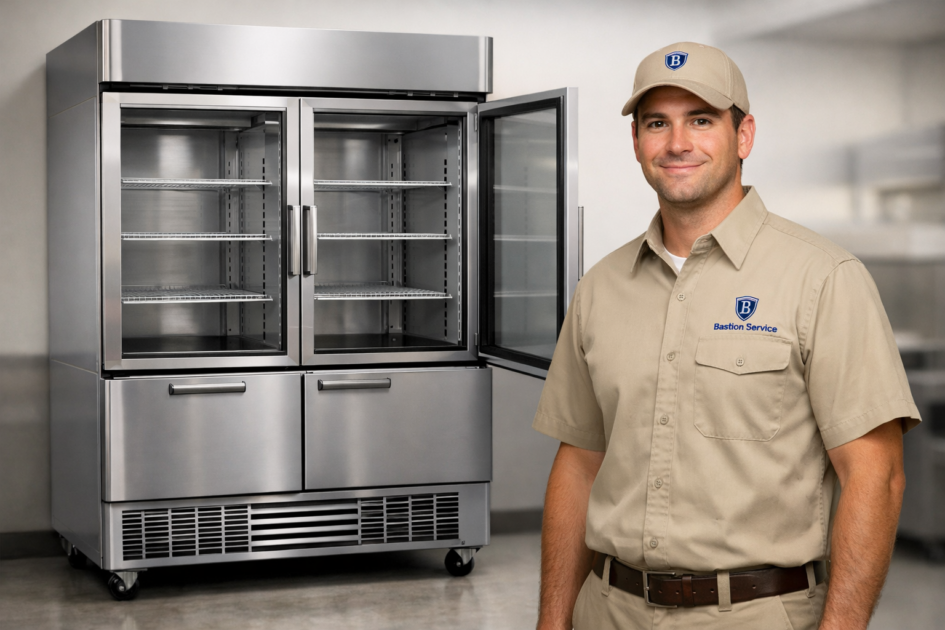
When Beverage-Air refrigeration equipment starts affecting storage conditions, prep flow, or daily service, the priority is to identify the fault quickly and decide how to stabilize operations. For restaurants, cafés, markets, and other food-service businesses in Del Rey, refrigerator and freezer problems can escalate from a minor performance issue into product loss, sanitation concerns, and schedule disruption. Bastion Service provides repair support centered on symptom-based diagnosis, repair scheduling, and the practical next step for equipment that is no longer performing the way the business needs it to.
For specific equipment paths in Del Rey, review Beverage-Air Refrigerator Repair in Del Rey, Beverage-Air Freezer Repair in Del Rey, and Commercial Appliance Repair in Del Rey.
What Beverage-Air refrigeration equipment problems do you troubleshoot?
Most service calls begin with a symptom the staff can see right away: a cabinet running warm, a freezer struggling to recover, frost returning after it has been cleared, or water collecting around the unit. In many cases, the visible issue is only part of the problem. A temperature complaint may be tied to airflow restriction, fan failure, sensor or control trouble, door gasket wear, drain problems, defrost issues, or compressor-related stress.
For Beverage-Air refrigerator and freezer repair, common troubleshooting concerns include:
- Cabinets not holding set temperature
- Freezers softening product or recovering slowly
- Frost or ice buildup inside the cabinet or around the evaporator area
- Uneven cooling from top to bottom or front to back
- Fans running abnormally loud or not moving air correctly
- Water leaks, excess condensation, or recurring moisture near the unit
- Units running constantly, short cycling, or shutting off unexpectedly
- Door gasket, alignment, or sealing issues affecting performance
Refrigerator symptoms that deserve prompt service
A Beverage-Air refrigerator does not have to stop completely to create a serious business problem. Many units continue running while slowly drifting out of range, causing inconsistent holding conditions that are easy to miss during a busy shift. If temperatures are creeping upward, staff are adjusting controls more often than usual, or certain shelves feel warmer than others, the unit should be evaluated before normal operation is interrupted further.
Warm cabinet conditions
A refrigerator that runs but no longer maintains proper cabinet temperature may be dealing with dirty condenser coils, weak fan performance, sensor or control issues, poor airflow, door seal leakage, or developing sealed-system strain. Warm conditions are especially disruptive when the unit appears active but cannot keep up with normal door openings and restocking.
Uneven cooling inside the refrigerator
If product in one area stays colder than product in another, the issue may involve blocked air movement, evaporator icing, fan trouble, loading patterns that expose an airflow problem, or a component beginning to fail under demand. Uneven cooling is often an early indicator that the unit is no longer distributing air the way it should.
Moisture, sweating, or water near the refrigerator
Water on the floor or excess moisture inside the cabinet can point to drainage issues, door sealing loss, condensation problems, or frost that is melting in the wrong place. For a business environment, this is not only an equipment issue but also a safety and housekeeping concern that should be addressed before it affects surrounding surfaces or nearby equipment.
Freezer problems that often point to a larger failure
Freezer issues usually become urgent faster because recovery problems can affect stored product in a short window. If a Beverage-Air freezer is taking longer to pull down temperature, showing soft product, or building heavy frost, it is important to determine whether the issue is related to airflow, defrost operation, gasket sealing, control problems, or a deeper cooling failure.
Freezer not freezing hard enough
When product texture changes, ice cream softens, or staff notice that the freezer feels cold but not cold enough, the unit may be losing capacity even if it has not shut down. This can happen from evaporator icing, restricted airflow, sensor or control faults, fan motor trouble, compressor stress, or heat infiltration through worn seals.
Slow recovery after door openings
If the freezer struggles to return to temperature after normal use, that can indicate a system that is no longer operating efficiently under load. In a busy kitchen or storage area, this symptom often shows up before a full breakdown and is a strong reason to schedule service before peak demand exposes a larger failure.
Frost and ice that keep coming back
Persistent frost is not always a housekeeping issue. Repeat ice buildup can signal a defrost problem, air leakage, door alignment trouble, moisture intrusion, or restricted circulation around the evaporator section. Left unresolved, ice accumulation can reduce performance, interfere with normal air movement, and increase stress on other components.
Airflow problems often sit behind temperature complaints
Many refrigerator and freezer service calls are ultimately tied to airflow. A cabinet may be technically cooling, but if air is not circulating correctly, the equipment can still produce warm zones, slow recovery, frosting, and inconsistent product conditions. Fan motors, evaporator condition, coil cleanliness, internal obstructions, and loading patterns can all contribute to an airflow-related complaint.
Common signs of airflow trouble include:
- Sections of the cabinet cooling differently
- Frost concentrated in one area
- Little or no air movement felt where it is normally present
- Product near doors or corners warming faster than expected
- Long run times without stable temperature results
Because airflow issues can resemble thermostat or cooling-system problems, inspection matters before any repair decision is made.
Why recurring frost, leaks, and temperature swings should not be ignored
Businesses sometimes work around refrigeration problems for days or weeks by moving inventory, reducing door openings, clearing visible ice, or changing settings repeatedly. Those workarounds may buy a little time, but they can also hide a fault that is getting worse. If the unit is running constantly, short cycling, leaking regularly, or moving between normal and abnormal temperatures, continued use may increase wear on major components and raise the risk of a longer outage.
Service is especially important when:
- Staff no longer trust the cabinet to hold product consistently
- The freezer cannot recover the way it used to
- Ice buildup returns soon after being removed
- The unit sounds different, runs longer, or cycles oddly
- Water or condensation keeps returning around the equipment
Repair decisions should be based on the actual failure
Not every Beverage-Air problem leads to the same recommendation. Two units with similar symptoms can require very different repairs depending on the failed component, the condition of the cabinet, the equipment age, and whether there is a history of repeat breakdowns. For that reason, repair planning should start with what the equipment is actually doing on site rather than with assumptions based on one visible symptom.
A service visit typically helps answer the questions operators care about most:
- What is causing the cooling or frost problem?
- Is the equipment still safe to use in a limited way until repair?
- How urgent is the issue?
- Are additional parts or follow-up work likely?
- Does repair still make sense for this unit?
Repair versus replacement for older Beverage-Air equipment
Older refrigeration equipment is not automatically a replacement case, and a newer unit is not automatically worth major repair. The better decision usually depends on the confirmed failure, the history of recent service, the condition of doors and cabinet structure, and how important the unit is to daily operations. If the problem is isolated and the equipment is otherwise sound, repair may restore dependable use. If the unit has ongoing cooling failures, repeated downtime, or rising repair frequency, replacement may be the more sensible business move.
This evaluation is especially useful when the cabinet still powers on but no longer performs consistently enough for normal service.
What businesses in Del Rey should do next
If a Beverage-Air refrigerator or freezer is running warm, building frost, leaking, or showing unstable performance, the next step is to schedule service before the issue affects more product or interrupts operations further. Early diagnosis helps determine whether the equipment can remain in limited use, what repair path makes sense, and how quickly the problem should be addressed so the business can return to more reliable refrigeration performance.


