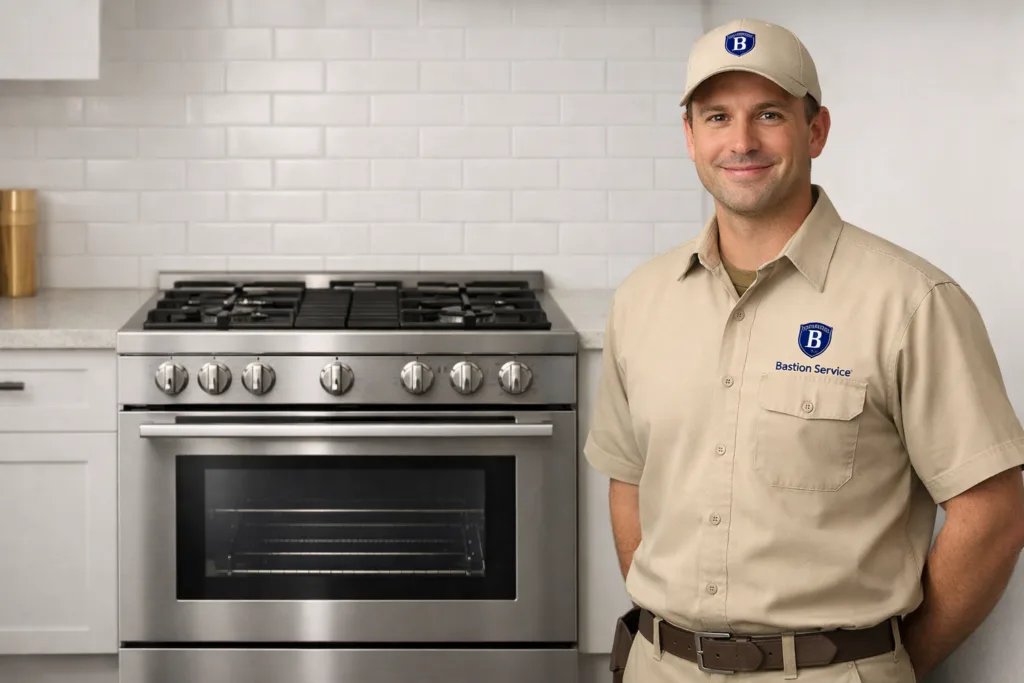
Range problems usually show up in everyday cooking before they look like a complete breakdown. You may notice a front burner clicking longer than usual, an oven taking much more time to preheat, or meals coming out unevenly even though your settings have not changed. With an Asko range, those small changes often point to a specific failing part or an operating issue that should be tested before anything is replaced.
Common Asko range symptoms and what they can mean
One symptom does not always equal one cause. A burner that will not light may be dealing with residue around the ports, poor cap alignment, moisture affecting spark performance, a faulty ignition switch, or a gas delivery issue. An oven that seems too cool may have a weak igniter, a failing bake element, a drifting sensor, or a control fault. Looking at the exact pattern of failure is what helps narrow the repair path.
Burner clicks but does not ignite
If the burner keeps clicking, lights after several tries, or only ignites with a delayed flame, the issue may be in the spark ignition system or in the burner assembly itself. Food debris, cleaning residue, and misaligned burner parts are common starting points. If those are not the problem, the fault may involve the spark module, switch, or wiring.
Delayed ignition should not be ignored. Even if the burner eventually lights, the change in behavior usually means performance is getting worse rather than better.
Burner will not light at all
When there is no ignition response, the problem may be electrical rather than gas-related. If one burner fails but others work, that often points to a component issue at that position. If multiple burners act up at once, broader ignition or power problems become more likely. In a West Hollywood home where the range is used daily, a no-light burner can quickly turn into a bigger inconvenience, especially if the problem spreads to other functions.
Oven takes too long to preheat
Slow preheating is one of the most common complaints on residential ranges. Gas models may have a weak igniter that still glows or sparks but no longer opens gas correctly under load. Electric heating problems may involve a partially failed bake element or a control issue that prevents full heat output. Homeowners usually notice it first when recipes suddenly need extra time or the oven seems stuck below the selected temperature.
Oven is not heating evenly
If cookies brown on one side, casseroles stay cool in the middle, or roasting results become inconsistent, the range may not be cycling heat properly. Possible causes include sensor drift, element trouble, ignition weakness, convection-related faults on equipped models, or control board problems. Uneven heating is often more noticeable during baking than during simple reheating.
Temperature seems off
Sometimes the oven heats, but not accurately. The set temperature may read normally while the actual cavity temperature runs too hot, too cool, or swings more than it should. That can be caused by a worn sensor, calibration issue, or a control problem affecting how heat cycles on and off. If the same recipes are suddenly failing, the temperature system deserves attention even if the oven still turns on.
Display, keypad, or control problems
Flashing errors, unresponsive buttons, beeping, or settings that change on their own can affect both cooking performance and safety. Control issues may prevent proper ignition, interfere with oven functions, or stop the appliance from holding the selected mode. These faults are best treated as full-system issues rather than isolated cosmetic annoyances.
Signs the problem is getting more serious
Some range issues remain stable for a short time, but many gradually worsen. Watch for patterns like these:
- Ignition takes longer each week
- The oven reaches temperature only sometimes
- Burners click after ignition instead of stopping normally
- The control panel resets, flickers, or shows intermittent errors
- Cooking results vary noticeably from one use to the next
- The appliance trips power or shuts off unexpectedly
When symptoms become intermittent, diagnosis becomes more important, not less. Intermittent faults are often the ones that lead to wasted time and unnecessary parts if the appliance is not tested carefully.
When to stop using the range until it is checked
Some conditions call for caution right away. It is better to stop using the appliance if burners ignite with a delay, the oven overheats, electrical behavior becomes erratic, or the controls do not respond predictably. Continued use can stress related components and make the final repair more involved.
If there is a persistent or strong gas smell, do not continue testing the range. Leave the appliance off and address safety first before arranging appliance service.
What homeowners can notice before a service visit
A few observations can make troubleshooting easier. It helps to note whether the problem affects one burner or all of them, whether the oven fails during preheat or during baking, whether error codes appear consistently, and whether the issue began after cleaning, a power interruption, or a recent change in performance. That information can help connect the symptom to the most likely failed system.
Simple visual checks such as confirming burner caps are seated correctly and making sure obvious spills are cleaned away can be worthwhile. Beyond that, repeated trial-and-error usually does not save time on an Asko range, especially when the symptom involves ignition timing, heat regulation, or electronics.
Repair versus replacement
Many range problems are repairable when the fault is limited to ignition parts, burner switches, sensors, heating elements, or a specific electronic control issue. Replacement becomes a more realistic conversation when there are multiple major failures, the unit has significant wear beyond the current symptom, or the repair cost approaches the value of keeping the appliance in service.
The most useful decision is based on the actual failed components, overall condition, and expected reliability after repair. That is especially important with cooking appliances, where consistent heat and safe operation matter just as much as simply turning on.
What a service call should help clarify
A worthwhile visit should identify which function has failed, what caused the symptom, and whether the repair path makes sense for your household. For Asko range repair in West Hollywood, that often means separating burner ignition issues from oven heating faults, temperature regulation problems, and control-related failures so the next step is based on how the appliance is actually behaving.
Why symptom-based diagnosis matters
Ranges often produce similar symptoms for very different reasons. A cold oven does not always need the same part. A clicking burner does not always mean the same failure. Testing the appliance by symptom pattern helps avoid replacing parts that are still working and gives a clearer picture of whether the issue is isolated or part of a larger control or power problem.
For homeowners in West Hollywood, that approach is usually the fastest way to decide whether the appliance needs a straightforward repair, a more involved parts replacement, or a broader discussion about whether keeping the current range is still the right choice.