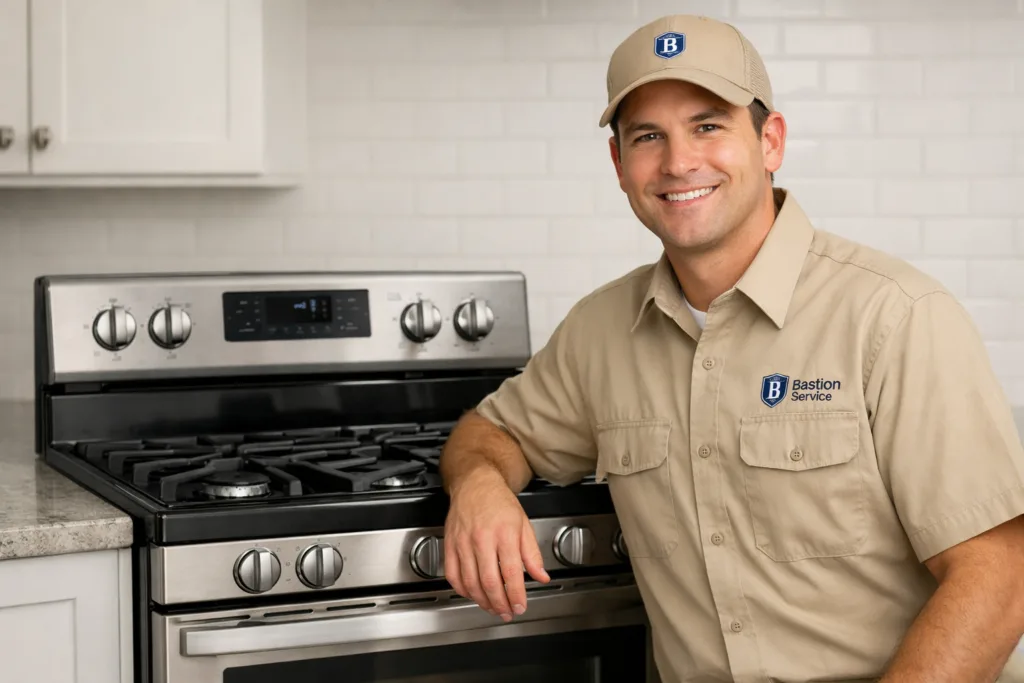
Range problems often start as small cooking inconsistencies before they become a full loss of heat. A surface burner may need several tries to light, the oven may take much longer to preheat, or meals that used to cook predictably may start coming out unevenly. On Whirlpool ranges, those symptoms can come from different components, so the most helpful first step is identifying whether the problem is isolated to ignition, heating, sensing, controls, or the appliance power supply.
Common Whirlpool range issues in Palos Verdes Estates homes
Household cooking routines make range problems hard to ignore. Breakfast, weeknight meals, and baking all depend on steady burner and oven performance, which is why certain symptoms tend to lead to service calls more quickly than others.
Burners that do not heat or ignite properly
On electric Whirlpool ranges, a surface burner that stays cool may be caused by a failed element, a damaged receptacle, a faulty switch, or a power-related issue inside the unit. If the burner heats only partway or cycles strangely, the problem may be developing rather than fully failed.
On gas models, clicking without ignition often points to moisture around the igniter, blocked burner ports, burner cap alignment issues, or a failing ignition component. If one burner is affected while the others work normally, that usually suggests a localized fault rather than a whole-range failure.
Oven not heating the way it should
A Whirlpool oven that will not reach the set temperature, preheats very slowly, or stops short of full heat can have a weak bake element, ignition trouble on a gas model, a temperature sensor issue, or a control problem. Sometimes the oven technically still works, but only after much longer cook times. That kind of partial failure can be frustrating because it looks like a recipe problem when it is really an appliance problem.
Uneven baking and temperature drift
If one side of a sheet pan browns faster than the other, baked dishes need extra time in the center, or the oven seems hotter or cooler than the display shows, the issue may involve sensor accuracy, element cycling, calibration, or electronic control behavior. These symptoms often develop gradually, which is why homeowners may notice inconsistent results before they suspect the range itself.
Clicking, sparking, or delayed ignition
Persistent clicking on a gas burner should not be ignored. In some cases, cleaning and drying the burner area resolves a temporary issue, but ongoing clicking or delayed ignition may signal a failing spark system or burner alignment problem. If the burner lights with a small flare, lights unevenly, or keeps sparking after ignition, it should be inspected before normal use continues.
Display, keypad, and control failures
When the control panel becomes unresponsive, shows error codes, resets the clock, or goes blank, the fault may involve the main control, touch interface, wiring, or incoming power conditions. Because Whirlpool ranges depend on the control system for oven functions and, on some models, additional safety features, a display problem can affect more than just the clock.
What specific symptoms can suggest
Many range complaints sound similar at first, but the pattern usually helps narrow the cause.
- Cooktop works but oven does not: often linked to an oven-specific heating, ignition, sensor, fuse, or control problem.
- Only one burner fails: commonly points to that burner’s switch, element, igniter, cap, or connection point.
- Oven temperature seems inaccurate: possible sensor drift, calibration issue, weak element, or control fault.
- Burner clicks repeatedly: may indicate ignition trouble, moisture contamination, misalignment, or a spark switch issue.
- Error code appears: can help narrow the problem, but the code still needs testing before any part is replaced.
- Breaker trips during use: may involve a shorted component, wiring damage, or another electrical fault that should be checked promptly.
When a Whirlpool range should be checked soon
Service is usually worth scheduling when the range becomes unreliable enough to affect daily cooking, especially if the symptom is getting worse. That includes burners that stop heating consistently, ovens that take too long to preheat, controls that work only sometimes, or ignition that requires repeated attempts.
Intermittent problems can be especially deceptive. A Whirlpool range may appear normal during one meal and fail during the next, which often points to a component that is weakening rather than completely dead. Catching that stage early may help prevent additional wear on related parts.
Signs continued use may cause more trouble
Some faults are inconvenient. Others can place stress on the appliance. A struggling igniter may keep cycling until it fails completely. A weak element may overwork the control system. Loose or damaged electrical connections can create excessive heat inside the range. If knobs feel unusually hot, the appliance trips power, or you notice the smell of electrical burning, stop using it until it has been inspected.
For gas Whirlpool ranges, any persistent gas odor should be treated as a safety concern first. Do not continue testing the appliance if the smell remains strong or returns repeatedly.
Repair or replace?
Many Whirlpool range problems are repairable when the issue is limited to a serviceable part such as an igniter, surface element, sensor, switch, burner component, or control-related part. Replacement becomes a more serious consideration when the range has multiple major faults, ongoing performance issues across several systems, or age-related wear that makes the repair path less practical.
The decision usually depends on the failed component, the overall condition of the appliance, how long the problem has been developing, and whether this is an isolated event or part of a larger pattern. A diagnosis helps separate a straightforward repair from a situation where replacement may make more sense.
What homeowners can notice before service
Even before a technician checks the unit, a few details can make the problem easier to identify. It helps to note whether the issue affects the cooktop, the oven, or both. Try to remember if the symptom started suddenly or gradually, whether it appears every time or only sometimes, and whether any error code showed up on the display. If one burner behaves differently from the others, or if the oven fails only after preheating, that pattern matters.
Simple observations like these can make Whirlpool range repair in Palos Verdes Estates more efficient because they point testing toward the correct system instead of assuming every heating complaint has the same cause.
Focused help for residential range problems
In a home kitchen, range trouble quickly affects the whole routine. Whether the issue is a burner that will not light, an oven that no longer holds temperature, or controls that stop responding, the goal is to confirm the cause and determine whether the repair is practical for the appliance’s condition. For homeowners in Palos Verdes Estates, that means symptom-based service that addresses how the range is actually failing rather than guessing from the surface complaint alone.