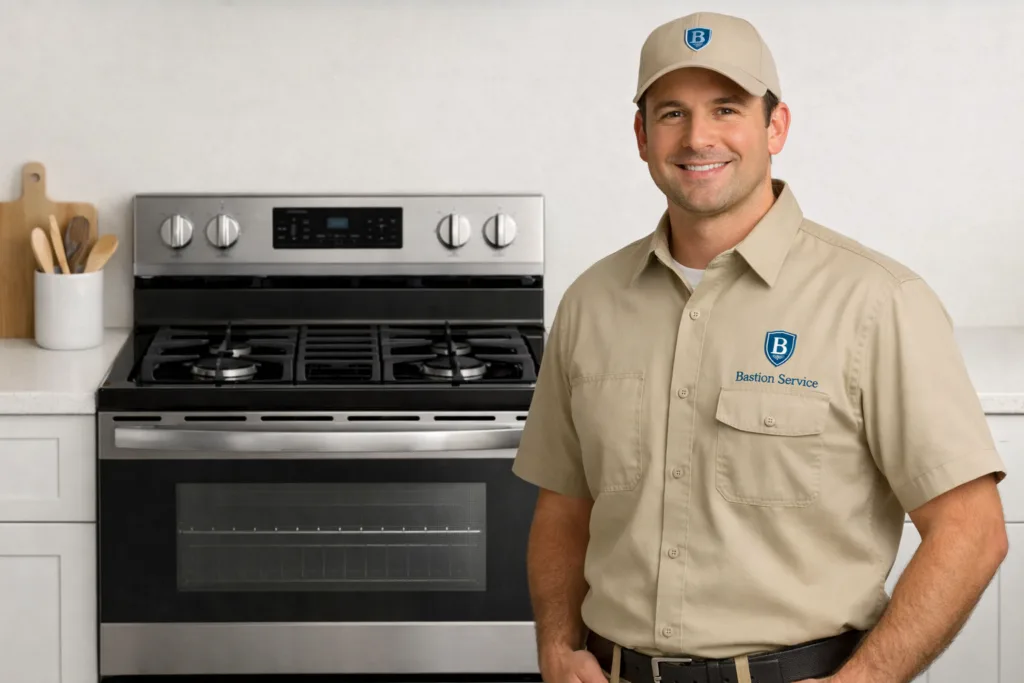
Common Whirlpool range problems in Century City homes

Whirlpool ranges tend to fail in recognizable ways. Some problems affect the cooktop first, while others show up as oven performance issues, strange control behavior, or intermittent operation that makes everyday cooking frustrating.
Related Whirlpool and range service paths in Century City include Whirlpool Appliance Repair in Century City, Range Repair in Century City, and Whirlpool Refrigerator Repair in Century City.
Burners that click, spark, or fail to ignite
If a gas burner clicks repeatedly but does not light, the cause may be as simple as moisture around the igniter or a burner cap that is sitting out of position. In other cases, blocked ports, a worn spark switch, damaged wiring, or an ignition component failure is preventing normal lighting. When the clicking continues after the flame appears, that usually points to an ignition issue that should be checked before regular use continues.
If you notice a strong gas odor, stop using the range and address the safety concern before scheduling appliance repair.
Oven not heating or taking too long to preheat
A Whirlpool range oven that stays cool, heats very slowly, or never seems to reach the set temperature may have a weak igniter, a failed bake or broil element, a temperature sensor problem, or a control fault. Some ovens appear to start normally but do not create enough steady heat to cook food through. That can lead to undercooked casseroles, uneven roasting, and baking results that are hard to trust.
Uneven cooking and temperature drift
When cookies brown too much on one side, sheet-pan meals finish unevenly, or recipes that used to work suddenly become inconsistent, the issue may not be total heat loss. Temperature swings can come from sensor errors, relay problems, calibration issues, or heat that is cycling improperly. These symptoms are often most noticeable during baking and longer oven cycles.
Surface elements not working properly
On electric Whirlpool ranges, a surface element that does not heat, overheats, or cycles unpredictably may involve the element itself, the receptacle, the infinite switch, or wiring beneath the top. A burner that gets stuck on one temperature can be just as disruptive as one that will not turn on at all.
Display, keypad, and control problems
If the control panel becomes unresponsive, flashes an error code, resets on its own, or fails to start a bake cycle, the fault may be electronic rather than mechanical. Control issues can also overlap with heating complaints, which is why testing matters. A range may appear to have an element or igniter problem when the actual cause is the board or related wiring.
How symptom patterns help narrow down the cause
The most useful starting point is the way the problem behaves, not just the fact that the range is malfunctioning. For example, a burner that never lights points in a different direction than a burner that lights only after several clicks. An oven that does not heat at all is a different diagnosis from one that heats, but overshoots or drops temperature during the cycle.
- Clicks with no flame: often tied to ignition, burner alignment, or clogged ports
- Slow preheat: may indicate a weak igniter, failing element, or sensor issue
- Food cooks unevenly: often linked to temperature regulation or heat distribution problems
- Dead display or erratic keypad: may point to control board or power-related faults
- Only one function failing: can suggest an isolated component instead of a full appliance replacement issue
Because these symptoms overlap, guessing at parts can get expensive quickly. The same complaint can come from different failures depending on the model and how the range behaves during operation.
When the problem is more than normal wear
Some issues start small and gradually become more disruptive. A burner may ignite after a few tries for weeks before it stops working altogether. An oven may need a little extra time to preheat before it eventually cannot maintain temperature. These are signs that a component is weakening rather than a one-time glitch.
It is usually time to schedule service when:
- preheating has become noticeably slower than normal
- burners fail repeatedly or only work intermittently
- the oven temperature is unreliable enough to affect meals
- the control panel shows repeated errors or resets
- a burner keeps clicking after ignition
- the appliance no longer feels safe or dependable for daily use
Waiting too long can turn a single failed part into added strain on related components, especially with ignition and control problems.
What Century City homeowners can check before booking service
Not every symptom means a major repair is needed. A few basic checks can help rule out simple causes before moving forward.
- Make sure burner caps are seated correctly after cleaning
- Check for spilled food or grease blocking burner ports
- Confirm the range has power and no breaker issue is involved
- For electric models, look for a damaged or loose surface element fit
- Allow recently cleaned ignition areas to dry fully before testing again
If the same problem returns after these steps, or if the range is showing electrical, heating, or control symptoms, the next step should be a clear diagnosis rather than repeated trial-and-error fixes.
Repair or replace?
Many Whirlpool range problems are worth repairing, especially when the issue is limited to an igniter, heating element, switch, sensor, or a specific control-related failure. A repair tends to make sense when the rest of the appliance is in solid condition and the problem is isolated.
Replacement becomes a more realistic option when the range has multiple failures at the same time, has a long pattern of recurring breakdowns, or needs extensive parts and labor compared with its age and overall condition. For most households in Century City, the decision comes down to the scope of the fault, the expected reliability after repair, and whether the range still fits the kitchen’s daily needs.
What a service visit should help you understand
A good repair visit should do more than identify one bad part. It should clarify what failed, whether that failure caused additional performance problems, and whether continued use could make the issue worse. That is especially important when the range still works some of the time, because intermittent operation can hide a worsening problem.
Homeowners usually want straightforward answers:
- Why is the range acting this way?
- Is it safe to keep using?
- Is the repair likely to restore normal cooking?
- Does the appliance condition support fixing it?
For a Whirlpool range that is used every day, those answers matter just as much as the repair itself. In Century City homes, restoring predictable burner performance and oven heat is really about getting the kitchen back to normal without unnecessary parts replacement or avoidable downtime.