
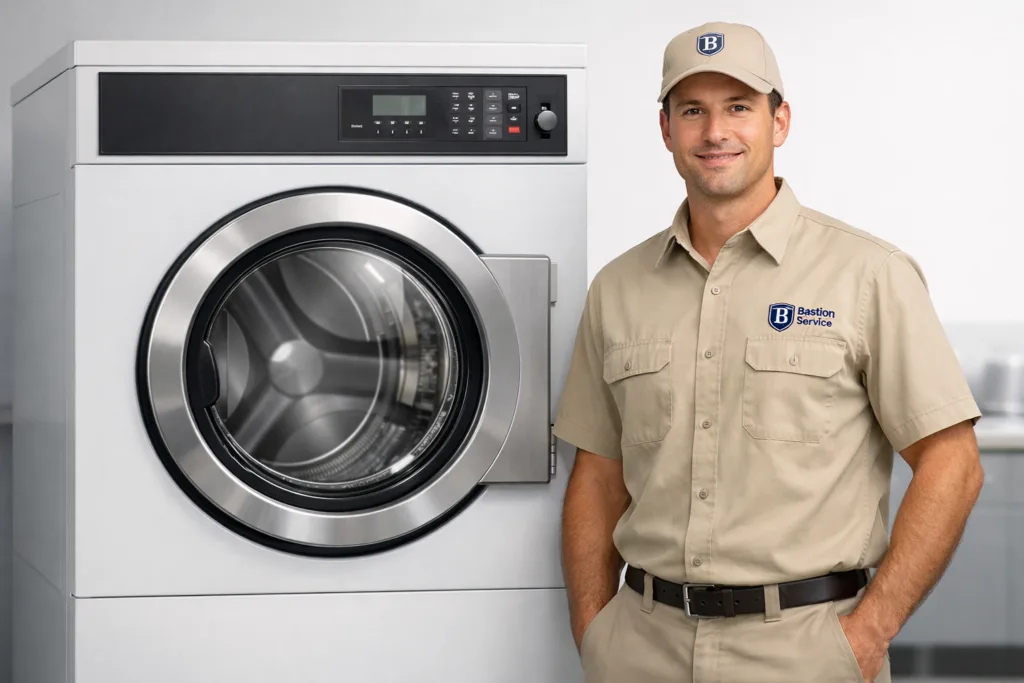




Dryer problems can slow production quickly when loads start stacking up, staff have to rerun cycles, or a unit drops out during a busy shift. For businesses in Rancho Palos Verdes, service is most effective when the symptom is tied to testing at the machine rather than assumptions about the part most likely to fail. Bastion Service provides Wascomat dryer repair with a service-first approach that looks at heat output, airflow, controls, drum movement, safety shutoffs, and overall operating condition before the repair path is set.
Related commercial service paths in Rancho Palos Verdes include Wascomat Repair in Rancho Palos Verdes, Commercial Dryer Repair in Rancho Palos Verdes, and Wascomat Washer Repair in Rancho Palos Verdes.
That matters because the same complaint can come from different failures. A dryer that is not heating may have a heater problem, but it may also be dealing with restricted exhaust, a failed sensor, a tripped safety device, or a control issue. A machine that stops mid-cycle may point to overheating, drive strain, electrical interruption, or a board fault. The goal is to identify what is actually causing the downtime so repair scheduling, parts decisions, and next steps make sense for daily operations.
Common Wascomat Dryer Symptoms and What They May Mean
No heat or poor heat
If the drum turns but loads stay damp, the problem may involve the heating circuit, temperature regulation, safety cutoffs, gas or electrical supply conditions, or blocked airflow. In some cases, the dryer produces some heat but not enough to finish loads on time, which can make the issue look smaller than it really is. Poor heat output often leads to longer cycles, extra labor, and unnecessary wear from repeated operation.
Long dry times
Extended cycle times are often linked to restricted exhaust flow, lint buildup inside key passages, weak heating performance, moisture-sensing problems, or control issues that prevent the machine from managing temperature correctly. Even when the dryer eventually finishes, reduced throughput can disrupt laundry timing across the day. In laundromats, hotels, care facilities, and other businesses in Rancho Palos Verdes, one slow dryer can create bottlenecks well beyond a single machine.
Dryer shuts down before the cycle ends
A unit that stops during operation or needs time to cool before restarting may be reacting to overheating, motor stress, failing switches, unstable electrical components, or control faults. Repeated shutdowns should be addressed early because continued operation can turn an intermittent issue into a full no-start condition. Mid-cycle stoppage also raises the chance of wet loads being delayed or reprocessed.
No start condition
When a Wascomat dryer will not start at all, diagnosis may need to focus on door switches, start circuits, control components, power supply issues, safety devices, or drive-related faults. A no-start complaint is not always a control-board problem, even if the panel appears inactive or inconsistent. The right repair depends on confirming whether the machine is failing to receive power, failing to respond to commands, or preventing startup because another condition has been detected.
Noise, vibration, or scraping
Squealing, thumping, grinding, rattling, or scraping usually points to wear in rollers, bearings, idler components, drum supports, the motor, or items caught where they should not be. These sounds can start gradually and then worsen as the dryer stays in use. Vibration should also be taken seriously, especially when it is new, because it may signal developing mechanical damage that can affect the drum system or drive components.
Burning smell or overheating signs
A burning odor can be tied to lint accumulation, slipping belts, overheated components, wiring problems, or heat that is not moving through the system as intended. If exterior surfaces seem excessively hot, the dryer area smells unusual, or shutdowns happen after temperature builds, the machine should be evaluated promptly. Overheating is not just a performance problem; it can also become a safety issue if ignored.
Error codes or erratic controls
Fault displays, unresponsive inputs, cycle inconsistency, or settings that do not behave as expected may involve sensors, harnesses, user interface parts, or the main control system. Error codes can help narrow the issue, but they do not always identify the failed component by themselves. Testing is still needed to determine whether the code reflects the real fault or a symptom of another problem in the machine.
Why Wascomat Dryer Diagnosis Matters Before Repair
Dryer symptoms overlap more than many operators expect. A heat complaint may begin with airflow. A shutdown complaint may be a thermal protection response. A noisy dryer may have more than one worn component, and replacing only the loudest one may not restore stable operation. Accurate diagnosis helps avoid ordering parts based on guesswork and reduces the risk of repeat service for the same unresolved problem.
For Rancho Palos Verdes businesses, that also supports better scheduling. Some faults justify immediate attention because continued use may damage motors, heating components, belts, or controls. Others can be planned around production demands if the machine is still operating safely and the issue is clearly defined. Good service is not just about fixing what failed today; it is about understanding whether the dryer can return to dependable use without creating a larger interruption next week.
Symptoms That Usually Mean Service Should Be Scheduled Soon
If a Wascomat dryer is still running, it can be tempting to keep it in rotation and wait. That often becomes costly when the original issue causes related wear or a complete stoppage during a critical part of the day. Service is usually worth scheduling promptly when you notice:
- Loads coming out damp after normal cycle settings
- Cycle times getting longer without a known cause
- Repeated shutdowns or reset attempts
- Grinding, squealing, scraping, or heavy vibration
- Burning smells or signs of overheating
- Controls that behave inconsistently from one load to the next
- Error codes that return after clearing
- One dryer in a group falling behind the others in performance
These patterns usually indicate more than routine wear. They are signs that the machine needs inspection under operating conditions so the cause can be confirmed and the next repair decision can be made with confidence.
Airflow Problems Can Look Like Heating Failure
One of the most common reasons for misdiagnosis is assuming that no heat or long dry times always come from the heat source itself. In many cases, restricted airflow keeps the dryer from moving heat and moisture out effectively. The machine may overheat, trip protection devices, stretch cycle length, or leave fabrics damp even though parts of the heating system are still working.
That is why airflow and vent-related conditions are part of a proper service evaluation. If the machine cannot breathe correctly, replacing a heater-related component alone may not solve the problem. It may also leave the dryer vulnerable to the same failure again. For businesses that depend on predictable load turnover, airflow issues can create hidden production loss long before a machine fully stops.
Mechanical Wear Often Shows Up Before a Full Breakdown
Wascomat dryers that develop roller wear, idler problems, belt issues, motor strain, or drum-support trouble often give warning signs first. A light squeak may turn into a loud squeal. A slight thump may become a clear drum-related issue. A dryer that still starts may begin sounding rougher each day until it eventually stops or damages nearby parts.
Addressing mechanical symptoms early can help limit secondary damage. When worn components stay in service too long, they can put more load on the drive system and increase repair scope. That is especially important in business settings where equipment is used repeatedly and a small noise problem can become a larger outage faster than expected.
Control and Sensor Issues Can Affect More Than One Function
Modern dryer operation depends on controls receiving reliable input from switches, sensors, and other electrical components. When one part of that chain fails, the symptom may show up as no heat, random stopping, poor cycle completion, moisture-detection issues, or an interface that does not respond correctly. Because those symptoms overlap with airflow and mechanical faults, electrical diagnosis needs to be tied to real machine behavior, not just a visual inspection.
If a dryer appears unpredictable, starts and stops inconsistently, or shows codes that do not match what staff are seeing during operation, a deeper test process is usually the best next step. That helps separate a direct control failure from a sensor or wiring issue that is causing the control to react incorrectly.
Repair or Replace?
Many Wascomat dryer problems are repairable, especially when the issue is limited to drive components, switches, sensors, airflow-related faults, certain electrical parts, or isolated control-related failures. Replacement becomes a more serious consideration when the dryer has a pattern of major breakdowns, extensive heat damage, poor overall condition, or repair costs that do not align with remaining useful life.
The right decision depends on more than one invoice. It should account for downtime impact, machine condition, repeat failure history, parts involved, and how important that specific dryer is to daily output. In a busy laundry setting, the better choice is often the option that restores stable throughput with the least disruption to operations.
Preparing for a Dryer Service Visit
Before scheduling service, it helps to note what the machine is doing and when the problem shows up. Useful details include whether the dryer starts, whether the drum turns, whether heat is present at any point, how long the cycle runs before stopping, what sounds are being heard, and whether any codes appear on the display. If the issue changes from load to load, that pattern is also worth documenting.
Operators can also be ready to explain whether the problem affects one dryer or multiple units, whether the issue began suddenly or gradually, and whether staff have noticed lint buildup, overheating, or repeated resets. That information can help narrow the likely fault path and support faster repair planning once the machine is inspected.
Wascomat Dryer Repair Support for Businesses in Rancho Palos Verdes
When a Wascomat dryer is running too long, not heating, making noise, shutting down, or failing to start, the most effective next step is a service visit focused on the actual symptom pattern and its impact on operations. For businesses in Rancho Palos Verdes, timely diagnosis helps reduce unnecessary downtime, avoid misdirected parts replacement, and move the machine back toward reliable daily use with a repair plan that fits the condition of the equipment.


