
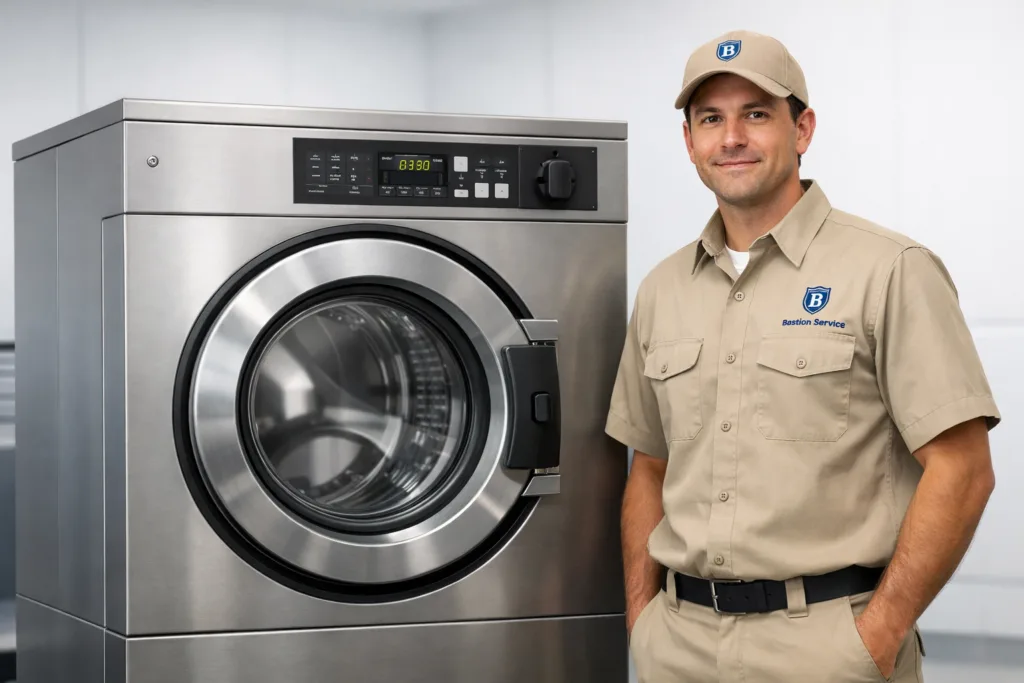




Equipment trouble rarely stays limited to one machine. In laundry rooms that support daily guest turnover, tenant use, or steady production, a Wascomat washer or dryer problem can quickly affect staffing, load timing, and overall workflow. The most effective next step is to schedule service around the actual symptom pattern so the repair plan addresses the fault causing the interruption rather than only the visible result.
For specific equipment paths in Beverly Hills, review Wascomat Washer Repair in Beverly Hills, Wascomat Dryer Repair in Beverly Hills, and Commercial Appliance Repair in Beverly Hills.
Bastion Service works with Beverly Hills businesses that need Wascomat laundry equipment evaluated for leaks, drainage problems, control faults, no-heat complaints, abnormal vibration, and other issues that interfere with reliable operation. Service is most useful when it helps operators understand what should be taken out of rotation, what may still be usable on a limited basis, and what repair path makes the most sense for the equipment.
Wascomat laundry equipment symptoms that often need repair
Many washer and dryer issues start as performance changes before they become full shutdowns. A washer may begin leaving water in the drum, stopping before spin, taking longer to finish cycles, or shaking harder than usual. A dryer may still run but fail to heat properly, dry unevenly, overheat, or shut down before the load is finished. In a business setting, those early warning signs matter because reduced performance often creates backlogs long before a machine goes completely offline.
It is also important not to assume one symptom always points to one failed part. Long dry times can involve heat production, airflow, sensors, controls, or a combination of conditions. A washer that does not complete cycles may have a drain-related issue, a door-lock problem, a drive fault, or an electronic control issue. Symptom-based testing helps determine whether the repair is straightforward or whether multiple systems are involved.
Wascomat washer problems that affect production
Water not draining or cycle not finishing
If a washer ends a cycle with standing water, pauses unexpectedly, or refuses to advance into spin, daily throughput can slow down immediately. Drain pumps, hoses, obstructions, controls, and safety-related components can all contribute to this type of failure. Even when the machine still runs intermittently, repeated incomplete loads usually signal a repair need rather than a one-time operating error.
For laundromats, hotels, and shared laundry rooms, this symptom often creates a second problem because wet loads occupy machines longer and delay the next set of users. Early service can help prevent a drain issue from turning into a wider outage that affects multiple loads and staff time.
Loads coming out too wet
When textiles leave the washer holding more moisture than normal, the problem may be related to imbalance, drive components, spin performance, controls, or a condition that prevents the machine from reaching proper extraction speed. This matters because washers and dryers work as a system. Weak extraction increases dryer time, reduces capacity, and can raise utility use across the laundry area.
If operators are noticing consistently heavy loads at unload or needing extra dry time to compensate, it is usually worth scheduling service before the issue spreads into broader production delays.
Leaks, overfilling, or inconsistent fill behavior
Water on the floor, unexpected fill problems, or poor water control should be addressed quickly in any business environment. A leak may stem from hoses, valves, seals, drain components, or internal wear. Overfilling or irregular fill behavior can also point to control-related faults or parts that are no longer regulating water correctly.
Beyond the machine itself, these symptoms can create slip hazards, disrupt surrounding equipment use, and lead operators to take units offline during busy periods. Repair service helps determine whether the issue is isolated or part of a larger wear pattern.
Noise, banging, and excessive vibration
Unusual movement during the wash or spin cycle often indicates more than routine wear. If a Wascomat washer starts banging, walking, scraping, or vibrating hard enough to draw staff attention, the cause may involve support components, mounting issues, drum-related wear, or balance-related faults. Continued operation can increase damage and may affect nearby equipment or the surrounding floor area.
When vibration has clearly worsened, it is wise to stop treating it as a nuisance and have the unit evaluated before the symptom becomes a mechanical failure that removes the machine from service entirely.
Wascomat dryer problems that reduce turnaround
No heat or poor drying performance
A dryer that tumbles but does not produce enough heat can slow output across the entire laundry operation. Heating components, controls, sensors, and airflow conditions can all contribute to this complaint. In some cases, the dryer is technically running but no longer meeting the production speed the business depends on.
If loads require repeat cycles or staff have started sorting around one underperforming dryer, that is usually a sign that the issue should be diagnosed before it creates a larger scheduling problem.
Long dry times and uneven results
Extended dry times do not always mean the dryer is the only source of the problem, but they do mean performance has dropped below normal. Restricted airflow, weak heat, sensor problems, moisture-related control issues, or upstream washer extraction issues can all play a role. The key point for operators is that longer cycles reduce available machine time and can back up the entire room.
Where daily linen, towel, garment, or resident laundry volume matters, even a moderate drying slowdown can become expensive in lost efficiency and staff workarounds.
Shutting off mid-cycle or overheating
A dryer that stops during operation, trips protections, or seems unusually hot should not be pushed through repeated use without inspection. Protective shutdowns often indicate that the equipment is reacting to an unsafe or damaging condition. In other cases, the machine may restart but continue failing unpredictably, which makes it difficult for staff to plan around.
Repair evaluation should focus not only on why the dryer stopped, but also on whether airflow, controls, or related components contributed to the event.
Squealing, grinding, or drum movement issues
Noises from the dryer cabinet or drum area often begin as an intermittent complaint and then progress into reduced movement or complete failure. Worn support parts, belt-related issues, idler problems, and other mechanical wear can all show up through squealing, thumping, scraping, or rough drum rotation.
These symptoms are often easier to address before the machine stops turning altogether. For businesses trying to keep equipment available during busy periods, early repair scheduling is usually more manageable than reacting to a full breakdown.
When service should be scheduled promptly
Some symptoms should move quickly from observation to repair scheduling. These include recurring cycle failures, visible leaks, poor draining, repeated error conditions, burning odors, significant vibration, no heat, overheating, and sudden changes in normal operating sound. If staff are resetting machines, repeating loads, or changing their routine to work around one unit, the equipment is already affecting operations enough to justify service.
It is also worth scheduling repair when the machine still works but no longer performs at the level your business needs. Laundry equipment does not have to be completely inoperative to be costing time, labor, and output.
Repair decisions based on equipment condition and downtime risk
Not every problem leads to the same recommendation. Some Wascomat issues are confined to a specific repair, while others reflect broader wear, repeat failures, or multiple systems declining at once. A proper assessment helps separate a practical repair from a situation where ongoing investment may no longer support reliable use.
For business operators, the decision is usually about more than parts. It includes machine availability, scheduling pressure, effect on employees, impact on guests or tenants, and whether temporary workarounds are now part of daily operations. Looking at the full operating picture makes it easier to decide whether to repair now, phase a unit out, or plan for replacement on your own timeline.
Service support for Beverly Hills laundry operations
Wascomat laundry equipment service in Beverly Hills is most helpful when it supports day-to-day operating decisions as well as the mechanical repair itself. Businesses need to know what symptom requires immediate attention, what issues may worsen if ignored, and how repair timing affects uptime across the washer and dryer lineup. If your equipment is causing delays, inconsistent results, leaks, or repeated interruptions, scheduling service now is the practical way to reduce downtime and restore more predictable operation.


