
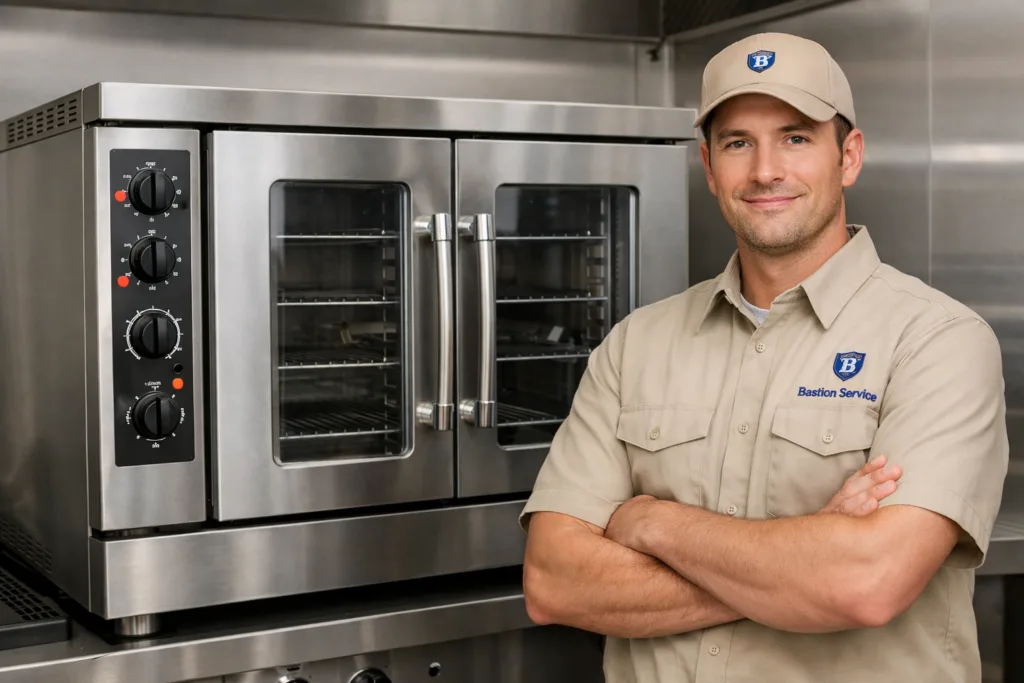







When a Vulcan oven starts missing temperature, delaying preheat, or dropping out during production, the next step should be service built around the actual symptom pattern. In Redondo Beach, restaurants and other food-service businesses often need more than a quick part swap; they need to know whether the issue involves ignition, heat regulation, airflow, controls, or a developing safety fault that could lead to a longer outage. Bastion Service works with businesses that need repair scheduling, accurate troubleshooting, and a repair path that makes sense for daily operations.
Related commercial service paths in Redondo Beach include Vulcan Commercial Repair in Redondo Beach, Commercial Oven Repair in Redondo Beach, and Vulcan Range Repair in Redondo Beach.
Common Vulcan oven symptoms that point to repair needs
Not heating or taking too long to preheat
If the oven is not heating at all, heating slowly, or struggling to recover temperature between loads, the cause may involve burners, igniters, heating elements, relays, temperature controls, or supply-related issues. In a busy kitchen, slow heat-up often shows up first as delayed prep and backed-up timing before the unit fully stops working.
Uneven baking or poor heat consistency
Hot spots, pale batches, overcooked edges, and inconsistent results across pans usually mean the oven is no longer distributing or regulating heat the way it should. That can be tied to sensor drift, thermostat or control problems, weak convection airflow, door seal wear, or internal heat-distribution issues. Even when the oven still runs, this symptom can create waste, rework, and quality problems.
Temperature overshooting or falling below set point
When the displayed setting does not match actual cooking performance, diagnosis often focuses on the temperature sensor, calibration, control response, cycling behavior, and related wiring. This type of problem is easy to misread because operators may assume the oven only needs adjustment when the real issue is a failing component that is getting worse over time.
Ignition problems or intermittent startup
A Vulcan oven that clicks without lighting, lights inconsistently, or starts and then shuts back down may have trouble with the igniter, flame sensing, gas valve operation, burner condition, or the control sequence. Intermittent ignition should not be ignored, because repeated failed starts and shutdowns can increase wear on connected components and disrupt service at unpredictable times.
Control failures, fault codes, or random shutdowns
Buttons that do not respond, displays that reset, recurring error messages, or ovens that lock out during operation often point to control-side issues rather than a simple heating complaint. Control boards, harnesses, switches, sensors, and safety circuits may all need to be checked together. A code can be useful, but it rarely tells the full story on its own.
Why is my Vulcan oven not heating evenly or reaching set temperature?
This usually comes down to one of a few system-level problems: the oven may not be sensing temperature correctly, may not be producing full heat consistently, or may not be circulating that heat properly through the cavity. A weak igniter, failing sensor, drifting thermostat logic, restricted airflow, worn door gasket, or convection fan problem can all create similar cooking results.
That overlap is exactly why testing matters before parts are ordered. Two ovens can show the same uneven-baking complaint while needing completely different repairs. For businesses in Redondo Beach, the value of diagnosis is knowing whether the fix is isolated and straightforward or whether the symptom is part of a larger reliability problem.
How diagnosis helps avoid repeat downtime
Oven failures often stack symptoms. A temperature complaint may actually begin with ignition weakness. A shutdown issue may stem from overheating caused by airflow trouble. A control complaint may come from a sensor feeding bad information to the board. Replacing only the most obvious part can get the oven running briefly without correcting the reason it failed in the first place.
A thorough service visit helps identify what failed, what related components should be checked, and whether continued use risks another interruption soon after repair. That is especially important when the oven is part of a tight production schedule and there is little room for callbacks or second outages.
When to schedule service before the oven goes fully down
Many serious oven failures start as manageable warning signs. Scheduling repair early is often the better move when staff are noticing:
- longer-than-normal preheat times
- inconsistent browning or baking results
- temperature settings that need constant adjustment
- burners or heat cycles that seem irregular
- intermittent ignition or delayed startup
- cool-downs between batches that are taking too long
- control panel errors, resets, or unresponsive inputs
These symptoms may not stop production immediately, but they usually mean the oven is no longer operating normally. Catching the problem at this stage can reduce lost output and help prevent a harder failure during a busy shift.
Signs the oven should not stay in use
Some conditions point to a higher urgency. If the oven is shutting down mid-cycle, overheating, failing to ignite consistently, tripping protections, or behaving erratically from one load to the next, continued use may increase damage or create safety concerns. The same applies when operators have to monitor the oven constantly, restart it repeatedly, or compensate with workarounds just to finish a batch.
In those situations, the issue is no longer only about convenience. It becomes a repair decision tied to food quality, workflow disruption, and whether the unit can be operated reliably enough to support normal service.
Repair or replacement: what makes sense for a Vulcan oven?
Many Vulcan oven problems can be resolved effectively when the failure is limited to a specific component or system and the rest of the unit remains in solid working condition. Repair is often the better choice when the oven has been dependable overall, the cabinet and core structure are sound, and the correction is likely to restore stable operation.
Replacement becomes more worth considering when breakdowns are recurring, multiple systems are failing at once, the controls have become unreliable, or the oven no longer supports the pace and output the kitchen needs. The better decision usually comes from looking at repair history, present condition, downtime cost, and whether a repair is likely to solve the issue rather than only delay the next interruption.
What to have ready before a service visit
If possible, it helps to note when the problem occurs and how the oven behaves under load. Useful details include whether the issue appears during preheat, after reaching temperature, only on certain settings, or only after the oven has been running for a while. It is also helpful to know whether the problem is constant or intermittent and whether any fault messages have appeared.
That information can make the service call more efficient and help narrow the cause faster, especially with symptoms that come and go. For Redondo Beach businesses trying to limit disruption, the goal is to move from vague complaints to a repair plan that fits the equipment’s real condition.
Service focused on uptime and usable next steps
Vulcan oven repair in Redondo Beach should leave a business with a clear understanding of what failed, whether the oven can stay in service, and what repair action is most likely to restore consistent performance. When an oven affects prep flow, batch quality, or daily output, the right next step is a scheduled diagnosis that ties symptoms to repair decisions instead of guesswork.


