
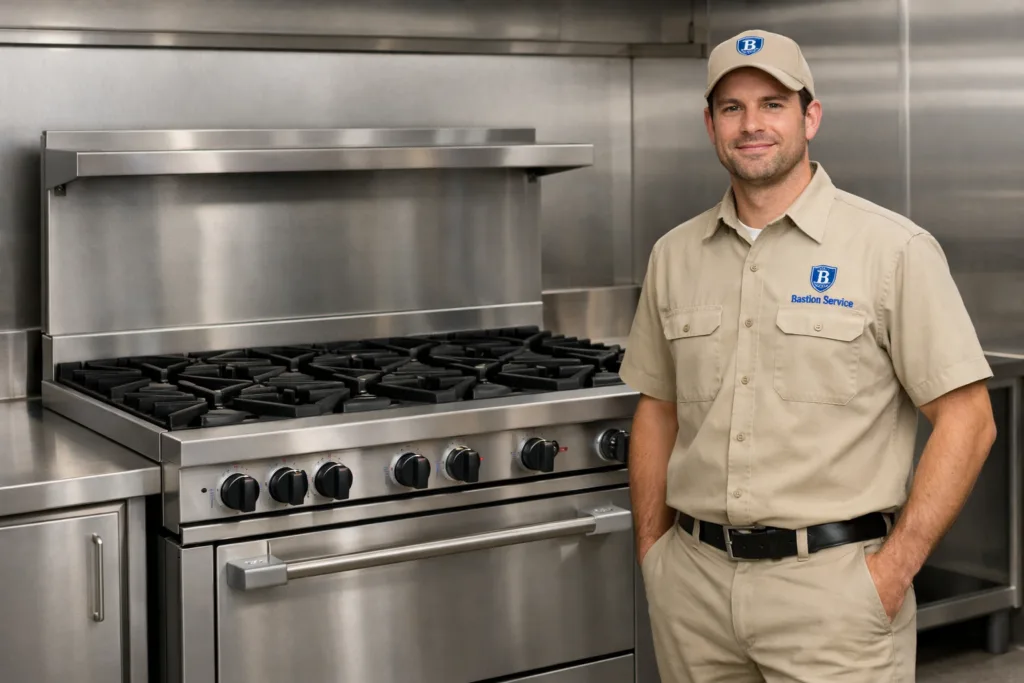




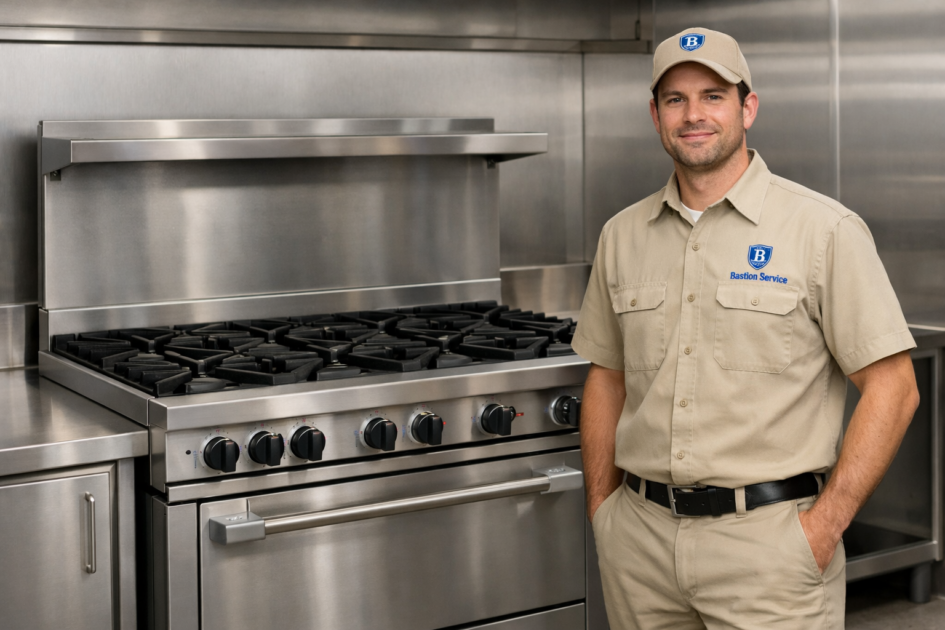
When a Vulcan fryer, oven, or range starts missing temperature, failing to ignite, or slowing production in Westwood, the fastest way to reduce disruption is to identify the actual failure and schedule repair around the kitchen’s operating demands. For restaurants, cafeterias, and other food-service businesses, service is not just about restoring heat. It is about determining whether the unit can keep running safely, whether output has already fallen below workable levels, and how quickly the problem is likely to spread into a larger shutdown.
For specific equipment paths in Westwood, review Vulcan Oven Repair in Westwood, Vulcan Range Repair in Westwood, and Vulcan Fryer Repair in Westwood.
Bastion Service works with businesses in Westwood that rely on Vulcan cooking equipment for daily service. When symptoms begin affecting consistency, timing, or line readiness, a service visit helps narrow the fault to the heating system, ignition components, gas delivery, controls, sensors, or other operating parts so the next step is based on how the equipment is actually behaving.
Common Vulcan Cooking Equipment Problems That Need Attention
Cooking equipment rarely goes from normal operation to total failure without warning. More often, the signs show up as uneven oven results, burners that do not stay steady, a fryer that takes too long to recover, or a unit that starts requiring resets to stay running. These patterns matter because they often point to developing issues that affect both production speed and food quality before the equipment stops completely.
Service becomes important when the problem is no longer occasional, when staff are building workarounds around the unit, or when the equipment is creating uncertainty during prep or service. Even if the machine still powers on, reduced performance can be enough to justify repair scheduling.
Heating and Temperature Control Problems
Temperature issues are some of the most common reasons businesses call for Vulcan cooking equipment repair in Westwood. Ovens may run hot, run cool, drift away from the set point, or heat unevenly across the cavity. Fryers may heat slowly, overshoot temperature, or fail to recover properly between loads. Ranges may produce inconsistent burner heat that makes timing difficult during active service.
These symptoms can come from several different sources, including failing thermostats, sensors, ignition components, control boards, gas regulation issues, worn heating parts, or calibration problems. Because the same symptom can have more than one cause, diagnosis is important before parts are ordered or replaced.
- Food cooks unevenly or requires longer than normal cook times
- Oil temperature drops too far during fryer use and recovers slowly
- Burners produce weak, unstable, or inconsistent heat
- The unit cycles erratically instead of maintaining a steady temperature
- Temperature settings no longer match actual cooking results
Once temperature control starts affecting output, the issue moves beyond inconvenience. It can lead to waste, remake volume, slower ticket times, and extra strain on components that are already beginning to fail.
Ignition, Burner, and Startup Faults
If a Vulcan unit does not light consistently, starts with delay, loses flame during operation, or shows burner performance that changes from one cycle to the next, the problem should be evaluated promptly. Startup faults often involve igniters, flame sensing, safety circuits, gas flow restrictions, burner assembly issues, or electronic controls.
Intermittent ignition is especially disruptive in business kitchens because it creates uncertainty. Staff may not know whether the unit will be ready at opening, whether it will hold through a rush, or whether it will shut down again after appearing to recover. In many cases, what looks like a minor startup issue is the beginning of a larger no-heat failure.
Service is usually warranted when ignition problems become repeatable, when burners do not light evenly, or when the equipment needs repeated attempts to start. Those conditions can affect line timing immediately and may also raise safety concerns that make continued use a poor choice.
Slow Recovery and Reduced Production Capacity
Some equipment failures are easy to spot because the unit stops working altogether. Others are more subtle but just as costly. A fryer that stays operational while recovering too slowly between batches, an oven that now needs extra time to reach usable temperature, or a range that has lost dependable burner output can all create significant bottlenecks without ever going fully down.
For businesses in Westwood, those slowdowns often show up as delayed ticket flow, prep backlogs, inconsistent batch timing, and pressure on nearby equipment to absorb the workload. In that situation, repair is not only about restoring operation. It is about restoring usable capacity.
When output has dropped, a service visit helps answer practical questions such as:
- Is the issue limited to one repairable component or part group?
- Has wear spread into multiple systems?
- Can the equipment stay in rotation while parts are sourced?
- Is the current slowdown likely to turn into a full outage soon?
How Symptom Patterns Help Guide Repair Decisions
Not every problem requires the same repair response. A single faulty igniter or control component may be straightforward to correct, while repeated shutdowns combined with temperature instability and burner issues may point to broader wear. Looking at the symptom pattern over time is often the best way to decide whether repair is likely to stabilize the unit or whether the equipment has reached a point where ongoing breakdowns are becoming too disruptive.
In general, repair is often a good path when the fault appears isolated, the unit has otherwise been operating well, and returning it to normal performance would restore dependable use. The decision becomes more complex when failures are stacking up, prior repairs have not solved the underlying problem, or the equipment is repeatedly interrupting production during critical hours.
Signs the Problem May Be Escalating
- Shutdowns are becoming more frequent
- The same issue returns shortly after recent service
- Temperature swings are now affecting product consistency daily
- Burner or ignition performance changes from shift to shift
- Staff must monitor the unit constantly to keep it usable
- The equipment causes recurring delays during peak production periods
When these signs are present, delaying service can increase both repair cost and operational impact. What starts as reduced performance can become a total outage at the least convenient moment.
When Continued Use Can Create Bigger Problems
It is common for kitchens to keep equipment in service while waiting for a slower window, but some symptoms should move the repair call higher on the schedule. Repeated ignition failures, overheating, unexplained shutdowns, unstable burner output, and major temperature drift are all signs that the equipment may no longer be reliable enough for normal use.
Continuing to run a fryer with weak recovery, an oven with erratic temperature control, or a range with inconsistent burner operation can create more than short-term inconvenience. It can contribute to product waste, service delays, and further wear on already stressed parts. In some cases, continued operation also makes diagnosis harder because secondary symptoms start appearing after the original fault has been ignored for too long.
If the unit is forcing workarounds, reducing confidence during service, or affecting food consistency, it is usually time to move from observation to repair planning.
What a Westwood Service Visit Helps Clarify
A service visit is useful because it gives your team a more direct answer on fault source, urgency, and next steps. That may include identifying whether the problem is tied to temperature sensing, heating performance, ignition failure, burner operation, gas-related components, or controls. It also helps determine whether the unit should remain in use, whether operation should be limited, and whether the repair path is likely to return the equipment to dependable performance.
For businesses in Westwood, timely service on Vulcan cooking equipment can help contain downtime before it affects more of the kitchen. When symptoms involve heating problems, ignition trouble, slow recovery, control faults, or repeated shutdowns, scheduling diagnosis is often the most practical next step for protecting output and organizing repair around daily operations.


