
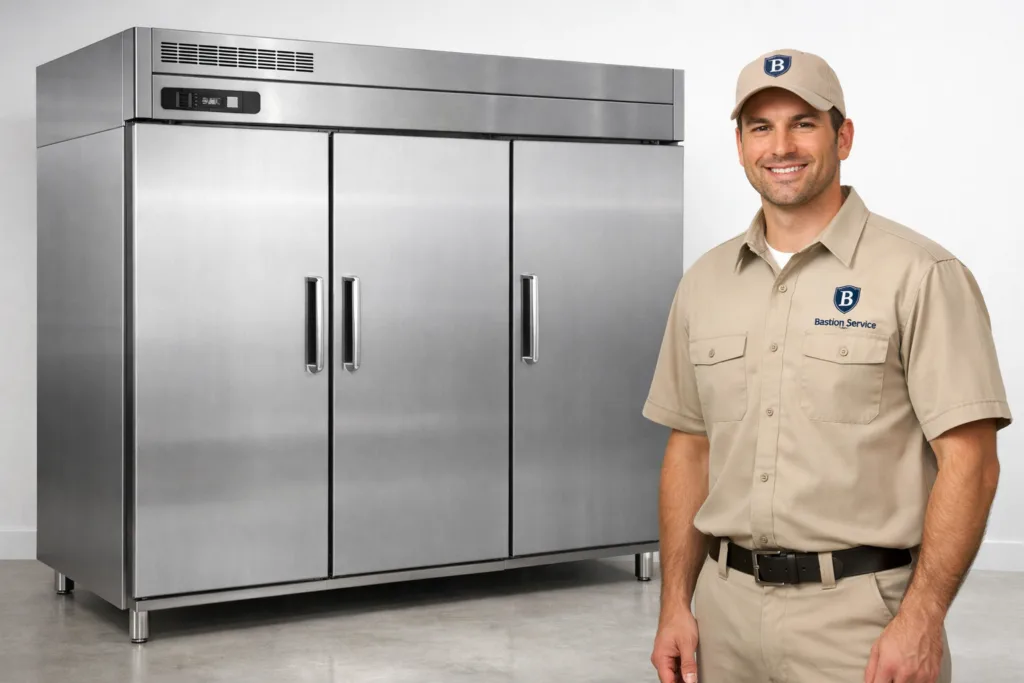




When Turbo Air refrigeration equipment starts affecting daily operations, service decisions need to happen quickly and with the actual symptom pattern in mind. A refrigerator that seems warm only during peak hours, a freezer with heavy frost, or a cabinet that runs nonstop may each point to a very different repair path. For businesses in Westwood, the goal is not just getting a unit looked at, but understanding whether it can keep operating, what failure is developing, and how repair scheduling should be handled to limit downtime.
For specific equipment paths in Westwood, review Turbo Air Refrigerator Repair in Westwood, Turbo Air Freezer Repair in Westwood, and Commercial Appliance Repair in Westwood.
Bastion Service works with Turbo Air refrigerator and freezer issues for businesses in Westwood that need timely troubleshooting, repair planning, and realistic next steps. That includes situations where equipment is still running but no longer performing consistently, as well as cases where cooling has dropped off enough to threaten stored product, workflow, or service capacity.
What Turbo Air refrigeration equipment problems do you troubleshoot?
Turbo Air refrigerator and freezer service often starts with one of a handful of business-disrupting symptoms: unstable temperature, warm cabinets, frost buildup, leaks, airflow complaints, recovery problems after the door opens, or unusual runtime and noise. While those symptoms can look straightforward from the outside, they may be tied to controls, fans, sensors, door sealing, defrost problems, drain issues, or refrigeration-system faults.
What matters most is how the equipment is behaving under normal use. A unit that cools overnight but struggles during the workday is different from one that never reaches target temperature at all. A freezer with surface frost is different from one icing over enough to block airflow. Troubleshooting focuses on the operating pattern, not just the visible symptom.
Refrigerator symptoms that usually need prompt repair
Warm cabinet temperatures
If a Turbo Air refrigerator is running but product temperatures are drifting upward, the cause may involve restricted airflow, dirty heat-rejection surfaces, fan motor problems, thermostat or sensor errors, door gasket wear, or a deeper cooling-system issue. Warm cabinet conditions should not be ignored simply because the unit still sounds active. In many cases, the refrigerator is working harder while delivering less cooling, which increases strain and raises the chance of a complete failure.
Uneven cooling from shelf to shelf
When some sections stay colder than others, staff may begin moving product around to compensate. That usually means airflow is no longer balanced the way it should be. Ice formation, blocked air paths, evaporator fan trouble, loading patterns, or control issues can all contribute. Uneven temperatures are especially important to address early because the problem often spreads from a small inconsistency to broader cooling loss.
Condensation and water around the cabinet
Moisture outside or inside a refrigerator may point to gasket leakage, drain restrictions, excessive humidity entering the cabinet, or temperature-control problems that cause the unit to cycle improperly. In a business environment, a leak is more than an inconvenience. It can create slip hazards, repeated cleanup, and hidden cabinet damage if the source is left unresolved.
Freezer symptoms that should be evaluated quickly
Heavy frost and ice buildup
A Turbo Air freezer with repeated frost accumulation may be dealing with a defrost failure, airflow restriction, fan problems, or warm air entering through a sealing issue. Thick frost changes how air moves through the cabinet and can eventually prevent the freezer from holding temperature evenly. If staff are scraping ice, forcing drawers or doors, or noticing frost returning soon after cleanup, the underlying problem usually needs repair rather than routine maintenance alone.
Slow pull-down and poor temperature recovery
Freezers should recover after loading and door openings within a reasonable period. If temperatures stay elevated too long, the equipment may be undersized for the current load, but it may also be losing performance because of airflow issues, coil conditions, controls, or failing refrigeration components. A freezer that recovers slowly often becomes more disruptive during busy periods, when frequent access exposes weak performance that is less noticeable during quiet hours.
Soft product or intermittent thawing concerns
When stored contents begin softening, refreezing, or showing signs of inconsistent holding temperature, service should be scheduled right away. Intermittent thaw conditions can stem from short cycling, sensor inaccuracies, defrost problems, or compressor-related performance loss. Even if the freezer later appears to return to normal, that swing in operation is a warning sign that should be evaluated before it turns into a full no-cool event.
Airflow, noise, and runtime changes often point to developing failures
Not every important refrigeration problem begins with obvious warmth. Many start as operational changes: fans sounding different, longer run cycles, hot exterior surfaces near the condensing section, or complaints that the unit never seems to shut off. These symptoms can indicate restricted airflow, fan motor wear, dirty components, control problems, or refrigerant-side performance issues.
New noises should also be taken seriously when they coincide with temperature drift or frost. Buzzing, rattling, clicking, or changes in fan sound may not identify the failed part by themselves, but they often help narrow down whether the issue is mechanical, airflow-related, or tied to the cooling system. For businesses in Westwood, these are often the signs that a manageable repair window is still available before operations are forced into emergency workarounds.
Why symptom-based diagnosis matters before repair approval
The same complaint can come from several very different causes. A warm refrigerator might have a door-seal problem, a failed evaporator fan, a sensor issue, or a more serious cooling-system fault. A frosted freezer might need defrost-related repair, airflow correction, or a fix for repeated warm air intrusion. Approving work based only on the visible symptom can lead to delays, unnecessary parts changes, or a unit returning to service without the actual problem being resolved.
Diagnosis helps answer the questions business operators usually care about most: whether continued use risks product loss, how quickly the condition is likely to worsen, whether parts may be needed, and whether the unit is still a good repair candidate. That makes the service visit more useful than a simple yes-or-no answer about whether the equipment is broken.
When continued operation may make the problem worse
Some refrigeration issues allow limited short-term operation. Others become more expensive the longer the unit is pushed. Service should be prioritized when any of the following are happening:
- Cabinet temperature will not hold consistently during normal use
- Frost buildup is blocking airflow or returning rapidly
- Water is leaking onto the floor or collecting inside the unit
- Staff are repeatedly adjusting controls to compensate for poor performance
- The unit runs continuously or short cycles abnormally
- Cooling recovery after door openings has become noticeably slower
- Noise changes appear alongside temperature or airflow problems
These conditions usually do not correct themselves. They tend to increase strain on other components, create avoidable disruption for staff, and make scheduling more urgent if the unit drops out of service completely.
Repair versus replacement considerations
Not every Turbo Air refrigeration problem points toward replacement. In many cases, the right repair can return a refrigerator or freezer to stable operation. The better question is whether the current issue is isolated or part of a larger pattern. Equipment age, repeat service history, cabinet condition, cooling performance after past repairs, and the role the unit plays in daily operations all matter.
If the fault is contained and the rest of the equipment is in solid condition, repair is often a practical choice. If failures are becoming frequent, temperatures remain inconsistent, or major system problems are showing up on an aging unit, it may make sense to compare repair scope against long-term reliability. A proper assessment helps businesses in Westwood make that decision based on actual condition rather than guesswork.
What to expect from a service-oriented next step
A useful repair visit should help clarify more than the failed symptom alone. It should show what is affecting performance, whether the equipment can continue operating in the short term, what risks come with delay, and how repair timing should be handled around business needs. That is especially important for refrigerators and freezers used every day, where even minor instability can affect inventory, prep flow, and staff efficiency.
If your Turbo Air refrigerator or freezer in Westwood is dealing with temperature drift, warm sections, frost buildup, leaks, airflow problems, or slow freezer recovery, the practical next step is to schedule service so the issue can be diagnosed and the repair plan can be set before the interruption expands further.


