
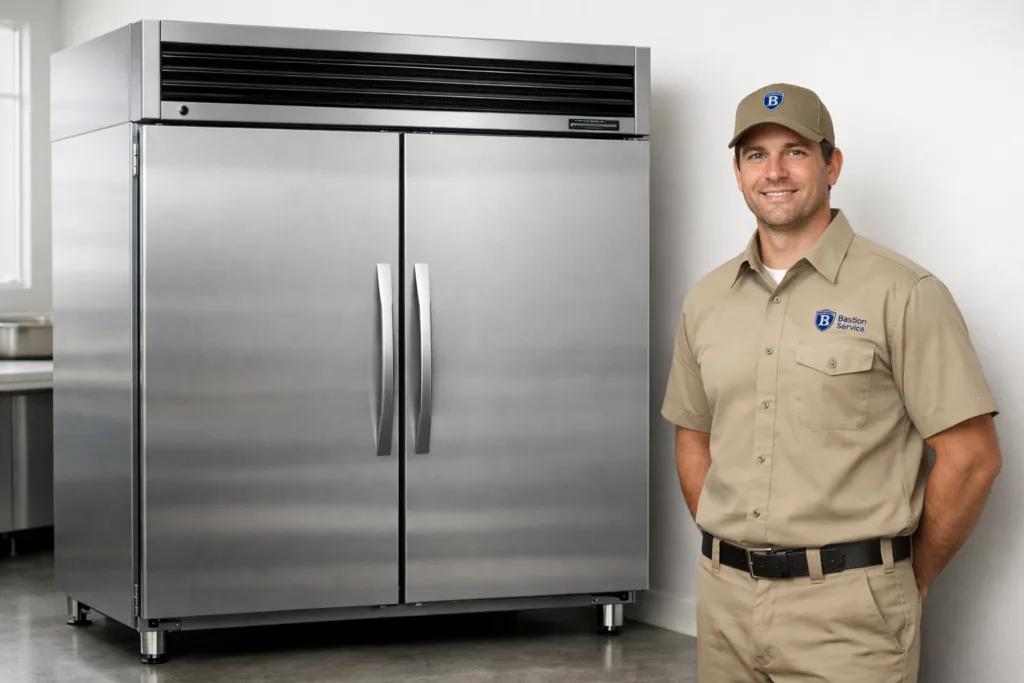




Equipment trouble usually starts as a small disruption and then turns into lost storage capacity, temperature uncertainty, or a full interruption to daily workflow. For businesses in Mid-City, scheduling service when a True refrigerator or freezer begins showing unstable performance can help limit downtime, protect inventory, and avoid the added strain that comes from letting the unit run in a failing condition. Bastion Service provides symptom-based diagnosis and repair scheduling for True refrigeration equipment used in day-to-day business operations.
For specific equipment paths in Mid-City, review True Refrigerator Repair in Mid-City, True Freezer Repair in Mid-City, and Commercial Appliance Repair in Mid-City.
What True refrigeration equipment problems do you troubleshoot?
Service calls often begin with one visible symptom, but the underlying cause can vary widely. True refrigeration equipment may need repair when a refrigerator runs warm, a freezer cannot recover temperature, frost returns quickly, airflow feels weak, water collects around the cabinet, or the unit starts making unusual sounds during normal operation.
Common issues that call for service include:
- Warm refrigerator compartments
- Freezers that soften product or recover too slowly after door openings
- Frost buildup on interior panels, coils, or around doors
- Water leaks, excess condensation, or recurring moisture inside the cabinet
- Evaporator fan or condenser fan performance problems
- Door gasket wear and poor door sealing
- Control, sensor, or thermostat-related temperature irregularities
- Constant running, short cycling, or sudden changes in run time
- Noisy operation, rattling, buzzing, or airflow changes
Because different faults can create similar symptoms, a repair decision is more reliable when it is based on how the equipment is actually behaving rather than on the symptom alone.
Refrigerator and freezer symptoms that should not be ignored
Warm cabinets and drifting temperature
When a refrigerator does not hold its expected temperature, the problem may involve poor airflow, dirty condenser surfaces, fan failure, a control problem, door leakage, or a sealed-system issue. In a freezer, temperature drift often shows up as soft product, frost changes, or much longer recovery after the door closes.
For businesses in Mid-City, temperature instability is one of the clearest signs that service should be scheduled promptly. Even if the unit is still running, cooling performance may be dropping enough to affect product quality and staff workflow.
Frost buildup and ice where it should not be
Frost is not just a cosmetic issue. In True freezers, recurring ice can point to defrost problems, air leaks, blocked airflow, sensor faults, or doors that are not sealing correctly. In refrigerators, moisture and light icing may signal similar airflow or sealing issues before the cabinet starts feeling obviously warm.
As frost spreads, it can block air movement and force the system to run longer. That often leads to uneven cooling, stressed components, and a repair that becomes more involved than it needed to be.
Leaks, condensation, and water on the floor
Water inside or under the unit may be tied to clogged drainage, ice melt, door seal failure, excess humidity entering the cabinet, or a cooling problem that is changing how moisture behaves inside the equipment. A recurring leak should be treated as an equipment problem, not only a cleanup issue.
For a busy kitchen or storage area, that moisture can create safety concerns for staff while also indicating that the refrigerator or freezer is no longer operating as it should.
Weak airflow and uneven cooling
If one section of the cabinet feels colder than another, or if airflow seems reduced, the issue may involve fan operation, evaporator icing, internal blockage, or control-related problems affecting circulation. Uneven cooling often shows up before a complete cooling failure, especially in units that are opened frequently during service hours.
When airflow changes are ignored, the result is often inconsistent cabinet performance that becomes harder to manage with product loading alone.
Constant running, short cycling, and abnormal noise
A refrigerator or freezer that runs nonstop, cycles much more often than usual, or suddenly becomes noisy may be signaling airflow restriction, component wear, mounting issues, fan trouble, or declining cooling efficiency. Buzzing, rattling, or changes in operating sound do not always mean immediate shutdown, but they often point to a condition that is getting worse.
In business settings, those warning signs matter because they can appear days or weeks before a no-cool event.
How these problems affect day-to-day operations
True refrigeration equipment supports product storage, prep flow, service timing, and back-of-house organization. When the equipment becomes unreliable, the problem reaches beyond the cabinet itself. Staff may need to relocate product, monitor temperatures more often, reduce use of a section, or work around leaks and icing until service is completed.
That is why repair timing matters. Early service may prevent a single failing part or restricted airflow condition from turning into larger downtime, more inventory risk, or a broader interruption to operations.
When to schedule repair right away
Prompt service is usually the best choice when any of the following is happening:
- The cabinet will not return to normal temperature after loading or door openings
- The freezer is no longer recovering properly
- Frost returns soon after being cleared
- Water leakage keeps coming back
- Airflow feels weak or inconsistent
- The unit is running nearly all the time
- Noise levels have changed noticeably
- There is uncertainty about whether product is being held safely
If the unit is clearly struggling, continuing normal use can increase wear on major components and make the final repair more disruptive than addressing the problem earlier.
Repair decisions depend on the symptom pattern
Not every warm cabinet points to the same type of repair, and not every frost complaint means the same failed part. One unit may need a fan-related repair or door-seal correction, while another may show signs of a deeper cooling-system problem. Looking at temperature behavior, frost location, leak pattern, runtime, and noise changes together gives a better picture of what the equipment needs.
That kind of symptom-based approach is especially useful for businesses managing refrigerator and freezer equipment that cannot stay down longer than necessary. It helps with scheduling, parts planning, and deciding whether limited short-term use is realistic before the repair is completed.
Repair versus replacement
Some True units can be returned to stable operation with a focused repair. Others may raise broader questions because of age, repeated failures, operating condition, or the extent of the cooling issue. The goal of service is not to force one outcome, but to determine what makes the most sense for the equipment and the business using it.
That evaluation becomes more practical when it is based on actual operating symptoms rather than guesswork. A leak, warm cabinet, or icing complaint on its own does not tell the full story, but diagnosis can show whether the issue is isolated and repairable or part of a larger pattern of decline.
Next step for businesses in Mid-City
If a True refrigerator or freezer is running warm, icing over, leaking, losing airflow, or no longer keeping up with normal use, the most useful next step is to arrange service before the problem creates longer downtime. A scheduled repair visit helps identify the fault, clarify whether the equipment should remain in use, and set a practical path toward restoring normal operation.


