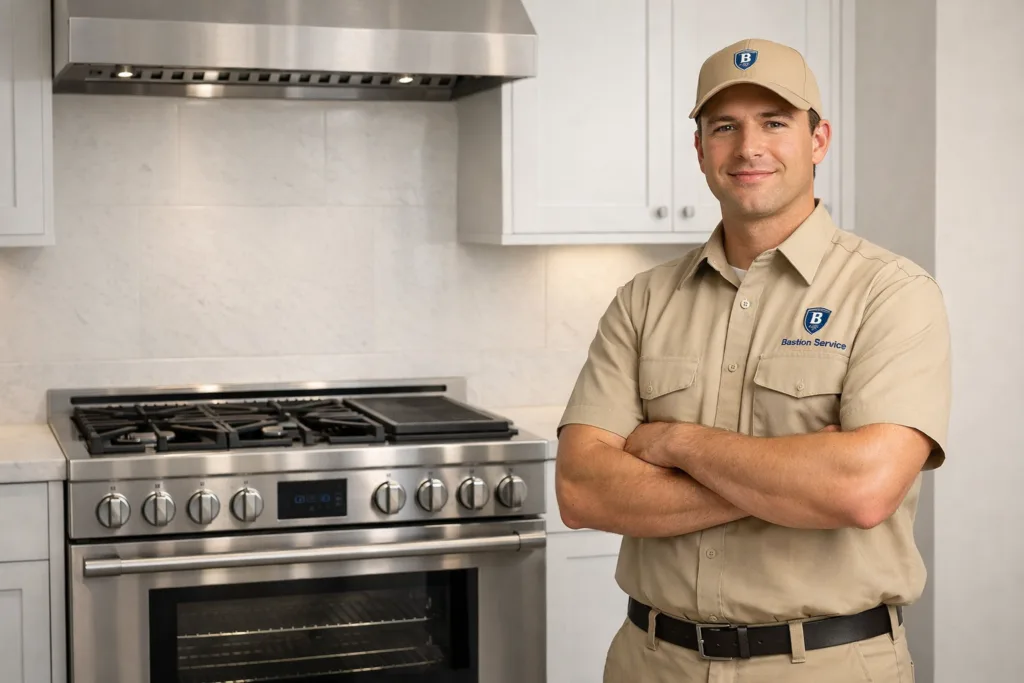
Thermador ranges are built for precise cooking, so even a small change in burner performance or oven temperature is usually noticeable right away. If dinner takes longer than usual, a burner starts clicking nonstop, or the oven browns unevenly, the symptom itself is the best starting point for figuring out what has failed.
Related Thermador and range service paths in Century City include Thermador Appliance Repair in Century City, Range Repair in Century City, and Thermador Refrigerator Repair in Century City.
What the symptom usually points to
Range problems are rarely solved well by guessing. The same complaint can come from different parts of the appliance, and the right repair depends on whether the issue is tied to ignition, heat production, gas flow, sensors, controls, or electrical supply. Paying attention to when the problem happens helps narrow the cause much faster.
- Burner clicks but does not light: often related to the igniter, burner cap placement, moisture, debris in burner ports, or the spark system.
- Burner lights slowly or unevenly: may involve partial blockage, weak ignition, or an issue affecting flame stability.
- Oven takes too long to preheat: commonly linked to a weak igniter, temperature sensor problem, or a heating circuit fault.
- Food bakes unevenly: can point to temperature drift, airflow issues, calibration trouble, or a component not cycling correctly.
- Display or controls act erratically: may involve the control board, keypad, wiring connections, or incoming power problems.
Cooktop burner issues on a Thermador range
Burner trouble often shows up as a clicking sound, delayed ignition, a weak flame, or a burner that works only sometimes. On a Thermador range, those symptoms should be checked carefully because they do not all come from the same source.
Clicking without ignition
If you hear repeated clicking but the burner does not light, the igniter may be sparking without proper gas ignition, or the burner parts may not be seated correctly. This can also happen after cleaning if a cap is slightly off-center or moisture remains around the ignition area. When the problem keeps returning during normal use, it is more likely to be a component issue than simple reassembly.
Weak, uneven, or unstable flame
A burner flame should be consistent and predictable. If it looks too low, flares too high, or seems patchy around the burner, the issue may involve clogged ports, burner wear, or gas delivery irregularities. Continued use can affect cooking results and may put extra strain on ignition parts.
One burner works, another does not
When only one burner is affected, that often helps isolate the problem to a specific burner assembly, igniter, switch, or local wiring path rather than the entire appliance. When multiple burners begin misbehaving at the same time, the diagnosis may shift toward a shared ignition or electrical issue.
Oven heating problems and uneven cooking
Oven complaints are often described as “not hot enough,” “too hot,” or “not cooking evenly,” but those broad descriptions can hide important differences. A range that never reaches temperature is different from one that reaches temperature and then drifts far off target.
Oven will not heat properly
If the oven struggles to preheat or never gets fully hot, a weak igniter is a common cause on gas models. Other possibilities include sensor faults, control issues, or failures in the heating circuit. This kind of problem is especially noticeable with baking, where foods come out pale, underdone, or inconsistent from one rack to another.
Oven overheats or burns food
An oven that runs hotter than the setting can cause scorched bottoms, overbrowned tops, and shortened cooking times that make recipes unreliable. This may point to a temperature sensor problem, calibration error, or control failure. Overheating should not be ignored, especially if the range seems to continue heating beyond normal operation.
Uneven results from front to back
When one side of a pan cooks faster than the other, the issue may involve heat distribution, sensor accuracy, or a component that is not cycling properly. Thermador owners often notice this quickly because the expected cooking performance is usually very consistent when the range is working correctly.
Control panel, display, and intermittent faults
Electronic symptoms can be some of the most frustrating because they may disappear during casual testing and return later. A control panel that resets, shows error codes, stops responding, or only works part of the time needs more than a quick part swap.
Intermittent range problems often depend on timing. If the issue appears only during preheat, only after the oven has been running for a while, or only when certain burners are in use, that pattern matters. In Century City homes, documenting what the appliance does before it fails can make service much more efficient.
Signs the range should not keep being used
Some symptoms are more than an inconvenience and should be addressed promptly. Using the range in that condition may lead to additional damage or create avoidable safety concerns.
- Repeated ignition failure
- Visible sparking outside normal burner ignition
- Persistent clicking after the burner is lit
- Strong or unusual odors during operation
- Oven overheating or shutting off unexpectedly
- Tripped breakers related to range use
- Controls changing settings on their own or failing unpredictably
If there is a persistent gas smell, stop using the appliance and address that safety issue first. A burner that clicks repeatedly without lighting may be repairable, but a strong gas odor should never be brushed off as a minor nuisance.
When repair makes sense
Many range problems are repairable when the fault is limited to ignition parts, sensors, switches, controls, or other serviceable components. Repair is often the better choice when the appliance is otherwise in good condition and the failure has not spread into multiple major systems.
Replacement becomes more worth considering when the range has several major issues at once, heavy wear, recurring breakdowns, or a repair cost that is hard to justify against the age and condition of the unit. The decision is usually strongest when based on the actual symptom pattern and overall appliance condition, not just on one bad cooking experience.
How homeowners in Century City can help speed up diagnosis
Before service is scheduled, a few observations can be useful. You do not need to diagnose the range yourself, but noticing the pattern can help identify the likely repair path.
- Which burner or oven function is affected
- Whether the issue is constant or intermittent
- If the problem started after cleaning, self-cleaning, or a power interruption
- Whether the oven temperature seems low, high, or unstable
- If clicking continues after ignition or stops normally
- Any error code or display behavior shown on the control panel
Scheduling service at the right time
It is smart to arrange service once basic checks no longer help, the range becomes unreliable for daily cooking, or the symptom appears to be getting worse. Problems involving ignition, heating, or controls often start small and become more disruptive over time.
For Century City homeowners, the most useful visit is one that connects the symptom to the actual failed part or system and explains whether repair is the sensible next step. That kind of symptom-based evaluation helps avoid unnecessary guesswork and gives you a repair plan that fits how the Thermador range is actually failing.