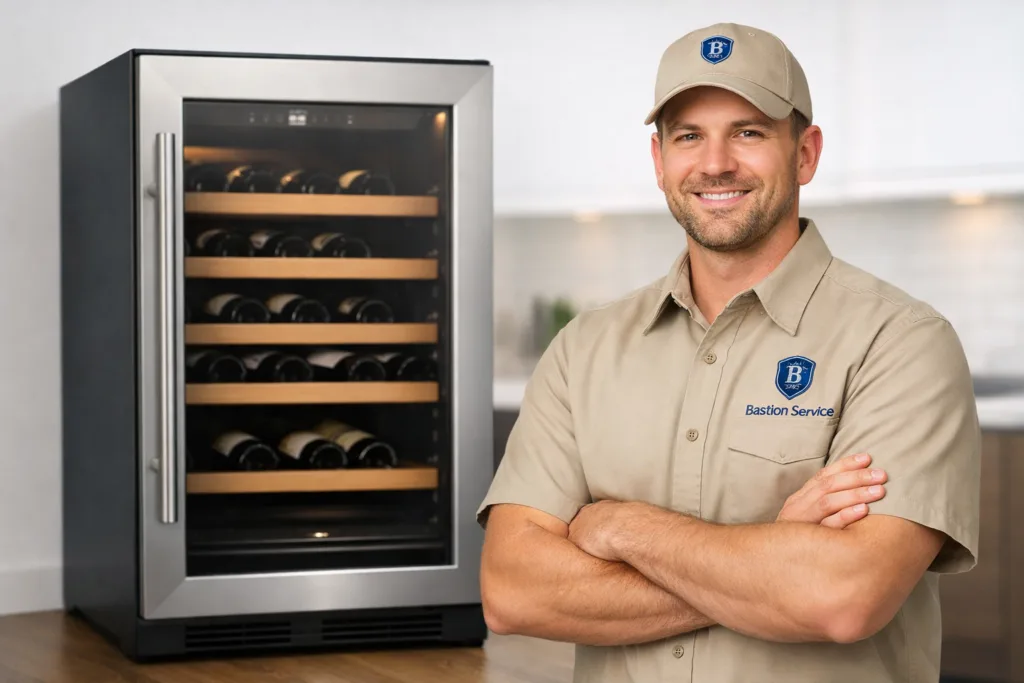
Stable storage matters with wine, which is why even a small change in cabinet temperature, humidity, or airflow can turn into a bigger problem than it first appears. In Century City homes, Summit wine coolers are often serviced for warm interiors, inconsistent cooling, moisture buildup, fan noise, and controls that no longer respond the way they should. The most useful approach is to match the symptom pattern to the likely failure instead of assuming every cooling complaint points to the same part.
Related Summit and wine cooler service paths in Century City include Summit Appliance Repair in Century City, Wine Cooler Repair in Century City, and Summit Refrigerator Repair in Century City.
Common Summit wine cooler problems in Century City homes
Wine coolers usually show trouble gradually. A unit may start taking longer to recover after the door is opened, run more often than it used to, or develop condensation around the glass and door frame. These early changes can point to airflow restrictions, sensor drift, fan trouble, seal problems, or control issues before a complete loss of cooling happens.
Because wine storage depends on consistency, a cooler that is only slightly off can still be a concern. A cabinet that remains cool but swings too much from one cycle to the next may need service just as much as one that stops cooling altogether.
Running warm or not holding the set temperature
If a Summit wine cooler is warmer than the display suggests, several issues may be involved. Weak evaporator or condenser airflow, a control board problem, a faulty temperature sensor, dirty heat-dissipation areas, or a sealed-system fault can all affect how well the unit maintains its range. In some cases, the cabinet cools, but not accurately enough for long-term storage.
Homeowners often notice this as:
- Bottles feeling warmer than expected
- Temperature drifting up during the day
- One shelf cooling differently than another
- The display reading normally while the interior does not match
When cooling is uneven rather than completely absent, the repair path is often different from a full no-cool condition. That is why symptom details matter.
Constant running or short cycling
A cooler that seems to run all the time is not necessarily maintaining proper storage conditions. It may be struggling to recover because of poor ventilation, a weak fan, warm air entering around the gasket, or a control issue that keeps the system operating longer than needed. On the other hand, rapid starts and stops can indicate sensor errors, electrical faults, or component stress.
If a Summit unit in Century City has suddenly changed its cycle pattern, it is worth checking before extra runtime leads to more wear on the cooling system.
Condensation, fogged glass, or water under the unit
Moisture problems are common with wine coolers and can come from more than one source. A worn or uneven door gasket can let humid air enter the cabinet. A drainage issue can leave water where it should not collect. Door alignment problems may create a small sealing gap that is easy to miss but large enough to disrupt stable operation.
Common signs include:
- Water pooling near or under the cooler
- Persistent condensation on the glass
- Moisture on shelves or cabinet walls
- A door that appears shut but does not seal tightly
These issues are not just cosmetic. Extra moisture can make the cooler work harder and can contribute to unstable internal conditions over time.
Fan noise, buzzing, rattling, or vibration
Some operating sound is normal, but new noise usually means something has changed. A rattling panel, obstructed fan blade, worn motor, leveling problem, or compressor-related vibration can all alter how the unit sounds. The type of noise often helps narrow the diagnosis.
For example, a light rattle may point to mounting or leveling, while a sharper buzzing or repeated clicking may suggest a component under strain. When the sound is new and repeats with each cycle, it should not be ignored.
Display, control, or sensor issues
When controls stop responding correctly, temperatures may become unreliable even though the cooler still appears to run. A Summit wine cooler may show inconsistent readings, fail to change settings properly, or cool at the wrong level because the control system is not interpreting cabinet conditions accurately.
Signs of a control-related issue can include:
- Set temperatures not matching actual cabinet temperature
- Erratic or blank display behavior
- Unexpected cycling patterns
- Cooling that changes without any setting adjustment
What homeowners can notice before service
A few simple observations can make diagnosis more efficient. It helps to note whether the cabinet is uniformly warm or only warm in certain areas, whether moisture appears after every door opening or remains constant, and whether the noise occurs during startup, while running, or when shutting off. If the door requires extra pressure to close or rebounds slightly, that can also be relevant.
These details do not replace service, but they can help identify whether the likely problem involves airflow, sealing, controls, or the cooling system itself.
When repair is worth scheduling promptly
It makes sense to arrange service when the cooler no longer maintains a stable range, develops recurring condensation, starts making sharp new noises, or runs far more than normal. Service is also a good idea when recovery becomes slow after the door is opened, since that can be one of the earlier signs of declining performance.
Waiting can make some problems worse. A struggling fan motor can affect temperature balance, a poor seal can increase runtime, and an unresolved control issue can create unnecessary stress on other components. Water leaks should also be addressed quickly to avoid damage around the appliance.
Repair versus replacement for a Summit wine cooler
Whether repair makes sense depends on the exact failure, the age of the unit, the cabinet condition, and whether the cooler has a history of repeated problems. Issues involving fans, sensors, controls, gaskets, drainage, and some electrical components are often more straightforward than major cooling-system failures. If the appliance has had ongoing temperature instability or multiple breakdowns, replacement may be the better long-term choice.
For many Century City homeowners, the goal is not simply to get the cooler running again, but to restore consistent storage conditions without stepping into repeat repairs. That is where a practical repair plan based on the actual fault becomes most helpful.
Why symptom-based diagnosis matters
Two wine coolers can show the same basic complaint and still need very different repairs. One unit that feels warm may have a door sealing issue, while another may have a sensor problem or a deeper cooling-system fault. Replacing parts by guesswork can add cost without restoring stable performance.
Summit Wine Cooler Repair in Century City is most effective when the service process focuses on how the appliance is behaving in real use: how it cools, how it cycles, where moisture appears, and what has changed from normal operation. That kind of inspection helps clarify whether the problem is minor, developing, or serious enough to reconsider continued use.