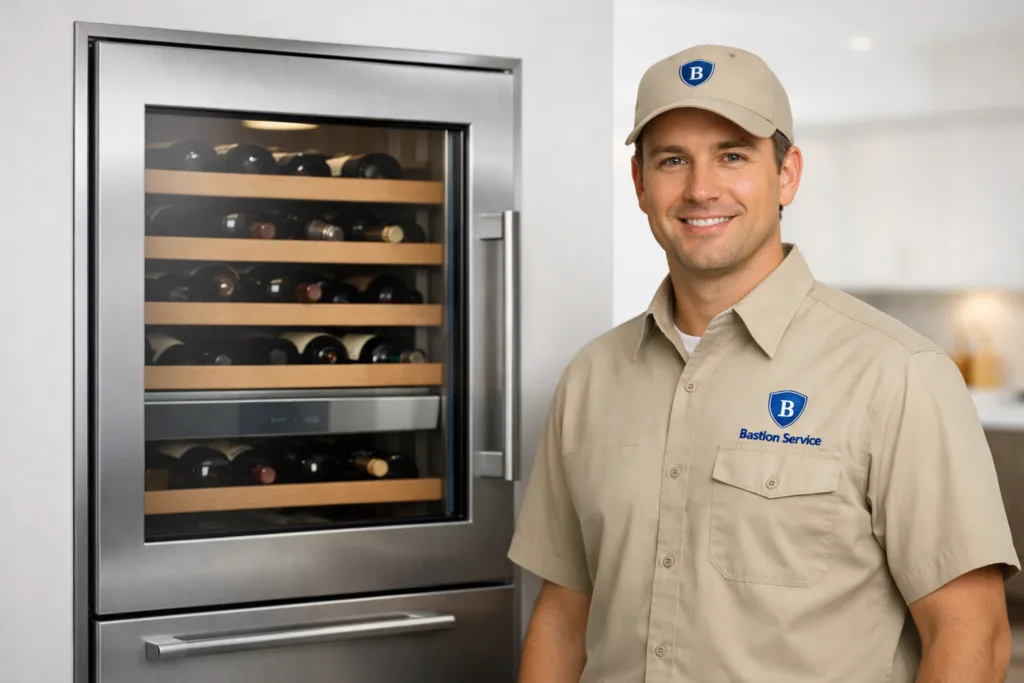
A wine cooler that stops protecting a stable storage environment can quietly put an entire collection at risk. With Sub-Zero units, the same outward symptom can come from very different causes, so the most useful approach is to match what you are seeing, hearing, and feeling to the system most likely involved.
Related Sub-Zero and wine cooler service paths in Century City include Sub-Zero Appliance Repair in Century City, Wine Cooler Repair in Century City, and Sub-Zero Refrigerator Repair in Century City.
Common Sub-Zero wine cooler symptoms in Century City homes
Most homeowners notice a problem in one of a few ways: the cabinet feels warmer than normal, temperatures drift without explanation, moisture appears inside, or the unit starts making unfamiliar noise. Some coolers run almost nonstop, while others seem to stop cycling often enough. A door that does not close cleanly or a display that behaves erratically can also be an early sign that service is needed.
Temperature swings or a cabinet that feels too warm
If your wine cooler is on but not holding a steady temperature, the issue may involve the temperature sensor, thermostat function, evaporator fan, condenser airflow, or a more serious cooling-system fault. In some cases, the unit is cooling, but not recovering properly after the door is opened. In others, warm air is leaking in through a worn gasket or a door that sits slightly out of alignment.
Signs that point to a true cooling problem include:
- Bottles consistently feeling warmer than usual
- The temperature display not matching actual cabinet conditions
- Long run times with poor cooling results
- Uneven cooling from one shelf area to another
Condensation, fogging, or moisture inside
Moisture is often dismissed as a minor nuisance, but it usually means the cooler is not managing air movement or sealing correctly. Condensation on the glass, droplets on shelves, or dampness near the door can come from a compromised gasket, a door closure issue, blocked drainage, or an internal airflow imbalance.
Left unresolved, extra moisture can lead to odors, stained interior surfaces, and additional strain on cooling components that are already working harder than they should.
Buzzing, clicking, rattling, or louder-than-normal operation
Sub-Zero wine coolers do make normal operating sounds, but a noticeable change matters. A new rattle may be something simple such as vibration or a loose panel. A persistent buzz or clicking pattern can point to a fan problem, compressor stress, or an electrical/control issue. Sound changes are especially important when they appear alongside weak cooling or longer run times.
The unit runs constantly or barely runs at all
Constant running usually means the cooler is struggling to remove heat efficiently. Dirty condenser areas, restricted ventilation, gasket leaks, fan issues, and cooling-system problems can all create that pattern. If the unit hardly runs, starts and stops abnormally, or appears unresponsive, the cause may involve controls, sensors, power supply issues, or electronic components.
Why symptom overlap makes proper testing important
A warm cabinet does not always mean compressor failure. Moisture around the door does not automatically mean the gasket is the only problem. Noise does not always point to a major mechanical repair. Because these symptoms overlap, replacing parts based on a guess can waste time and money without solving the issue.
Useful testing typically focuses on actual cabinet temperature, fan operation, control response, airflow, door seal condition, and whether the unit is rejecting heat the way it should. That process helps separate a targeted repair from a larger problem that may affect the long-term value of the appliance.
Problems that should not be ignored
Some changes in performance can be monitored briefly, but others are worth addressing right away. Service should be scheduled sooner rather than later if you notice:
- Rapid or repeated temperature loss
- Heavy condensation that keeps returning
- The cooler running for very long periods without reaching set temperature
- New clicking or buzzing accompanied by weak cooling
- A door that no longer seals with a firm, even contact
- Controls or display behavior that seems inconsistent or unresponsive
Continuing to operate the unit in those conditions can add wear to other components and sometimes turns a smaller repair into a broader one.
What specific symptoms can suggest
If the wine cooler is cool at the bottom but warm at the top
This often suggests an airflow problem inside the cabinet. The evaporator fan may not be moving air properly, vents may be obstructed, or the system may be cooling unevenly due to sensor or control issues.
If the glass fogs up frequently
Frequent fogging usually points to warm air intrusion or humidity management problems inside the cooler. Door gasket wear, slight misalignment, or repeated failure to seal fully are common reasons.
If the display works but cooling does not
When controls appear active but the cabinet does not cool correctly, the problem may be behind the interface rather than in the display itself. Sensors, relays, fan circuits, and cooling components may need to be checked rather than assuming the panel is the main failure.
If the unit restarts often
Short cycling can indicate control problems, overheating, airflow restrictions, or strain within the cooling system. This pattern is worth attention because repeated starts can increase wear over time.
Repair versus replacement for an older Sub-Zero wine cooler
Many wine cooler issues are still sensible to repair, especially when the problem is limited to a fan motor, sensor, control-related part, door gasket, or drainage issue. Those repairs can restore proper storage conditions without turning into a major project.
Replacement becomes more likely when the unit has a major sealed-system problem, a history of repeat breakdowns, or overall wear that makes additional repair hard to justify. Age alone is not the only factor. The better question is whether the repair meaningfully restores reliable temperature control without leaving multiple unresolved concerns behind.
What homeowners should do before service
Before a visit, it helps to note a few details:
- Whether the cabinet is warm all the time or only intermittently
- If moisture appears after every door opening or even when left closed
- What kind of sound changed and when it started
- Whether the display temperature matches how the bottles actually feel
- If the door seems loose, uneven, or harder to close than before
Those observations often make diagnosis faster and help narrow down whether the issue is related to sealing, airflow, controls, or cooling performance.
What a focused service visit should accomplish
A worthwhile appointment should do more than confirm that the cooler is malfunctioning. It should identify the most likely failed component or system, explain how that relates to the symptom pattern, and clarify whether repair is appropriate based on the unit’s condition. For a built-in Sub-Zero wine cooler, that usually means evaluating airflow, temperature response, fan operation, controls, gasket condition, and any ventilation or fit issues affecting performance in the home.
For Century City homeowners, that kind of practical repair guidance makes it easier to decide whether to move forward with a targeted fix, pause use until repairs are completed, or consider replacement if the problem is larger than expected.