
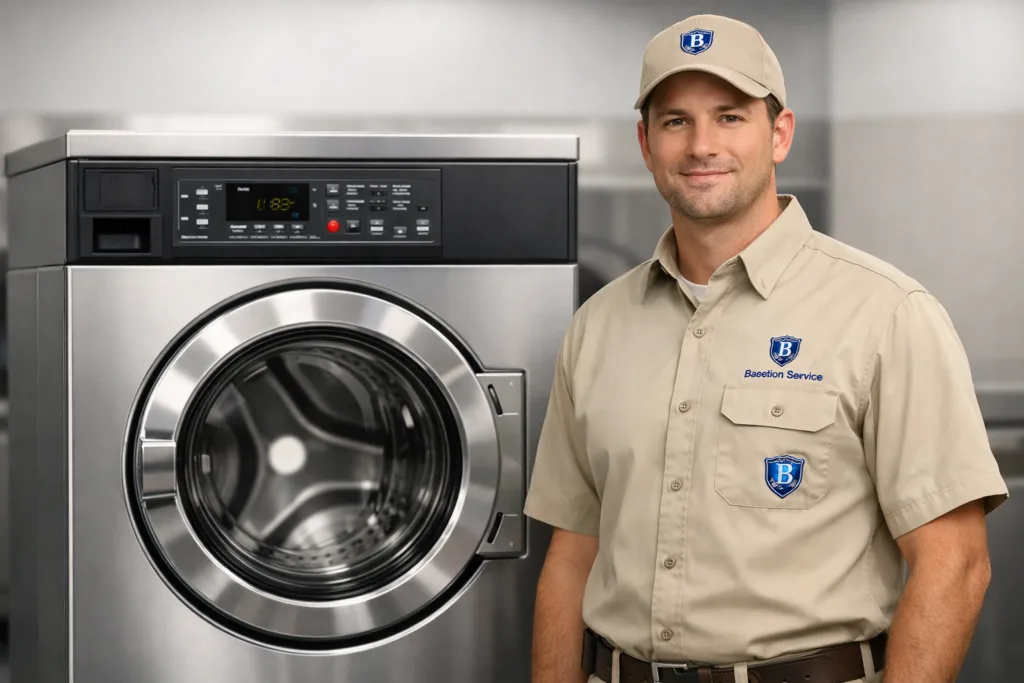




Washer downtime can ripple through staffing, linen turnover, cleanup routines, and customer-facing operations. When a Speed Queen washer begins stopping mid-cycle, failing to drain, leaking, or producing poor wash results, the best next step is service that identifies the actual failure before more loads are affected. Bastion Service helps Fairfax businesses evaluate symptom patterns, confirm the cause, and schedule repair based on how urgently the washer is affecting daily operations.
Related commercial service paths in Fairfax include Speed Queen Commercial Repair in Fairfax, Commercial Washer Repair in Fairfax, and Speed Queen Dryer Repair in Fairfax.
Common Speed Queen Washer Problems Seen in Fairfax
Heavy-use laundry equipment often shows warning signs before a full breakdown. On Speed Queen washers, several symptom groups tend to point technicians toward specific systems such as drainage, fill, drive, locking, controls, or support components. Knowing what the machine is doing wrong helps narrow the repair path quickly.
Washer not starting or not completing the cycle
If the washer will not respond when a cycle is selected, starts inconsistently, or shuts down before completion, the problem may involve the control board, user interface, door or lid lock assembly, wiring, or incoming power. In some cases, the machine appears to start but pauses when it cannot verify a lock condition, water level, or drain status. A unit that fails only on certain cycles or under heavier loads still needs attention, because intermittent faults often become complete no-start failures.
Drainage problems and standing water
A Speed Queen washer that leaves water in the tub, drains slowly, or times out during the drain portion of the cycle may have a blocked drain path, failing drain pump, damaged hose, or restriction affecting water flow out of the machine. Weak drainage often leads to secondary complaints such as poor spin performance, extended cycle times, and loads coming out too wet for the next step in the laundry process.
Weak spin or wet loads after cycle completion
When items come out heavier than normal, the issue is not always the spin system alone. Poor extraction can be related to drainage restrictions, load sensing issues, suspension wear, belt or drive problems, or a control fault that prevents the washer from reaching proper spin speed. For businesses in Fairfax, this symptom often creates downstream delays because dryers have to run longer and staff spend more time handling loads that should have been properly extracted.
Excessive vibration, banging, or unusual noise
Loud spin cycles, cabinet striking, grinding, or repeated out-of-balance behavior can point to worn support parts, bearing wear, drive component problems, or installation-related movement that becomes more obvious under repeated use. If the sound is getting worse, the machine should not be forced through additional cycles without inspection. Continued operation can increase wear and turn a contained repair into a larger mechanical issue.
Slow filling, no fill, or temperature inconsistency
If the washer takes too long to fill, fills with the wrong water temperature, or fails to reach the expected water level, the cause may involve inlet valves, clogged screens, supply restrictions, control issues, or sensors that are not reading properly. These problems can affect cycle timing, detergent performance, and overall wash quality, especially when consistent results matter across repeated loads.
Leaks around the washer
Water on the floor may come from supply hoses, internal hoses, pump connections, door or lid sealing points, drain components, or overfill conditions. Even when the leak appears minor, repeated moisture around the base of the machine should be addressed quickly. Leaks can create slip hazards, flooring damage, and added strain on nearby equipment areas.
How Symptom Patterns Help Identify the Real Failure
Washer problems rarely present as neatly as a single failed part. A machine that will not spin may actually be failing to drain. A unit that stops mid-cycle may be reacting to a lock fault or a fill problem. A complaint about poor wash results may be tied to low water intake or incorrect temperature rather than agitation itself.
This is why the symptom pattern matters. Helpful details include whether the issue happens on every load or only some loads, whether the problem appears at the same point in the cycle, whether staff hear unusual sounds, and whether any water remains in the tub after shutdown. Those clues make it easier to separate a control issue from a mechanical one and to decide whether the machine should stay out of service until repairs are completed.
When to Schedule Repair Instead of Waiting
Some washer issues begin as minor disruptions but quickly become operational problems. If employees are adjusting load sizes, repeating cycles, moving work to other machines, or mopping up recurring leaks, the washer is already affecting labor and throughput. Scheduling service early often reduces the chance of a larger breakdown during a busy period.
It makes sense to arrange repair when you notice any of the following:
- The washer repeatedly fails to start or stops before the cycle ends
- Water remains in the tub after the cycle
- Loads come out unusually wet
- Noise or vibration is increasing from one day to the next
- Water is leaking around or beneath the machine
- Fill times are slowing down or temperature results are inconsistent
- Wash quality has dropped even when loading practices have not changed
If the same complaint is coming from multiple staff members or across multiple shifts, that usually indicates an established fault rather than a one-time loading issue.
Problems That Should Not Be Ignored
Some conditions carry a higher risk of additional damage if the washer stays in use. Grinding noises, repeated hard impacts during spin, visible leaks, electrical intermittency, and incomplete draining all deserve prompt attention. Running the machine in that condition can increase wear on related parts and may create a longer outage later.
A washer with control interruptions can also become more difficult to manage over time. What starts as an occasional restart or random stop may turn into a total failure to begin a cycle. Addressing the problem while the symptom is still consistent can make diagnosis faster and help Fairfax businesses plan around the repair more effectively.
Repair Decisions Based on Uptime, Condition, and Failure Severity
Whether a Speed Queen washer should be repaired depends on the nature of the failure and the condition of the unit overall. Many washers are good repair candidates when the problem is limited to a pump, valve, lock mechanism, support part, or another serviceable component. In those cases, restoring normal function can be the most efficient option for keeping laundry operations on track.
Replacement becomes a more serious consideration when the machine has multiple active problems, extensive wear, recurring breakdown history, or structural issues that make continued investment harder to justify. The right decision comes from evaluating the specific symptom set, the expected scope of work, and how essential that washer is to daily output.
What to Have Ready Before a Service Visit
A little preparation can speed up the appointment and help narrow the diagnosis. If possible, have the model information available and note what the machine is doing at the point of failure. It also helps to know whether the issue happens with every load, whether any error indication appears, and whether the problem began suddenly or developed over time.
Useful observations include:
- Whether the washer fills, agitates, drains, and spins normally or fails at one specific stage
- If water remains inside after shutdown
- Whether leaks appear only during fill, wash, drain, or spin
- What kind of noise is present: grinding, banging, humming, or scraping
- Whether the problem is load-dependent or present even with lighter use
Those details help connect the complaint to the most likely system and can reduce delays during troubleshooting.
Service That Supports Daily Operations
For businesses in Fairfax, washer repair is not just about getting a machine to power back on. It is about restoring predictable laundry output, reducing disruption to staff, and making a sound decision about next steps. When a Speed Queen washer starts failing, slowing down, or producing inconsistent results, timely service helps protect workflow and avoid a more expensive interruption later.
If your washer is leaking, not draining, stopping mid-cycle, or leaving loads too wet, scheduling repair promptly gives you the best chance to contain downtime and return the machine to reliable use.


