
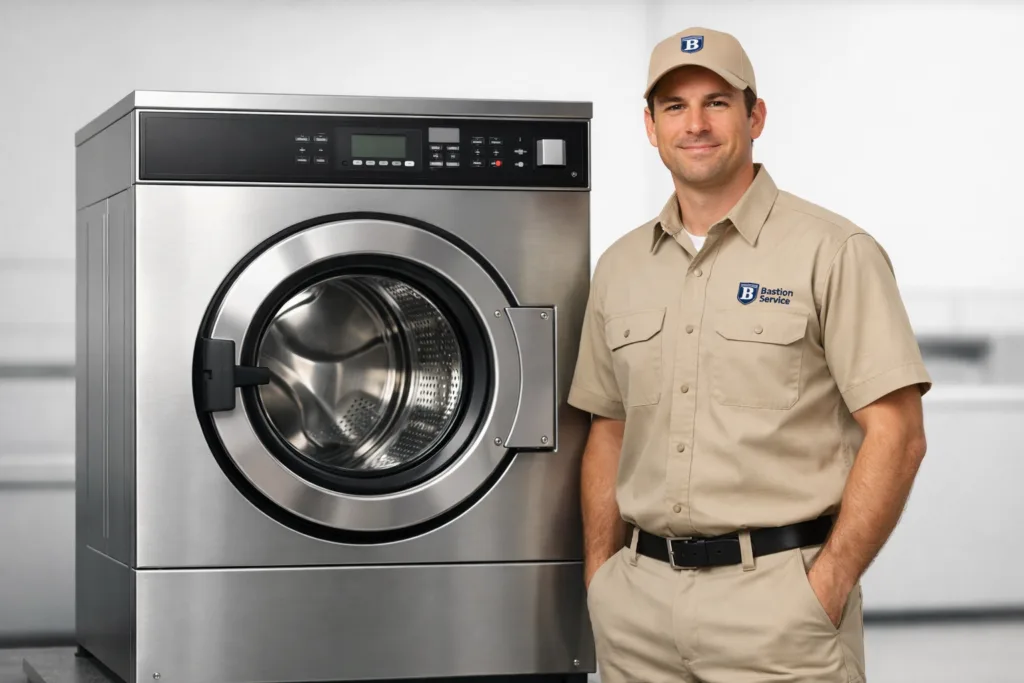




When Speed Queen laundry equipment starts interrupting daily operations, the repair decision usually comes down to two priorities: stopping avoidable downtime and preventing a small fault from turning into a larger equipment failure. For laundromats, shared laundry rooms, hotels, and other Pico-Robertson businesses, washer and dryer problems affect turnaround time, staff workload, and service reliability. Bastion Service provides Speed Queen repair support with symptom-based diagnosis, repair scheduling, and next-step guidance based on how the equipment is actually performing in use.
For specific equipment paths in Pico-Robertson, review Speed Queen Washer Repair in Pico-Robertson, Speed Queen Dryer Repair in Pico-Robertson, and Commercial Appliance Repair in Pico-Robertson.
How Speed Queen Laundry Equipment Problems Usually Show Up
Most laundry equipment failures do not begin as a complete shutdown. They often start with slower cycles, inconsistent results, unusual noise, drainage problems, overheating, or repeated restarts. Those early warning signs matter because they help identify whether the issue is limited to one worn part, tied to controls or sensors, or connected to conditions that could affect surrounding components if the machine stays in rotation.
For businesses in Pico-Robertson, the most important question is not only what symptom is visible, but how that symptom changes production. A washer that finishes with water left inside or a dryer that takes two cycles to finish one load may still run, but it is already reducing output and increasing labor. That is often the point where service becomes the practical next step.
Washer Symptoms That Usually Need Prompt Repair
Speed Queen washers can develop issues in filling, draining, spinning, cycle completion, or overall stability during operation. Some faults stay intermittent at first, which makes them easy to overlook, but repeat behavior usually points to a problem that should be inspected before it causes a shutdown or water-related disruption.
Washer not draining or leaving water after the cycle
If a washer finishes with standing water in the tub, common causes can include drain restrictions, pump failure, lock-related issues, or a control problem that prevents the machine from completing the drain and spin sequence correctly. In business use, this creates more than a wet-load problem. It can slow turnover, increase manual handling, and raise the chance of overflow or repeat stoppages when staff try to rerun the cycle.
Drainage trouble that happens more than once should usually be treated as a repair issue rather than a one-time inconvenience.
Washer not spinning, not agitating, or stopping mid-cycle
A washer that will not spin properly often leaves loads heavy, wet, and not ready for the dryer. Depending on the model and symptom pattern, the cause may involve the drive system, lid or door lock function, load sensing, motor-related components, or electronic controls. Mid-cycle shutdowns can also point to fault conditions that worsen under load.
When the machine needs repeated restarts or fails on similar cycle points, it is usually best to take that pattern seriously. Continuing to run it can increase wear and make the final repair more involved.
Leaks, vibration, banging, or unusual washer noise
Leaks around a Speed Queen washer can come from hoses, seals, pumps, internal connections, or component wear that only becomes obvious under operating pressure. Strong vibration, walking, or banging sounds can point to balance problems, mounting issues, worn suspension parts, or other mechanical faults.
These symptoms matter because they can affect both the equipment and the surrounding laundry area. Water escape, repeated impact, and unstable operation are all signs that service should be scheduled before the unit is relied on for normal daily use.
Dryer Problems That Reduce Throughput
Dryer issues often become noticeable as lower heat, longer dry times, shutdowns during operation, strange smells, or drum movement problems. Even when the dryer still runs, weak performance can create a backlog quickly because every delayed load holds up the next one. That is why drying problems should be evaluated based on output loss as well as the specific mechanical or electrical fault.
No heat or weak heat
If a Speed Queen dryer tumbles but does not heat correctly, the issue may involve heating components, thermostatic controls, sensors, airflow restrictions, or electrical supply problems. From an operations standpoint, the result is usually the same: loads take too long, staff rerun cycles, and machine time gets used inefficiently.
Inconsistent heat is also important. A dryer that heats on one load and not the next may be developing a fault that is not yet constant, but still needs service before it becomes a complete no-heat failure.
Long dry times and repeated cycles
Long dry times are not always caused by one failed part. They can come from reduced airflow, heating weakness, sensor issues, partial component failure, or conditions that make the dryer run without performing efficiently. For businesses, this symptom is easy to underestimate because the machine appears to be working while output steadily drops.
If normal loads now require extra cycle time or come out unevenly dried, that usually indicates a service issue worth diagnosing instead of managing around.
Dryer shuts off mid-cycle or will not start
A dryer that stops during operation or fails to start at all can involve door switch problems, thermal safety trips, motor issues, control faults, or other electrical failures. These symptoms tend to move from occasional interruption to full stoppage, especially when staff must keep restarting the machine to finish one load.
Repeated shutdowns are a strong sign that the unit should be inspected before it stays in regular rotation.
Squealing, scraping, thumping, or drum rotation problems
Unusual dryer noise often points to wear in support parts, belt issues, drum movement problems, motor strain, or internal obstruction. A dryer that hums without turning, starts with effort, or produces rhythmic impact sounds is usually showing mechanical wear that can lead to a no-run condition if ignored.
Burning odor or overheated smell should be treated with even more urgency, especially if it appears together with weak drying performance or sudden shutdowns.
Symptoms That Usually Mean the Machine Should Stay Out of Use
Some performance issues can wait briefly for a scheduled visit, but others should push the equipment out of service until it is evaluated. Washer and dryer symptoms that typically justify immediate caution include:
- Active leaking or water escaping during washer operation
- Severe vibration, banging, or unstable washer movement
- Repeated cycle failures that leave loads unfinished
- Dryer overheating, burning odor, or thermal shutoff behavior
- Drum not turning smoothly or not turning at all
- Electrical faults, repeated restart attempts, or sudden complete loss of function
Keeping equipment running through these conditions can increase repair cost, create safety concerns, and affect nearby operations.
Repair vs. Replacement Considerations
Not every Speed Queen equipment problem means replacement is necessary. In many cases, a targeted repair can restore normal operation and protect uptime. The better decision depends on how often the machine has been failing, whether the symptom is tied to one repairable issue or several worn components, and how critical that unit is to daily load volume.
For businesses in Pico-Robertson, repair planning is usually easier when it is based on present condition rather than guesswork. If one washer or dryer is carrying a large share of daily production, even a moderate fault may deserve faster scheduling. If the equipment has multiple recurring issues, replacement may become the more practical option.
What to Prepare Before Scheduling Service
A faster repair visit often starts with a clearer symptom history. Before scheduling service, it helps to note:
- Whether the problem happens on every cycle or only intermittently
- Any error patterns, shutdown timing, or incomplete cycle behavior
- Whether the issue appears under heavy loads, all loads, or specific settings
- Any leaking, noise, odor, heat loss, or drainage concerns
- Whether the machine is still operating or should remain out of use
That information helps narrow the problem faster and supports better planning around staffing, load routing, and repair timing.
Scheduling Speed Queen Repair in Pico-Robertson
If your Speed Queen washer or dryer is leaking, failing to drain, not heating, taking too long to dry, stopping mid-cycle, or producing unusual vibration or noise, scheduling service early is usually the best way to limit disruption. A repair visit can identify the failed component, determine whether the machine should stay offline, and help set the right path for restoring reliable laundry equipment performance in Pico-Robertson.


