





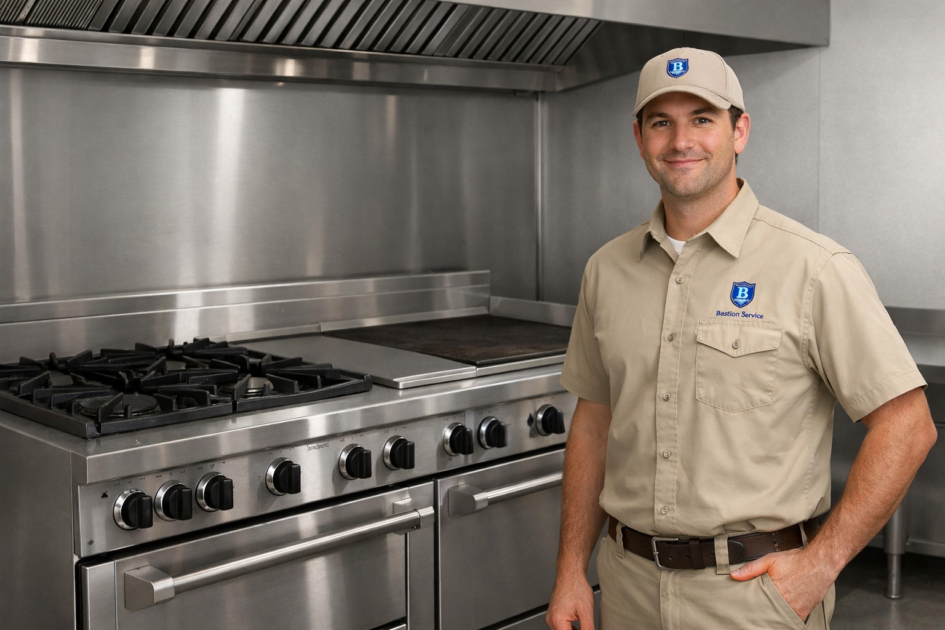
When a Southbend oven or range starts missing temperature, failing to ignite, or slowing production in Inglewood, the next step is to get the problem evaluated in a way that supports scheduling, safety, and kitchen output. For restaurants, catering operations, and other food-service businesses, the goal is not only to restore heat, but to determine whether the unit can stay in use, needs prompt repair, or should be taken offline before a larger interruption develops.
For specific equipment paths in Inglewood, review Southbend Oven Repair in Inglewood, Southbend Range Repair in Inglewood, and Commercial Appliance Repair in Inglewood.
Many service calls begin before a full shutdown happens. A range with weak burner performance or an oven with uneven heat can cause ticket delays, inconsistent results, and unnecessary strain on the rest of the line. Bastion Service helps businesses in Inglewood troubleshoot Southbend cooking equipment issues based on the actual symptom pattern so repair decisions are tied to downtime impact rather than guesswork.
Southbend oven and range problems that often need repair
Cooking equipment problems do not always point to one obvious failed part. A heating complaint may involve ignition components, burner assemblies, temperature controls, sensors, wiring, gas-related faults, or safety shutoff behavior. That is why symptom-based diagnosis matters: the visible issue on the line is not always the true source of the failure.
Temperature problems and uneven heating
If an oven runs cooler than expected, overheats, drifts away from the set temperature, or cooks unevenly from one section to another, service is usually needed to identify whether the issue is tied to controls, sensing, heat distribution, or fuel delivery. In daily production, temperature instability affects batch consistency, cook times, and food quality. Teams often notice the problem first when recipes suddenly need extra time or when product comes out uneven despite normal loading.
On ranges, poor heat output may show up as weak burners, unstable flame, or slower response during peak use. These symptoms can interfere with prep speed and line timing even when the unit still appears to be operating. What looks like a minor performance dip can become a broader production issue once staff begin avoiding certain burners or adjusting workflow around unreliable heat.
Ignition failures and unreliable startup
Intermittent ignition is one of the most disruptive problems because it creates uncertainty at opening and during busy service periods. If a Southbend unit clicks repeatedly, lights inconsistently, or needs repeated attempts to start, the problem should be checked before normal use continues. These symptoms may point to ignition component wear, control faults, or another issue affecting normal startup.
If the equipment does not light at all, shuts off during operation, or starts and then drops out, that usually signals a repair need that should not be postponed. In a business kitchen, unreliable startup affects staffing flow, prep timing, and confidence in whether the station will hold through the shift.
Slow recovery and loss of output during busy periods
Some Southbend equipment still heats, but not fast enough to support production demand. Ovens that recover too slowly between loads and ranges that lose performance when the kitchen is busy can create a hidden bottleneck. Staff may compensate by extending cook times, changing order pacing, or shifting work to other equipment, but those workarounds usually mean the unit is no longer supporting the kitchen the way it should.
Slow recovery can be related to burners, controls, calibration, ignition performance, or other operating faults. Because the equipment has not fully stopped, this type of problem is sometimes delayed until a total failure happens. In practice, earlier repair is often the better choice because it addresses the source of lost throughput before the outage gets worse.
Symptoms that usually mean service should be scheduled soon
It is generally time to arrange repair when operators notice repeated ignition trouble, unstable temperatures, weak burners, control irregularities, unexplained shutdowns, or a pattern of inconsistent cooking results. These are not only equipment complaints; they are operational warnings that the unit is affecting labor, timing, and output.
- Food taking longer than normal to cook
- Hot spots or uneven results across the oven cavity
- Burners that do not hold steady output
- Equipment that needs repeated restarts
- Opening delays caused by startup problems
- Staff avoiding part of the range or changing workflow to compensate
When these patterns are present, continuing to run the equipment through multiple shifts can increase the chance of a more disruptive failure. Even if the unit still powers on, the question is whether it is supporting reliable production. If it is not, repair planning usually makes more sense than waiting for a complete stop.
How repair decisions are usually made for Southbend cooking equipment
Not every fault leads to the same repair path. Some problems are limited to a specific component and can be addressed with targeted replacement and testing. Others reflect wider wear, repeated breakdown history, or multiple symptoms that suggest the unit needs broader corrective work. The most useful service visit helps answer practical questions: what failed, what else should be checked, whether the equipment can remain in limited operation, and how repair timing should fit the kitchen schedule.
This matters for businesses in Inglewood because downtime is rarely isolated to one appliance. When an oven or range underperforms, surrounding stations often absorb the load. That can slow prep, reduce menu flexibility, and create pressure on labor during already busy service windows. Repair planning should account for the actual business impact, not just the technical fault.
Why symptom history helps the repair process
Equipment behavior over time often tells more than a single failure moment. A unit that has been gradually losing heat, showing occasional ignition trouble, or shutting down only during peak use may indicate a pattern that helps narrow the fault faster. Helpful details include whether the issue appears at startup, after the equipment has been running for a while, under heavier production demand, or only on certain burners or cooking cycles.
That symptom history helps determine whether the problem is isolated or part of a larger performance decline. It also helps businesses decide whether to schedule work around service hours or remove the unit from use until the condition is verified.
What businesses in Inglewood should do next
If a Southbend oven or range is showing heating problems, ignition issues, slow recovery, burner trouble, control faults, or unexpected shutdowns, scheduling service is the practical next step. A repair appointment should clarify the cause of the problem, the urgency of the repair, and whether continued operation is likely to create more downtime. For businesses in Inglewood, that kind of timely evaluation helps protect production flow and makes the repair decision easier to manage before the issue spreads through the kitchen.


