
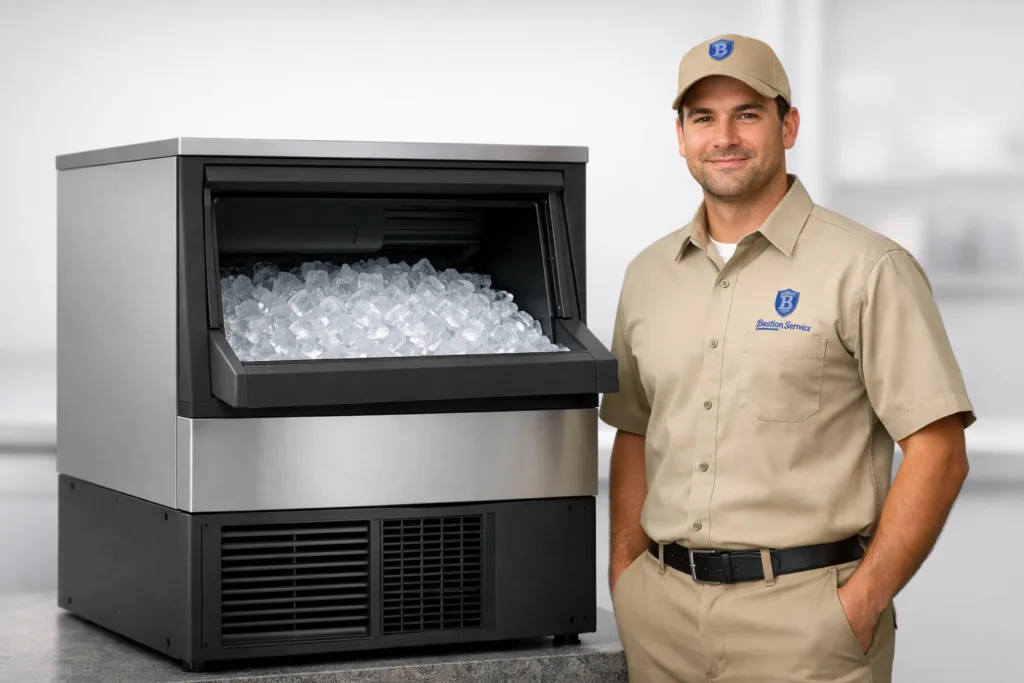





When a Scotsman ice machine starts missing production, holding water, leaking, or shutting down during operating hours, the next step is usually to get the problem diagnosed before a minor issue turns into lost ice supply or a longer outage. For businesses in Westwood, service decisions often depend on how severely the symptom is affecting beverage service, prep flow, staff efficiency, or sanitation. In many cases, the most useful first move is to determine whether the machine can remain in limited use, whether cleaning and parts replacement are both needed, and how quickly repair should be scheduled.
For specific equipment paths in Westwood, review Scotsman Ice Machine Repair in Westwood and Commercial Appliance Repair in Westwood.
Bastion Service helps businesses in Westwood evaluate Scotsman ice machine problems based on actual operating symptoms. That matters because the same complaint from staff, such as “it is making less ice” or “it keeps stopping,” can come from very different causes. A service visit should help narrow the fault, identify risk to continued operation, and provide a practical repair plan that fits the urgency of the equipment failure.
Common Scotsman ice machine problems that need attention
Scotsman ice machines often show trouble through a small group of symptoms that affect daily operations quickly. The most common service calls involve:
- Low ice production or no ice at all
- Leaks, overflow, or puddling around the unit
- Water not filling or draining correctly
- Harvest cycles that stall or fail
- Scale buildup affecting performance
- Shutdowns, resets, or inconsistent cycling
- Cloudy, thin, misshapen, or poor-quality ice
These symptoms may point to water flow restrictions, drain problems, failed components, dirty systems, sensing issues, refrigeration-related performance loss, or control faults. Because multiple issues can create similar results, symptom-based diagnosis is more useful than guessing based on one visible problem.
Why low ice production should not be ignored
Slow output or an empty bin during busy hours
If the machine is still running but cannot keep up, the problem may already be affecting the freeze cycle, harvest timing, airflow, water delivery, or system temperature. Businesses often wait because some ice is still being made, but reduced production usually means the machine is operating inefficiently or struggling to complete cycles correctly. That can turn a manageable repair into a complete interruption if the unit is left to run under stress.
Machine runs, but production stays inconsistent
Inconsistent output can be harder to manage than a full shutdown because it creates uncertainty for staff. One shift may have enough ice, while the next falls behind. That pattern often points to developing problems rather than a total component failure. Water quality, scale, weak fill, partial drainage, sensor response, and condenser performance can all contribute to inconsistent production.
Thin, hollow, or undersized cubes
When ice shape changes, the machine is often telling you that water flow, freeze conditions, or cycle timing are no longer normal. Thin cubes, incomplete slabs, or ice that melts quickly in the bin can be signs of restricted water supply, mineral buildup, or poor system performance. Even if the machine is technically still making ice, low-quality output usually means service should be scheduled before production drops further.
Water flow issues and leaks
Weak fill or no water entering the unit
If water is not entering properly, a Scotsman machine may stall, make partial batches, or shut itself down. Staff may notice longer cycle times, very little ice, or repeated restart attempts. Water inlet problems can involve valves, filters, float systems, internal restrictions, or scale in the water path. Since these issues can also affect ice quality and harvest performance, it helps to evaluate the whole operating pattern rather than only the fill complaint.
Drain problems and standing water
Drain issues can interfere with normal cycling and create overflow conditions inside the machine. Water that does not clear properly may lead to poor ice formation, repeated shutdowns, or visible pooling near the base of the unit. In a business setting, that also creates slip risk and can damage nearby surfaces or equipment if the problem continues.
Leaks that appear during or after a cycle
A puddle on the floor does not always mean the same thing. Leaks may come from loose connections, damaged hoses, internal overflow, blocked drain paths, or components that are no longer sealing correctly. If the source is not obvious, continued operation can make the problem worse and complicate diagnosis later. Tracking when the leak appears, such as during fill, freeze, or harvest, can help narrow the cause during service.
Harvest problems and repeated shutdowns
Ice will not release properly
Harvest issues often show up as ice sticking to the plate, batches that break irregularly, or cycles that run too long before stopping. When a machine cannot harvest correctly, production drops fast because the unit cannot move cleanly into the next cycle. In Scotsman equipment, this can be related to scale, water distribution problems, sensor faults, or components involved in the harvest sequence.
Machine stops and restarts on its own
If the unit shuts down, resets, or needs repeated attention from staff, the problem is usually beyond routine upkeep. Intermittent shutdowns can be tied to overheating, control response, water faults, bin sensing, or cycle failures that cause the machine to protect itself. A unit that keeps stopping is rarely reliable enough to leave unaddressed, especially when ice supply supports front-of-house service or patient, guest, or employee needs.
Repeated alarms or lockout behavior
When a machine appears to enter a protective mode or does not recover normally after a reset, that usually means a recurring operating fault is still present. Restarting it may temporarily restore function, but if the underlying issue remains, the same shutdown pattern often returns. Scheduling repair at this stage can prevent a more disruptive failure during service hours.
Scale buildup and ice quality concerns
Scale is one of the most common reasons an ice machine gradually loses reliability. Mineral buildup can restrict water movement, affect sensing, interfere with freeze consistency, and contribute to harvest problems. What begins as reduced output may eventually show up as poor ice shape, cloudy batches, long cycle times, or unexplained shutdowns.
Visible buildup is only part of the story. A machine can have internal scaling that affects performance even when the exterior looks manageable. If a Scotsman unit in Westwood has recurring production issues, repeated calls for similar symptoms, or ice quality complaints that return after cleaning, it may need more than routine maintenance. Service can help determine whether the issue is primarily cleaning-related, part-related, or a combination of both.
Signs the ice itself may indicate a deeper problem
- Cloudy or soft ice
- Irregular cube size or shape
- Slabs that do not break cleanly
- Ice that melts unusually fast in the bin
- Off appearance associated with buildup or poor circulation
These issues affect more than presentation. They can indicate that the machine is no longer producing ice consistently enough for normal business use.
When the machine should stay off until it is inspected
Some symptoms suggest it is safer to stop using the machine until service is completed. That is often the right choice if the unit is leaking significantly, tripping power, producing poor-quality ice, making unusual mechanical noise, or repeatedly shutting down right after restart. Continued operation in those conditions can increase damage, create sanitation concerns, or turn a contained repair into a larger one.
For businesses in Westwood, the decision usually comes down to balancing short-term demand against the risk of a more serious failure. If the machine is unstable rather than fully down, that is often the point where scheduling repair makes the most sense.
Repair planning for older Scotsman equipment
Not every service call points to replacement. Many units respond well to targeted repair when the main problem is isolated and the machine is otherwise in solid condition. But if an older machine has chronic scale issues, repeated leaks, unreliable harvest, or multiple recent breakdowns, it may be worth looking at the overall pattern instead of only the latest symptom.
A proper evaluation should consider age, condition, repair history, severity of the current failure, and how important the machine is to daily operations. For some businesses, restoring a dependable machine with a focused repair is the right choice. For others, frequent interruptions may signal that ongoing repair costs are starting to compete with replacement planning.
Scheduling Scotsman ice machine service in Westwood
If your Scotsman ice machine is producing less ice, leaking, showing scale buildup, failing to harvest, or stopping unexpectedly, scheduling service is usually the most practical next step. A technician can identify the fault, explain whether continued operation is reasonable, and outline what is needed to restore reliable performance. For businesses in Westwood, early repair often means less downtime, fewer repeat interruptions, and a better chance of keeping ice supply stable during normal operations.


