
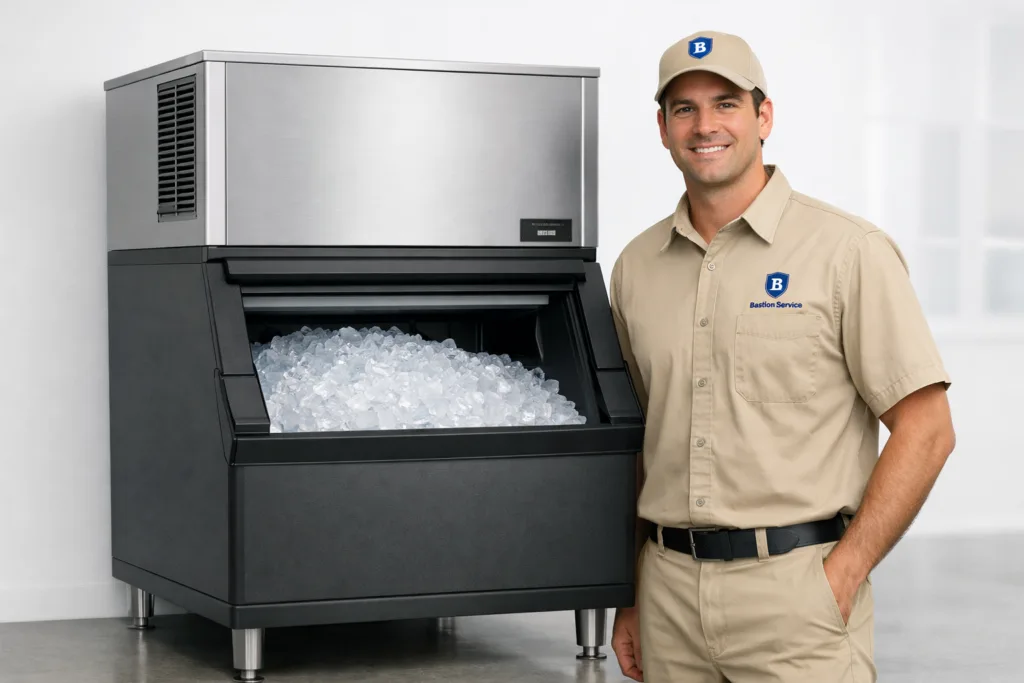




Ice machine problems can disrupt beverage service, food holding routines, bar operations, and daily workflow faster than many businesses expect. When a Scotsman unit starts leaking, slowing down, dropping inconsistent ice, or stopping mid-cycle, the most useful next step is service that identifies the actual fault and helps you decide whether the machine can stay in limited use, needs prompt repair, or should be taken offline. Bastion Service works with businesses in West Hollywood to diagnose these issues, schedule repair appropriately, and reduce the chance that a smaller performance problem turns into a longer outage.
For specific equipment paths in West Hollywood, review Scotsman Ice Machine Repair in West Hollywood and Commercial Appliance Repair in West Hollywood.
Scotsman ice machine symptoms that usually require repair
Many machine failures begin with a symptom pattern rather than a complete shutdown. A unit may still make some ice while taking too long to freeze, failing to release cubes properly, or stopping after part of a cycle. In Scotsman ice machine equipment, those complaints often relate to water supply restrictions, mineral scale, drain problems, failed valves, sensor issues, pump trouble, condenser performance loss, or refrigeration-related faults. Because several different failures can create similar visible symptoms, repair decisions are more reliable when based on testing instead of trial-and-error part replacement.
Low ice production or no ice at all
If output has dropped, the machine may be dealing with incomplete fill, restricted water flow, reduced cooling performance, scale interfering with internal operation, or a control problem that interrupts normal cycling. Some units continue running but never complete enough harvest cycles to keep up with demand. Others start, attempt to freeze, and then stop before usable ice is produced.
For businesses in West Hollywood, this symptom matters most when the machine still appears active but no longer supports normal service volume. Early repair is often the better move than waiting for a complete loss of production, especially when staff are already compensating for lower output.
Harvest issues and incomplete release
When ice does not release cleanly, forms unevenly, bridges together, or drops inconsistently, the harvest cycle may be compromised. Scale buildup, sensing problems, water distribution issues, and temperature-related performance loss can all affect release. A machine with harvest trouble may seem to be making ice, but actual usable production can fall sharply because each cycle becomes slower or less complete.
Ignoring harvest symptoms can also add stress to other components. If the unit repeatedly struggles to complete the same stage, wear can increase and the machine may begin shutting itself down to prevent further issues.
Leaks, overflow, and drain-related complaints
Water around the machine should be treated as a repair issue, not just a housekeeping problem. External leaks may come from loose connections, restricted drains, overflow conditions, cracked water path components, or internal faults that alter how the machine manages fill and discharge. In some cases, what looks like a drain problem is actually tied to a larger operating issue inside the unit.
Prompt service helps determine whether the problem is localized or part of a broader failure pattern. That matters for protecting surrounding surfaces, avoiding sanitation concerns, and preventing disruptions to nearby equipment.
Scale buildup and recurring ice quality problems
Cloudy ice, irregular shape, poor clarity, or inconsistent cube release may indicate more than routine cleaning needs. Mineral buildup can interfere with water movement, sensing accuracy, and cycle timing. Once scale begins affecting component function, the machine may show a mix of symptoms such as slow production, poor harvest, intermittent shutdowns, and repeat quality complaints.
If ice quality issues return soon after cleaning, repair may be needed to address wear or operating faults that are allowing those problems to persist. This is especially important when the machine is producing ice that no longer meets normal service expectations.
Shutdowns, resets, and intermittent operation
A machine that stops unexpectedly, restarts inconsistently, or requires repeated resetting is usually responding to a specific fault condition. Sensor failures, pump problems, overheating, electrical issues, and control-related malfunctions can all cause intermittent operation. From the outside, the behavior may look random, but the shutdown pattern usually tells an experienced technician where to begin diagnosis.
Repeatedly restarting the machine without identifying the cause can lead to more downtime and can sometimes worsen the underlying issue. If the unit is cycling unpredictably, it is usually time to schedule repair rather than continue relying on resets.
What these symptoms often indicate
While exact causes vary by model and condition, a few fault categories appear often when Scotsman ice machines lose reliability:
- Water flow problems: restricted supply, inlet valve issues, poor fill, or uneven distribution
- Scale-related interference: mineral buildup affecting sensors, water movement, and harvest timing
- Drainage issues: slow draining, backup conditions, or overflow contributing to leaks and shutdowns
- Cooling performance loss: longer freeze times, weak production, or incomplete cycles
- Control and sensor faults: intermittent stopping, incorrect cycle transitions, or error conditions
- Pump and circulation problems: inconsistent water delivery and unstable operation during freeze or harvest
The important point is that similar symptoms do not always mean the same repair. Low production could be caused by scale, poor water fill, a failing component, or reduced cooling efficiency. That is why symptom-based diagnosis is more useful than assuming one common fix applies to every machine.
When to schedule service right away
Some issues can wait for planned scheduling, but others should be addressed quickly because they tend to worsen with continued use. Repair should move up in priority when:
- ice output drops noticeably from day to day
- the machine leaks or overflows during operation
- shutdowns or restarts are becoming more frequent
- ice quality is affecting customer-facing service
- the machine makes unusual sounds during freeze or harvest
- staff are manually compensating for unreliable production
Businesses often try to stretch operation through partial performance loss, but that can turn a manageable repair into a more disruptive problem. If the machine is still producing some ice, service can help determine whether limited use is reasonable while repair is arranged. If water is escaping, cycles are abnormal, or shutdowns are persistent, taking the machine offline may be the safer choice.
How repair planning helps protect uptime
Service is not only about naming a failed part. It is also about understanding how the current symptom affects operations, whether there are contributing conditions such as scale or water flow restrictions, and what repair timing makes the most sense for the business. For an ice machine that supports daily drink service or kitchen workflow, repair planning should clarify urgency, likely next steps, and whether the unit is expected to return to stable production after the problem is corrected.
This becomes especially important when the machine has a history of repeat complaints. If prior cleaning or service has not resolved the issue for long, the current visit should help determine whether the problem is isolated or part of broader wear that will continue affecting reliability.
When replacement may be part of the conversation
Repair is often the right path when the failure is specific and the machine is otherwise in solid working condition. Replacement may be worth discussing when the unit has recurring shutdowns, repeated leaks, heavy scale-related wear, ongoing production loss, or multiple problems affecting water flow, harvest, and ice quality at the same time.
The goal is not to push replacement too early. It is to compare the likely repair path against expected uptime, future service frequency, and the operational cost of another interruption. For some businesses, restoring the current unit is the most sensible decision. For others, repeated outages may make longer-term planning more practical.
Repair support for businesses in West Hollywood
When a Scotsman ice machine is no longer producing reliably, service should provide more than a guess about what might be wrong. It should give the business a useful answer on the source of the problem, the repair path, and whether continued operation is realistic. If your machine is showing low production, leaks, shutdowns, water flow issues, harvest trouble, scale-related performance loss, or declining ice quality, scheduling repair is the best next step to protect operations and restore dependable output.


