
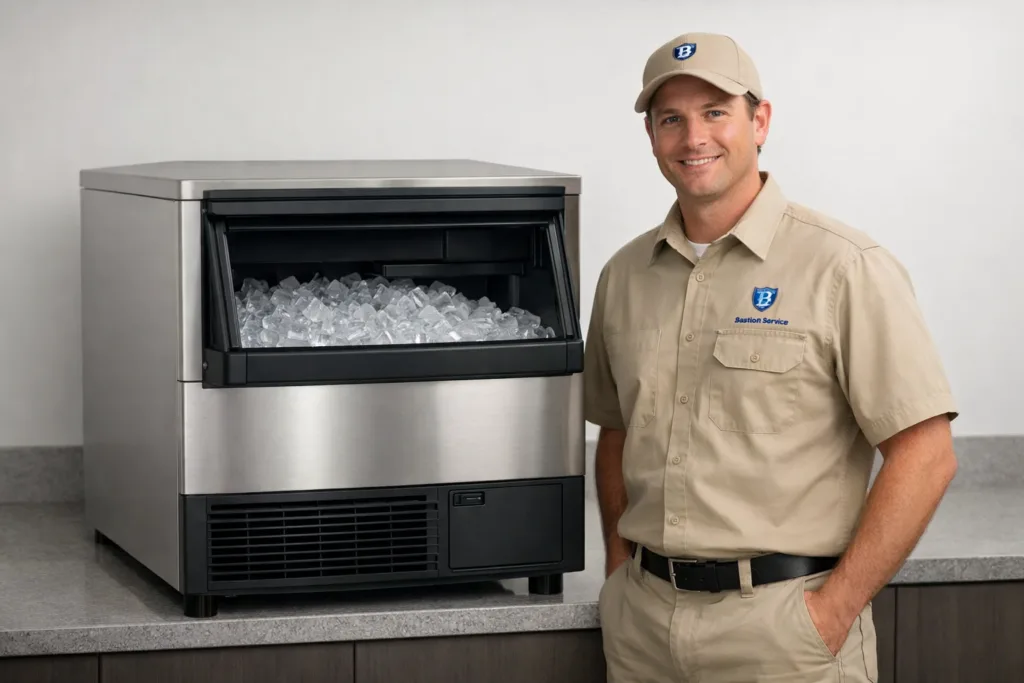




When a Scotsman ice machine begins falling behind on output, leaking, shutting down, or producing poor ice, the right next step is service that identifies what is actually failing and how quickly it needs attention. For businesses in Rancho Park, repair decisions often affect staffing, beverage service, food handling, and day-to-day workflow, so symptom-based diagnosis matters before the problem turns into a full outage. Bastion Service works with local operators to inspect the machine, confirm the fault, and schedule repair based on urgency, production demands, and the condition of the equipment.
For specific equipment paths in Rancho Park, review Scotsman Ice Machine Repair in Rancho Park and Commercial Appliance Repair in Rancho Park.
Common Scotsman ice machine symptoms that point to repair needs
Many ice machine issues look similar at first, but they do not always come from the same cause. Low production can be tied to water supply restrictions, scale buildup, condenser problems, controls, or refrigeration-related faults. Leaks may come from a drain issue, a fill problem, or a component failure inside the machine. That is why symptom patterns are useful: they help narrow the problem and guide the repair plan.
Low ice production or no ice at all
If the machine is producing less ice than usual, taking longer to recover, or not making ice at all, several fault areas may be involved. Common causes include restricted water flow, clogged filters, inlet valve issues, dirty heat-exchange surfaces, sensor problems, or a cycle control issue. In a busy Rancho Park operation, reduced output usually shows up first as a service bottleneck rather than a total breakdown, which is why early repair is often the better choice.
A unit that still makes some ice should not automatically be treated as stable. Partial production can indicate a machine struggling through freeze or harvest cycles, and continued use may add wear or mask a bigger failure developing in the background.
Harvest problems and ice that will not release properly
When ice forms but does not drop correctly, the machine may pause too long in harvest, release unevenly, or shut down after incomplete cycles. This can happen because of mineral buildup, control issues, temperature-sensing problems, or weak performance in the systems that support release. Operators may notice smaller batches, irregular timing, or ice left hanging where it should have dropped cleanly.
Harvest issues are important to address quickly because they tend to affect both output and consistency. A machine that cannot move cleanly from freeze to harvest will usually become less reliable over time, not more.
Water leaks, overflow, or drainage trouble
Water under the machine or around nearby surfaces should be taken seriously. The source may be a blocked drain line, cracked tubing, a faulty valve, a sump problem, or improper fill behavior during the cycle. Some leaks appear only at certain points in operation, which is why technicians often need to connect the symptom to the timing of the leak, not just the presence of water.
For businesses in Rancho Park, leakage can create more than an equipment problem. It can affect flooring, sanitation conditions, and nearby work areas, making quick inspection and repair scheduling especially important.
Scale buildup and declining ice quality
Cloudy ice, misshapen cubes, white residue, odd taste transfer, or inconsistent texture often point to mineral accumulation or water-distribution problems. Scale does more than change appearance. It can interfere with water movement, sensors, freeze efficiency, and harvest performance, leading to wider reliability problems if left untreated.
When ice quality changes at the same time as production slows or cycles become erratic, that combination usually suggests the machine needs more than casual observation. Service can help determine whether the issue is primarily buildup-related or whether component failure is also involved.
Unexpected shutdowns or intermittent operation
A Scotsman machine that runs for a while and then stops without a clear pattern can be difficult for staff to manage. Intermittent shutdowns may involve controls, bin sensing, overheating conditions, electrical faults, or protective responses triggered by another problem in the system. These calls often feel urgent because the machine may appear normal between failures, even though reliability is already compromised.
If shutdowns are becoming more frequent, it is usually best not to wait for a complete stop. Intermittent faults often become harder on operations precisely because they create uncertainty around available ice supply.
Why the same symptom can have different causes
Ice machine repair works best when the symptom is connected to testing, not assumptions. A production complaint could be caused by poor water flow, scale, temperature-related issues, condenser fouling, or controls that are no longer responding properly. A leak could be a simple drainage problem or part of a broader fill-cycle failure. A shutdown could be electrical, mechanical, or protective in nature.
That is why diagnosis comes before parts decisions. It reduces the chance of replacing the wrong component, helps set realistic scheduling expectations, and gives the business a better basis for deciding whether the unit can stay in limited use or should be taken offline until repairs are completed.
Signs continued use may make the problem worse
Some machines can remain in temporary use while waiting for a repair window, but others should be evaluated quickly because continued operation can increase damage or create avoidable disruption. Warning signs include:
- steady leaking or recurring overflow
- sharp production loss during normal demand
- failed or delayed harvest cycles
- repeated shutdowns or short cycling
- heavy scale affecting ice formation or release
- noticeably inconsistent ice quality from batch to batch
When these conditions are present, waiting too long can turn a targeted repair into a larger service event. It can also push the equipment into a full outage at the worst possible time for staff and customers.
What helps speed up repair scheduling
Good symptom notes can make a service visit more efficient. If possible, it helps to note whether production dropped suddenly or gradually, whether leaks happen during specific cycles, whether the issue started after cleaning or maintenance, and whether the machine has been shutting down at repeating intervals. Even simple observations can help narrow the likely fault path.
It is also useful to consider the business impact before scheduling. Some operators can work around a reduced-output machine for a short period, while others need faster attention because ice demand is tied directly to customer service, product holding, or routine kitchen flow. Matching service timing to actual operating pressure is part of a practical repair plan.
Repair versus replacement: when to take a closer look
Not every Scotsman machine should be repaired without review. If the unit has had repeated breakdowns, major wear, or multiple unresolved performance issues, it may make sense to compare the repair scope with the expected remaining service life of the equipment. Age alone does not decide the outcome, but condition, parts needs, labor, and likely reliability after repair all matter.
In many cases, a focused repair is the most sensible path and restores stable production. In others, inspection may show that the machine is becoming too costly or unpredictable to keep in service. A tested assessment helps operators make that decision with real information instead of guesswork.
Service decisions that support uptime in Rancho Park
Scotsman ice machine repair in Rancho Park is ultimately about protecting operations from preventable downtime. Whether the machine is dealing with low production, water flow problems, leaks, shutdowns, harvest trouble, scale buildup, or declining ice quality, the most useful next step is a service visit that confirms the cause and outlines what comes next. If the equipment is already affecting daily business activity, scheduling repair promptly can help limit disruption, reduce the chance of a larger failure, and restore more consistent performance.


