
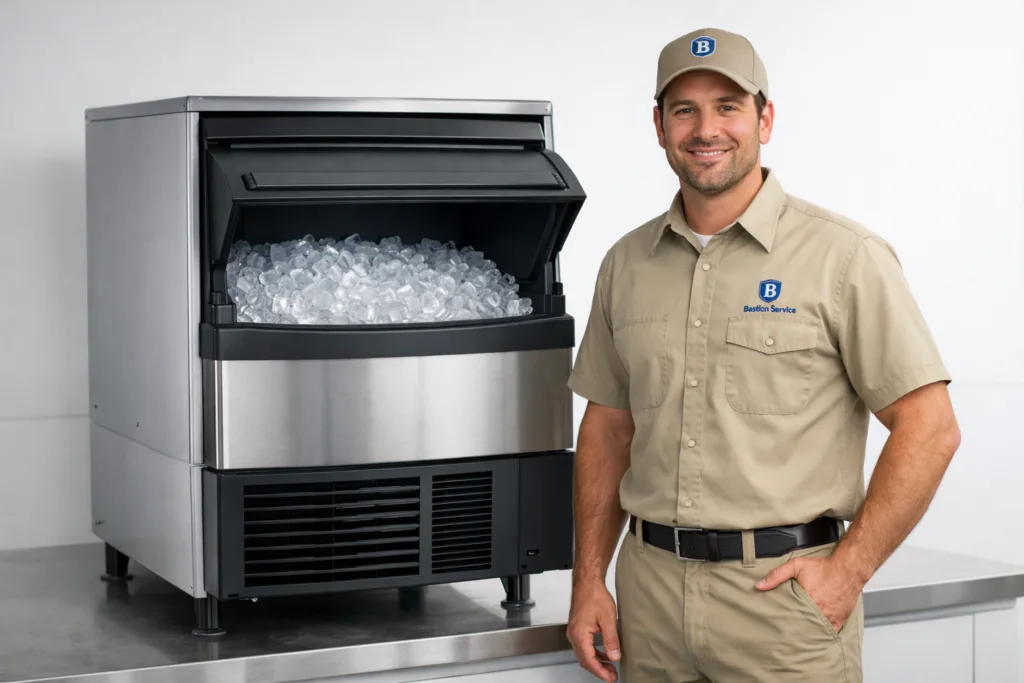





When an ice machine starts falling behind, the immediate concern is not just the symptom itself but how quickly it will affect beverage service, food holding, guest experience, and staff workflow. In Los Angeles, fast-moving operations often depend on steady ice production throughout the day, so a Scotsman unit that is leaking, short-cycling, slowing down, or producing inconsistent ice usually needs prompt inspection. Bastion Service provides repair support focused on identifying the fault, explaining the operating risk, and helping businesses schedule the right repair before a manageable issue turns into a full outage.
For specific equipment paths in Los Angeles, review Scotsman Ice Machine Repair in Los Angeles and Commercial Appliance Repair in Los Angeles.
Common Scotsman ice machine problems that point to needed repair
Many machines give advance warning before they stop completely. Output may gradually drop, ice may change shape or clarity, water may begin appearing around the unit, or the machine may seem to run longer than normal without filling the bin. These symptoms often connect to water flow restrictions, scale buildup, drainage problems, sensor issues, refrigeration-related performance loss, or wear in parts that control freeze and harvest timing.
Low ice production or no ice at all
If the machine is making less ice than usual, the issue may involve reduced incoming water, blocked distribution, mineral buildup, poor heat transfer, control faults, or a harvest problem that prevents normal cycling. In business use, low production matters even before complete shutdown because the machine may still appear to operate while failing to keep up with demand. That is often the point where repair scheduling becomes urgent.
Leaks, overflow, or water around the machine
Water on the floor should be treated as an active equipment problem rather than a minor nuisance. Leaks can come from drainage restrictions, loose fittings, inlet valve issues, cracked lines, internal overflow, or ice forming where it should not. Besides creating a slip hazard, excess water can affect surrounding surfaces and make it harder to tell whether the machine is operating within normal limits.
Harvest issues and incomplete cycles
A Scotsman machine that freezes but struggles to release ice, hangs in cycle too long, or drops uneven sheets or malformed cubes may have a harvest-related problem. These issues can be tied to scale, sensor readings, water distribution, temperature imbalance, or component wear. Harvest trouble is important because it often leads to reduced output, repeated shutdowns, and stress on parts that are trying to cycle under the wrong conditions.
Poor ice quality
Cloudy, soft, thin, hollow, or odd-shaped ice can signal more than a cosmetic issue. It may reflect water quality concerns, internal scale, inconsistent fill, freezing problems, or control timing that is no longer accurate. For customer-facing operations, poor ice quality can quickly become a service concern, especially when appearance and consistency matter.
Unexpected shutdowns or recurring alarms
If the machine stops and restarts, locks out, or repeatedly shows alarm behavior, the safest assumption is that the unit is reacting to a condition it cannot manage on its own. Repeated resets may temporarily restart the machine, but they do not correct the underlying fault. In many cases, the pattern points to a sensor issue, drainage problem, overheating condition, water supply interruption, or an internal component that is failing under load.
Why symptom-based diagnosis matters
The same visible symptom can come from several different causes. Low production, for example, may be tied to scale, water feed problems, weak cooling performance, or control issues. A leak might come from a drain obstruction, a fill problem, or ice formation caused by abnormal cycling. That is why repair decisions should be based on how the machine is behaving as a system, not on one isolated sign.
A proper evaluation helps answer practical questions that matter to a manager or facility team:
- Is the machine safe to keep running until the repair visit?
- Is output loss likely to get worse quickly?
- Is the problem confined to one repairable issue, or are several conditions contributing?
- Will continued operation risk added damage, overflow, or sanitation concerns?
Signs scale buildup may be affecting performance
Scale is one of the most common contributors to declining ice machine performance, especially when symptoms develop gradually. Mineral accumulation can interfere with water movement, freeze efficiency, sensing, and harvest release. A machine with scale buildup may still run, but it often runs less efficiently and more inconsistently than it should.
Possible signs include:
- longer cycle times
- lower daily ice volume
- uneven or incomplete cubes
- water overflow during operation
- harvest problems or ice sticking
- more frequent shutdowns after previously normal performance
Because scale can affect multiple parts of the machine at once, inspection is important before assuming a single failed part is the only issue.
Water flow and drainage problems should not be ignored
Ice machines depend on steady water supply and proper drainage to complete cycles correctly. When water flow becomes restricted or drainage slows down, the machine may not fill, freeze, release, or clear water as designed. That can lead to low production, poor cube formation, leaks, and off-cycle shutdowns.
Water-related problems are especially disruptive because they often create both production loss and housekeeping concerns at the same time. If the machine is producing less ice while also leaving water around the base or bin area, a service call is usually more appropriate than continued observation.
When continued use can make repair more expensive
Some issues allow temporary operation while a visit is being scheduled, but others are more likely to worsen with continued use. If the machine is leaking, making abnormal noise, producing unusable ice, failing during harvest, or repeatedly shutting itself down, ongoing operation can increase stress on affected components and make the final repair more involved.
Businesses should be especially cautious when:
- ice output has dropped sharply during normal demand
- water is pooling near the machine
- the unit requires frequent resetting
- ice quality raises appearance or sanitation concerns
- cycle timing has become obviously erratic
In these situations, prompt repair planning is usually the lower-disruption choice compared with waiting for a total stop during a busy period.
Repair planning for Los Angeles businesses
Repair decisions are rarely only about one broken part. For many businesses, the real question is how the machine’s current condition affects service capacity today and whether the unit can reasonably support operations until the repair is completed. A useful service visit should help clarify the source of the problem, the urgency, and whether there are related conditions that need to be addressed at the same time.
That planning is especially important when the machine supports front-of-house beverage service, bar demand, guest rooms, employee break areas, patient service, or high-volume kitchen production. Even partial output loss can create ripple effects across the day, so the repair decision should account for both the fault itself and the role the machine plays in daily operations.
When repair is usually the right next step
Many Scotsman machines are strong repair candidates when the problem is isolated and the rest of the equipment remains in sound condition. Leaks from a specific source, water flow problems, sensor issues, harvest faults, and certain shutdown causes can often be addressed without assuming the entire machine is at end of life. What matters most is whether the equipment has a repairable primary failure and whether overall condition supports continued use after service.
Replacement becomes more relevant when a machine has repeated breakdowns, ongoing reliability issues, broader wear, or a repair outlook that no longer makes sense for the operation. The value of diagnosis is that it gives decision-makers a factual basis for choosing the next step instead of guessing from symptoms alone.
What to do if your Scotsman ice machine is showing these symptoms
If your machine is producing less ice, leaking, shutting down, struggling through harvest, or making inconsistent ice, the most useful next step is to schedule service before the problem affects a full shift or service window. A repair-focused inspection can confirm whether the issue is tied to water flow, scale, drainage, controls, or another failing component and help determine whether the unit should stay in operation while work is planned. For businesses in Los Angeles, early action is often the best way to reduce downtime, protect daily service, and restore more predictable ice production.


