
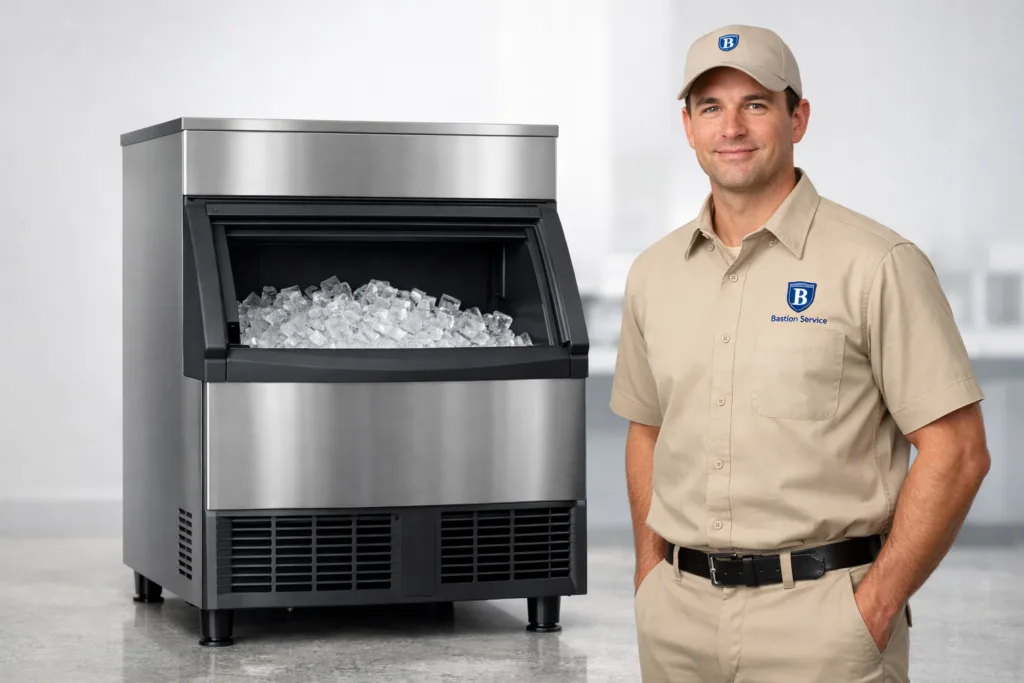





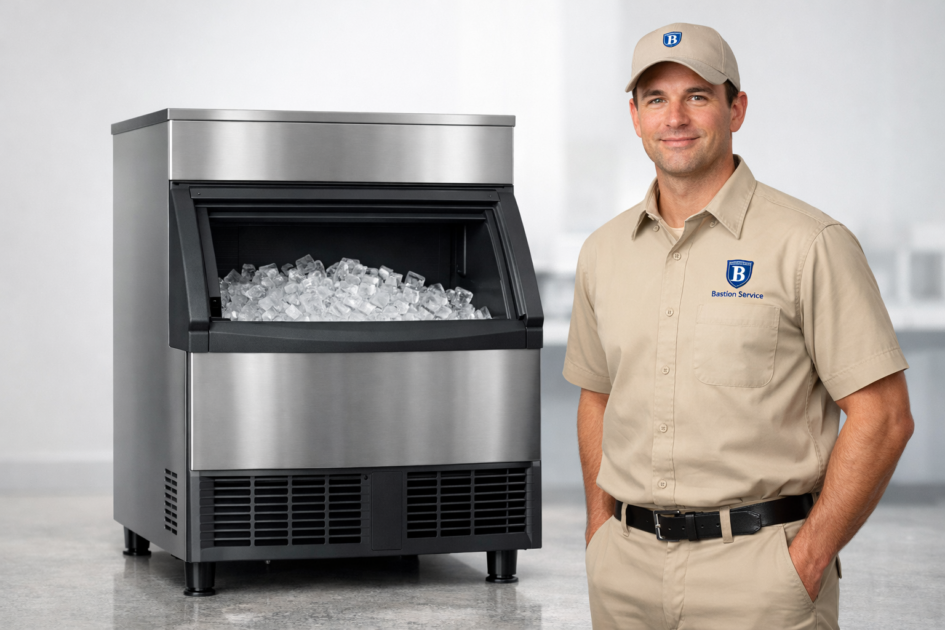
When a Scotsman ice machine starts leaking, slowing down, missing harvest, or shutting off unexpectedly, the right response is to move quickly from symptoms to a repair decision. For businesses in Century City, ice problems affect beverage service, food holding, workflow, and sanitation, so service should focus on what the machine is doing now, whether it can stay in use safely, and what needs to be repaired to restore stable production. Bastion Service provides Scotsman ice machine repair for businesses that need a prompt assessment, realistic scheduling, and a repair plan tied to actual operating conditions.
For specific equipment paths in Century City, review Scotsman Ice Machine Repair in Century City and Commercial Appliance Repair in Century City.
Common Scotsman ice machine symptoms that point to repair
Ice machines rarely fail without warning. In many cases, the first signs are lower output, slower cycle times, unusual ice shape, water where it should not be, or intermittent shutdowns that start as an occasional nuisance and become a daily problem. On Scotsman equipment, those symptoms can come from water supply restrictions, scale buildup, drain issues, sensor faults, pump problems, control failures, or refrigeration-related performance loss.
Several different faults can produce similar results, which is why symptom-based service matters. A machine making thin ice, stopping during harvest, or leaving standing water may not have a single obvious cause from the outside. Repair starts with identifying whether the issue is isolated to water flow, bin control, freezing and release timing, or a more significant component problem that could worsen with continued use.
Low ice production and slow recovery
What reduced output usually means
If the machine is producing less ice than normal, taking too long to refill the bin, or falling behind during busy periods, the problem may involve reduced incoming water, mineral buildup, condenser-related performance loss, or timing issues within the freeze and harvest sequence. Some machines continue running while output steadily declines, which can make the problem look smaller than it really is until demand rises.
This is one of the most important service calls for businesses in Century City because low production often leads staff to compensate by over-relying on an already stressed unit. If output is dropping while cycle times are changing, ice thickness is inconsistent, or the machine is stopping between batches, repair should be scheduled before the unit reaches full downtime.
Harvest issues and incomplete release
Why ice may not drop correctly
A Scotsman machine that forms ice but struggles to release it during harvest may show long pauses, partial slabs, stuck cubes, or repeated attempts to complete the same cycle. Harvest problems can be connected to scale, water distribution problems, sensor errors, hot gas issues, or control faults that interfere with normal release timing.
These symptoms deserve attention because harvest problems often lead to secondary issues. The machine may run longer than expected, shut itself down, produce irregular batches, or create excess ice buildup in areas that affect the next cycle. When staff notice repeated incomplete drops or inconsistent batch release, repair is usually more appropriate than repeated resets.
Leaks, overflows, and standing water
Water problems that should not be ignored
Leaks around the cabinet, water collecting near the bin, or overflow during operation can point to blocked drains, pump trouble, inlet valve problems, cracked water-contact parts, or ice formation that redirects water away from its intended path. Even a small recurring leak can become a larger operational problem if it affects surrounding flooring, creates cleanup demands, or causes staff to restart the machine repeatedly.
Water issues are especially important because the visible leak is not always the real source. A machine may appear to be leaking from one corner while the actual problem begins in the drain path, distribution area, or internal freeze process. If leakage is active, recurring, or paired with poor production, the safest next step is repair evaluation rather than continued operation.
Water flow problems and scale buildup
How restriction changes performance
Restricted water flow can affect almost every part of ice production. The machine may fill slowly, produce undersized or hollow ice, misread water conditions, or fail to complete a normal cycle. Over time, mineral accumulation can also interfere with sensors, pumps, valves, and other components that depend on clean and consistent water movement.
What appears to be a simple maintenance issue may actually be a repair issue once scale has been allowed to affect machine operation for too long. If performance does not return after basic cleaning, or if the same symptoms keep returning, the machine should be inspected for wear or damage tied to prolonged buildup and restriction.
Ice quality concerns and visible changes in the ice
What the ice itself can reveal
Cloudy cubes, uneven size, thin batches, fused ice, hollow centers, and inconsistent shape often signal a machine problem rather than a one-time irregularity. Changes in ice quality can reflect water flow imbalance, scale accumulation, sensor issues, freezing inconsistencies, or trouble during harvest. For businesses that rely on clean, consistent ice appearance, these changes affect both product quality and confidence in the machine.
When ice quality drops at the same time as slower production, leaks, or unexpected stoppages, it usually indicates a broader system issue rather than a cosmetic one. In that situation, repair should focus on the source of the pattern instead of treating the visible ice problem by itself.
Shutdowns, resets, and intermittent operation
Why stop-and-start performance is disruptive
A machine that shuts down without warning, stops mid-cycle, or needs repeated resetting may have problems with controls, safety conditions, water sensing, harvest timing, or refrigeration performance outside normal range. Intermittent faults are frustrating because the machine may appear normal during part of the day and fail when demand is highest.
For businesses in Century City, this type of symptom creates planning problems as much as equipment problems. Staff do not know whether the machine will complete the next cycle, whether the bin will refill, or whether another shutdown will happen during service. If the machine is no longer operating predictably, repair should be treated as urgent even if it occasionally comes back online.
When the machine should be taken out of use
It is usually best to stop using the machine when there is active leaking, repeated overflow, major decline in ice quality, frequent shutdown, obvious drain failure, or unusual noise that suggests a mechanical issue. A unit that must be reset often, monitored constantly, or cleaned up after each cycle is no longer operating in a normal way.
In less severe cases, such as reduced production without water on the floor, short-term continued use may be possible while service is being arranged. The decision depends on stability. If the machine can no longer run through normal cycles consistently, continued use may increase damage and turn a manageable repair into a larger interruption.
Repair versus replacement for Scotsman equipment
Not every Scotsman ice machine with recurring symptoms needs to be replaced, but not every aging unit should continue through repeated repairs either. The best choice depends on the machine’s age, overall condition, service history, severity of the current problem, and how critical that unit is to daily operations.
If the fault is isolated and the machine is otherwise dependable, repair is often the sensible step. If problems involve repeated low production, chronic leaks, ongoing shutdowns, or multiple system concerns at once, replacement planning may deserve consideration. A diagnosis gives businesses the information needed to compare those options based on actual condition instead of making a rushed decision during a breakdown.
What helps before a repair visit
Useful details can make the service process more efficient. It helps to note whether the machine is producing any ice at all, whether the problem is constant or intermittent, whether leaks appear during fill, freeze, or harvest, and whether staff have noticed changes in cube size, cycle time, or shutdown behavior. If the unit has already been reset, cleaned, or temporarily taken offline, that history also helps narrow the likely cause.
The goal is not to troubleshoot everything internally. The goal is to give the technician a clear picture of the symptom pattern so repair can move faster from inspection to action.
Scheduling Scotsman ice machine repair in Century City
When a machine begins affecting service flow, sanitation, or ice availability, the practical next step is to schedule repair before the issue spreads into a larger outage. Businesses in Century City benefit from acting early when they see water flow problems, low production, harvest trouble, visible scale, leaks, or unreliable operation. A timely service visit helps determine whether the machine should remain online, be limited temporarily, or be taken out of use until repairs are completed, giving operators a more controlled path back to consistent ice production.


