
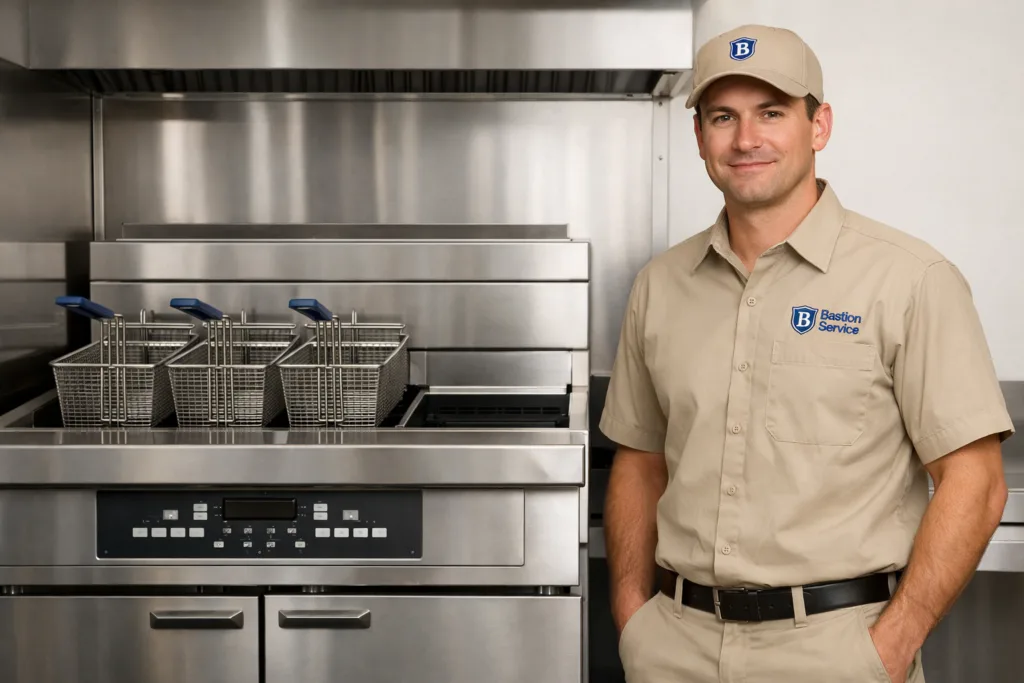




When Pitco cooking equipment starts missing temperature, recovering too slowly, or shutting down during a rush, the issue quickly affects ticket times, food quality, labor flow, and daily output. For businesses in West Los Angeles, the right repair decision starts with symptom-based testing that shows what has failed, whether continued operation is risky, and how urgently service should be scheduled. Bastion Service provides repair support for Pitco cooking equipment with attention to downtime impact, repair scope, and the practical next steps needed to get the kitchen back on track.
For specific equipment paths in West Los Angeles, review Pitco Fryer Repair in West Los Angeles and Commercial Appliance Repair in West Los Angeles.
Common Pitco cooking equipment problems that need repair
Many faults begin as small changes in performance before they become full interruptions. A fryer may still heat, but recover too slowly. Ignition may work sometimes, but fail when demand is highest. Controls may appear functional, yet temperatures drift enough to affect consistency. These are the kinds of symptoms that often point to service needs rather than operator adjustment.
Heating problems and slow recovery
If equipment is taking too long to reach temperature or cannot recover between batches, production slows almost immediately. On Pitco fryers, that may relate to burners, sensors, controls, gas flow issues, high-limit conditions, or heat-transfer problems caused by wear or buildup. Slow recovery often shows up first as longer cook times, uneven color, and backed-up orders before the unit stops working altogether.
For a busy kitchen, this is more than an inconvenience. Reduced heat performance can create waste, strain nearby stations, and force staff to change process timing just to keep orders moving. Service is usually warranted when recovery time is noticeably worse than normal, even if the equipment has not failed completely.
Ignition failures and burner instability
Ignition problems can appear as delayed lighting, repeated clicking, burner dropout, or a complete failure to start. In some cases the unit may ignite at opening and then become unreliable later in the day. These symptoms can involve ignition components, flame sensing, control faults, wiring issues, or gas-related problems that require testing rather than repeated resets.
Unstable burner performance also affects temperature control. Even short interruptions in flame can reduce output and create inconsistent cook results. If the equipment is failing to light reliably or the flame is not staying stable, it is best to schedule repair before the problem causes a full service interruption.
Temperature control faults and inconsistent results
When batches come out too dark, too light, greasy, or uneven, the problem is often tied to temperature accuracy rather than product handling alone. A Pitco unit with a drifting sensor, control board issue, calibration problem, or cycling fault may still run, but not at the temperature the operator expects. That can lead to inconsistent quality and unnecessary oil stress.
Temperature-related complaints are especially important when they happen across multiple shifts or only under heavier production. Those patterns often help narrow the cause and shape the repair plan. Instead of guessing, a service visit should confirm whether the issue is sensor-related, control-related, or connected to burner operation.
Unexpected shutdowns during service
Intermittent shutdowns are among the most disruptive equipment problems because they create uncertainty. A unit may run for an hour and then cut off, or restart after cooling only to fail again later. Possible causes include overheating, high-limit trips, control interruption, electrical faults, or a gas-delivery problem that becomes more obvious under load.
If shutdowns are happening without a clear trigger, continued use can turn a manageable repair into a larger outage. Businesses in West Los Angeles often benefit from scheduling diagnosis before peak periods rather than waiting for the next full stop during active service.
Why symptom patterns matter in Pitco fryer repair
Good repair work starts with what the equipment is actually doing in operation. A fryer that never reaches temperature points to a different repair path than one that reaches setpoint but drops off during demand. A unit that fails only after several cycles suggests something different from one that will not ignite at all. Looking at the symptom pattern helps isolate the fault faster and reduces unnecessary part replacement.
This approach also helps kitchen managers make operational decisions. If the issue is tied to safety controls, unstable ignition, or repeated shutdowns, the unit may need to stay offline until repaired. If the fault is affecting performance without creating an immediate shutdown condition, service can sometimes be planned around prep and rush periods. The value of diagnosis is that it supports those decisions with evidence instead of guesswork.
Signs the equipment should not stay in normal use
Some problems should be treated as urgent because continued operation can increase risk or cause broader damage. Service should be prioritized when you notice:
- Repeated ignition attempts or unreliable startup
- Burners that drop out or do not stay stable
- Oil temperature that swings widely or does not match settings
- High-limit trips or unexplained shutdowns
- Recovery times that are getting worse during normal volume
- Control behavior that is erratic, unresponsive, or inconsistent
Even if the equipment is still partially usable, these symptoms can affect food quality, output, and safety. Waiting too long often means the kitchen ends up dealing with the problem at the worst possible time.
How repair decisions affect daily kitchen operations
For many West Los Angeles businesses, the real issue is not only what failed but how the failure affects production. A single fryer problem can change menu timing, reduce available capacity, increase pressure on other stations, and create unnecessary labor inefficiency. When repair is delayed, staff often work around the problem in ways that are hard to maintain through a full service day.
That is why repair planning should take into account more than the failed component. It should also consider whether the equipment can hold normal volume, whether performance is degrading, and whether the fault is likely to become a complete shutdown. This helps determine whether to authorize immediate repair, stage service around operating hours, or evaluate whether the current unit is developing broader reliability issues.
Repair versus replacement for recurring Pitco equipment issues
Not every recurring problem means the equipment should be replaced, but repeated failures should be reviewed carefully. If the unit has a solid overall condition and the issue is isolated to a control, ignition, or burner-related repair, restoring dependable operation may be the most cost-effective path. If the equipment has a pattern of breakdowns, extended downtime, or multiple overlapping faults, replacement planning may become part of the conversation.
The most useful service assessment looks at the current symptom, recent breakdown history, major component condition, and the operational cost of keeping the unit in rotation. For businesses trying to protect service flow, the goal is usually to stabilize production first and then decide whether additional investment in the current equipment makes sense.
What to expect from a service-focused repair visit
A repair appointment for Pitco cooking equipment should focus on the actual complaint, the conditions under which it happens, and the systems most likely involved. That usually includes checking ignition behavior, burner performance, temperature response, control operation, and any shutdown history reported by staff. A useful diagnosis should answer three practical questions: what is causing the symptom, whether the unit should remain in use, and what repair is needed to restore more consistent performance.
If your Pitco equipment is losing heat, failing to ignite, recovering too slowly, or dropping out during production, scheduling service promptly is the best way to limit disruption. For West Los Angeles kitchens, fast action can help prevent a smaller performance issue from turning into a larger outage, while giving operators a clear repair path that supports uptime and daily service demands.


