
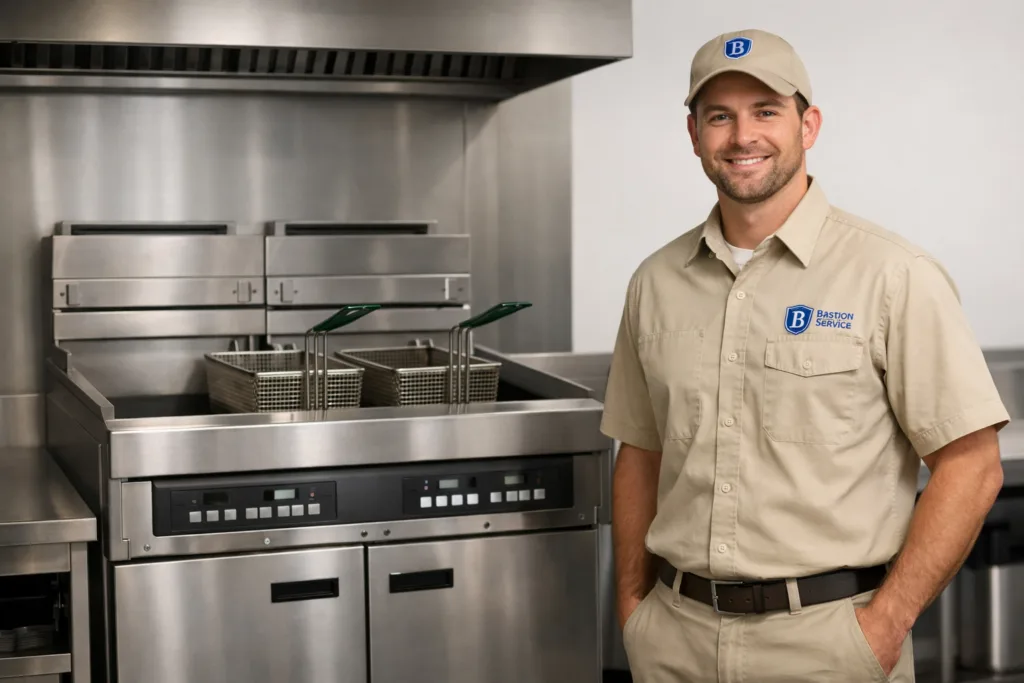




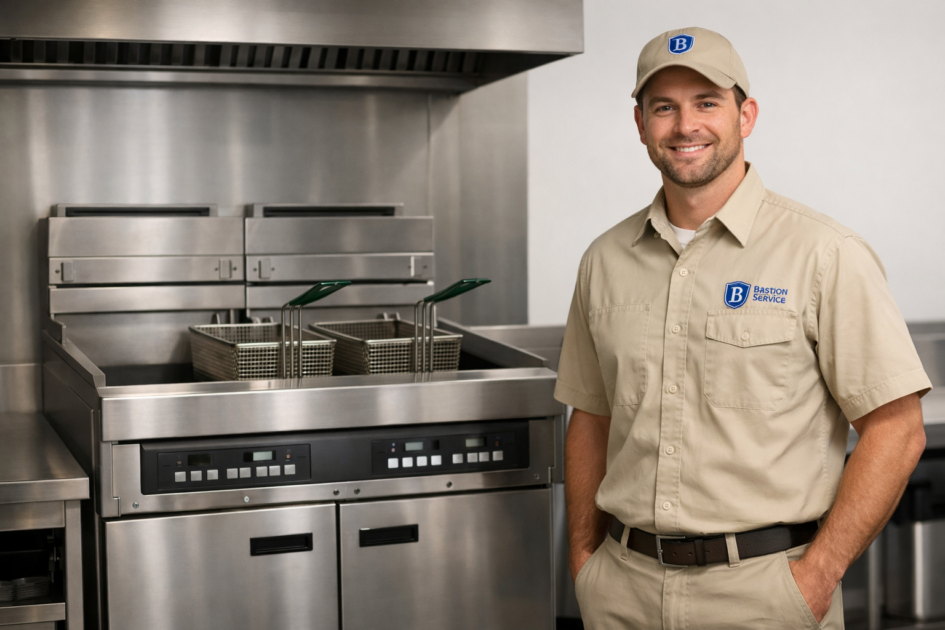
Kitchen downtime usually starts with a symptom that seems manageable at first: longer heat-up times, erratic temperatures, ignition hesitation, or a fryer that drops out in the middle of a rush. For businesses in West Hollywood, those patterns are best treated as repair issues early, before they affect output, food consistency, and staff workflow. Bastion Service works with Pitco cooking equipment used in daily operations, helping operators schedule diagnosis, identify the likely fault path, and decide whether the unit can stay in limited use until repair is completed.
For specific equipment paths in West Hollywood, review Pitco Fryer Repair in West Hollywood and Commercial Appliance Repair in West Hollywood.
What Pitco cooking equipment problems usually need service
Pitco cooking equipment problems often show up as performance loss before a full shutdown. On fryer systems, that may mean slow recovery, unstable temperatures, ignition failures, weak burner performance, or controls that do not respond the way they should. In a business kitchen, these symptoms rarely stay isolated for long. They usually lead to slower ticket times, product inconsistency, repeat resets, and avoidable stress on the rest of the line.
Service is typically warranted when operators notice one or more of the following:
- Longer-than-normal preheat or recovery times
- Oil temperature that runs too hot, too cold, or fluctuates during use
- Failure to ignite, delayed ignition, or repeated attempts to light
- Burners that seem weak, uneven, or inconsistent
- Unexpected shutdowns during active production
- Error behavior, lockouts, or controls that require frequent resetting
- Performance changes after heavy daily use
These issues can come from different causes even when the symptom looks straightforward, which is why parts-swapping or guesswork often extends downtime instead of resolving it.
Heating and recovery problems that affect production
Slow heat-up
If a Pitco unit takes too long to come up to operating temperature, the problem may involve burners, gas delivery, ignition sequence components, sensing, or control response. For a kitchen running on timing and batch consistency, slow heat-up reduces flexibility at opening and makes it harder to recover once service volume increases.
Slow recovery between batches
Recovery issues are especially disruptive on fryer equipment because they directly affect throughput. A unit that cannot recover properly may still appear to be running, but actual performance drops when production demand rises. Operators often notice longer cook times, uneven results, or staff compensating in ways that create more waste and inconsistency. When recovery falls off, repair should usually be scheduled promptly rather than monitored indefinitely.
Temperature drift and inconsistent cooking results
When set temperature and actual cooking performance no longer match, the fault may be related to a thermostat, probe, control system, calibration problem, or another electrical or gas-side component affecting regulation. Temperature drift matters because it can change product quality from batch to batch, which is costly even before the equipment stops completely.
Ignition and startup faults
Failure to ignite
A no-ignite condition can involve the pilot system, ignition hardware, flame sensing, controls, wiring, or related safety components. Even if the equipment eventually starts after several attempts, that delay is a sign the startup sequence is no longer operating normally. In business use, intermittent ignition is often treated the same way as a more obvious failure because it creates uncertainty at the start of service and during busy periods.
Repeated ignition attempts or lockout behavior
If the unit tries to light more than once, drops into a lockout condition, or needs a reset before running again, the issue should be inspected before continued operation becomes routine. Repeated restarts can mask an underlying condition that worsens under load. What looks like an occasional startup nuisance can turn into a no-heat event at the worst possible time.
Burner and flame performance issues
Burner-related problems may show up as weak heating output, uneven flame behavior, reduced capacity, or mid-cycle instability. On fryer equipment, that often translates into poor recovery and inconsistent temperature maintenance. Causes can include contamination, wear, restricted flow, control problems, or related ignition faults that affect stable burner operation.
From a service standpoint, burner complaints are important because they are not just about restoring heat. They are also about determining whether the equipment can continue to operate predictably and whether continued use risks a larger interruption. If performance is visibly uneven or shutdowns are becoming more common, it is usually better to move forward with repair scheduling than to keep working around the symptom.
Unexpected shutdowns and control-related problems
Shutdowns during active use are among the most disruptive issues for businesses in West Hollywood. A Pitco unit that stops mid-cycle, trips a safety condition, or requires frequent resetting may have a problem tied to high-limit protection, control logic, wiring, sensor feedback, or intermittent component failure.
Control issues do not always look dramatic at first. In some cases, operators report unresponsive settings, displays that behave inconsistently, or operation that does not match the selected temperature. Those signs usually point to a need for diagnosis rather than simple adjustment. If the root cause is not confirmed, a partial repair can leave the kitchen dealing with the same downtime again shortly afterward.
When limited use is risky
Some equipment problems allow temporary operation while service is being arranged, but others should push a faster decision. If the unit is overheating, failing to ignite consistently, shutting down unpredictably, or producing clearly unstable cooking results, continued use may worsen component wear and increase the chance of a full outage.
A practical service visit helps answer questions operators actually care about:
- Is the equipment safe to keep in rotation for now?
- Is the problem likely to spread into a larger failure?
- Does the repair appear isolated, or are multiple systems involved?
- Should the unit be removed from production until parts are installed?
That kind of repair decision-making is especially important when kitchen flow depends on a single fryer or when backup capacity is limited.
Repair planning for Pitco fryer issues
Because the supported equipment on this page is Pitco fryer repair, the service approach should match fryer-specific symptoms rather than broad kitchen assumptions. The most useful repair process starts with the complaint pattern: heating loss, ignition trouble, weak recovery, unstable temperature control, burner inconsistency, or repeated shutdowns. From there, the goal is to identify the failed or failing components, check for related wear, and determine whether the fix is straightforward or part of a larger reliability problem.
For businesses, that matters because the real cost is not just the repair itself. It is the impact on production, staff timing, food quality, and the risk of repeated interruptions if the underlying cause is missed.
Repair versus replacement considerations
Many Pitco equipment faults are repairable, especially when the issue is isolated to ignition components, controls, sensors, burner-related parts, or other serviceable systems. Replacement becomes a more serious discussion when the equipment has a long pattern of major failures, recurring downtime, or condition issues that make dependable operation less realistic even after repair.
A service assessment helps frame that decision with operational context, not just part cost. If a repair restores stable performance and protects uptime, it often makes sense. If the unit has become unpredictable and repair needs are stacking up, a broader equipment decision may be warranted. The right choice is usually the one that reduces repeat disruption rather than simply postponing it.
Scheduling Pitco cooking equipment repair in West Hollywood
If your Pitco fryer is showing temperature problems, ignition issues, shutdowns, slow recovery, burner trouble, or control faults, scheduling service sooner usually prevents a more disruptive outage later. For businesses in West Hollywood, the next step is to arrange diagnosis based on the symptom pattern, confirm whether the equipment can remain in limited use, and move forward with repair scheduling that fits operating demands.


