
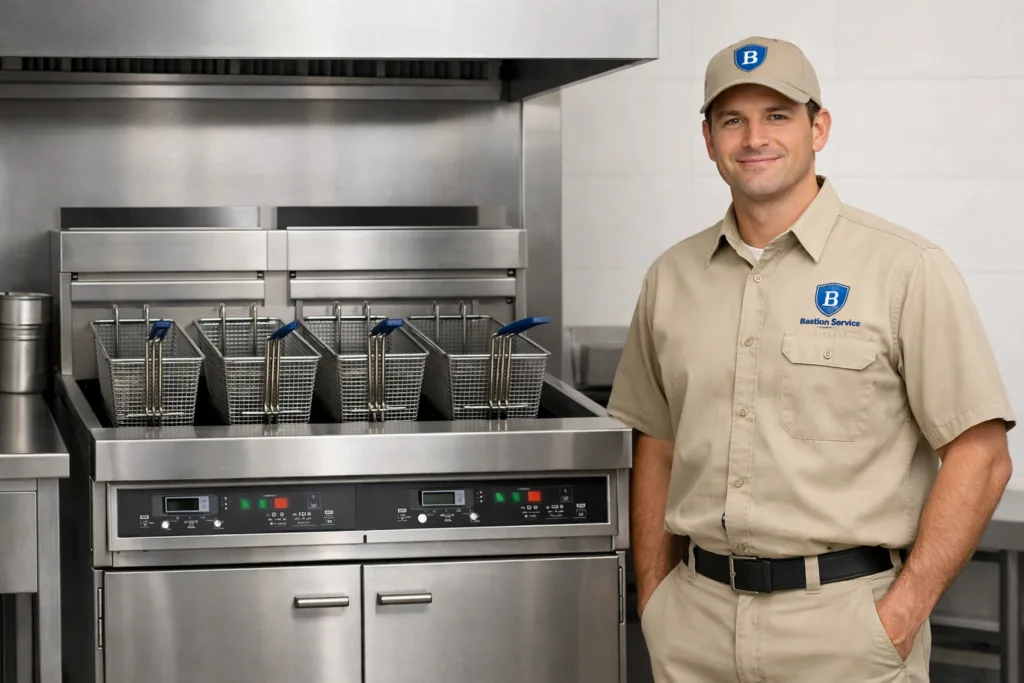




When Pitco cooking equipment starts disrupting service, the most important next step is to identify whether the problem is isolated, intermittent, or likely to cause wider downtime across the kitchen. Bastion Service helps businesses in Mar Vista evaluate symptom patterns, schedule repair, and decide whether equipment can stay in use until service is completed or should be taken offline to avoid a more serious interruption.
For specific equipment paths in Mar Vista, review Pitco Fryer Repair in Mar Vista and Commercial Appliance Repair in Mar Vista.
What Pitco cooking equipment problems usually require repair
Most service calls begin with one of a few operational complaints: the unit will not heat, takes too long to recover, will not ignite consistently, runs hotter or cooler than expected, or shuts down in the middle of production. With Pitco cooking equipment, those symptoms can point to burner trouble, ignition faults, temperature sensing problems, control failures, safety-limit issues, or wear in supporting electrical or gas-related components.
Common problems businesses in Mar Vista report include:
- Slow heat-up or no heat
- Ignition failure or repeated startup attempts
- Burners that do not stay lit
- Temperature drift, overheating, or poor temperature hold
- Weak recovery during peak cooking periods
- Unexpected shutdowns or lockouts
- Control panel faults or inconsistent operation
- Performance issues that delay orders and reduce output
Because several different faults can create the same visible symptom, repair decisions should be based on testing and inspection rather than assumptions.
Fryer issues that affect output and consistency
Pitco fryer problems often show up first as slower ticket times, uneven product quality, or a unit that cannot keep pace during rush periods. A fryer may still appear functional while gradually losing recovery speed, cycling unpredictably, or falling behind under normal kitchen demand. That is usually the stage where scheduled repair makes the most sense, before the unit reaches full downtime.
Slow heat-up and weak recovery
If the fryer takes longer than usual to reach operating temperature or struggles to recover between batches, staff may start adjusting workflow around the equipment. That often leads to slower production and inconsistent results. Causes can include burner performance issues, ignition interruptions, thermostat or probe faults, control problems, or restricted fuel delivery. The repair goal is not just to make the unit heat again, but to restore stable output during normal service volume.
Temperature swings and overheating
A fryer that runs too hot, too cool, or drifts away from the setpoint creates both quality and operational risk. Food may cook unevenly, oil may break down faster, and shutdowns may become more frequent. These symptoms often indicate problems with sensing, regulation, controls, or safety components. Continued use without diagnosis can turn a manageable repair into a larger interruption.
Ignition and burner symptoms that should not be ignored
Ignition trouble is one of the most common reasons businesses schedule service on cooking equipment. Sometimes the problem is obvious, such as a unit that will not start at all. In other cases, the equipment starts after multiple attempts, lights inconsistently, or loses flame during use. Intermittent ignition behavior is still a repair issue because it usually becomes less predictable over time, not more reliable.
Failure to ignite
If the equipment does not ignite or requires repeated restarts, the issue may involve ignition components, flame sensing, controls, wiring, or gas-related operation. Repeated resets may get the unit running temporarily, but they do not resolve the cause. In a busy kitchen, that kind of workaround can quickly become a larger service disruption.
Burner instability
Burners that cycle abnormally, sound unusual, or fail to maintain steady operation can affect heating performance long before a complete shutdown occurs. Even if the unit is still producing some heat, unstable burner operation often leads to poor recovery, temperature inconsistency, and more frequent interruptions. Repair at this stage is usually less disruptive than waiting for the equipment to fail during active service.
Control faults and unexpected shutdowns
When a Pitco unit powers on but does not behave normally, the problem may involve controls, sensors, safety circuits, or related wiring. Shutdowns that seem random are especially important to evaluate because they can interrupt prep, slow the line, and force staff to redirect production to already busy stations.
Signs that point to a control-related issue include:
- The unit starts but does not heat as expected
- Operating behavior changes from shift to shift
- The equipment shuts down without a clear pattern
- Resetting temporarily restores operation
- Fault behavior becomes more frequent during busy periods
These symptoms deserve prompt service because they affect reliability as much as performance. A unit that works only some of the time can be harder on operations than one that is fully offline and already scheduled for repair.
When to stop using the equipment until service is completed
Some cooking equipment problems can be monitored briefly while repair is being arranged, but others are strong signs that continued operation may make the situation worse. If the equipment is overheating, failing to maintain temperature, shutting down repeatedly, or showing unstable ignition behavior, it is often smarter to limit use and have the condition assessed quickly.
For businesses in Mar Vista, the practical question is whether the equipment is still supporting service predictably. If staff are compensating for poor recovery, restarting the unit repeatedly, or adjusting production around unreliable heat, the downtime impact has already started. Scheduling repair before the next peak period can prevent broader disruption.
Repair or replace: how businesses usually decide
Not every Pitco problem points to replacement. Many failures are repairable when the issue is identified early and the rest of the equipment remains in solid operating condition. A targeted repair is often the better choice when the fault is limited to ignition, temperature regulation, controls, burners, or another defined system.
Replacement becomes a more serious consideration when breakdowns are recurring, multiple major systems are involved, or reliability has dropped enough that managers can no longer plan service around the unit with confidence. The right assessment should help you understand whether repair is likely to restore dependable operation or whether further investment may not match the equipment’s remaining value.
What to expect from a service-focused diagnosis
A useful repair visit should answer more than whether one part has failed. It should help the business understand the symptom pattern, likely cause, repair scope, urgency, and whether the equipment can remain in use safely until work is completed. That matters most when a kitchen is balancing staffing, menu demand, and limited equipment redundancy.
If your Pitco cooking equipment is missing temperature, recovering too slowly, showing ignition trouble, or shutting down during production in Mar Vista, the best next step is to schedule diagnosis and repair planning so you can reduce downtime, protect service flow, and make a confident decision about the unit before the problem grows.


