
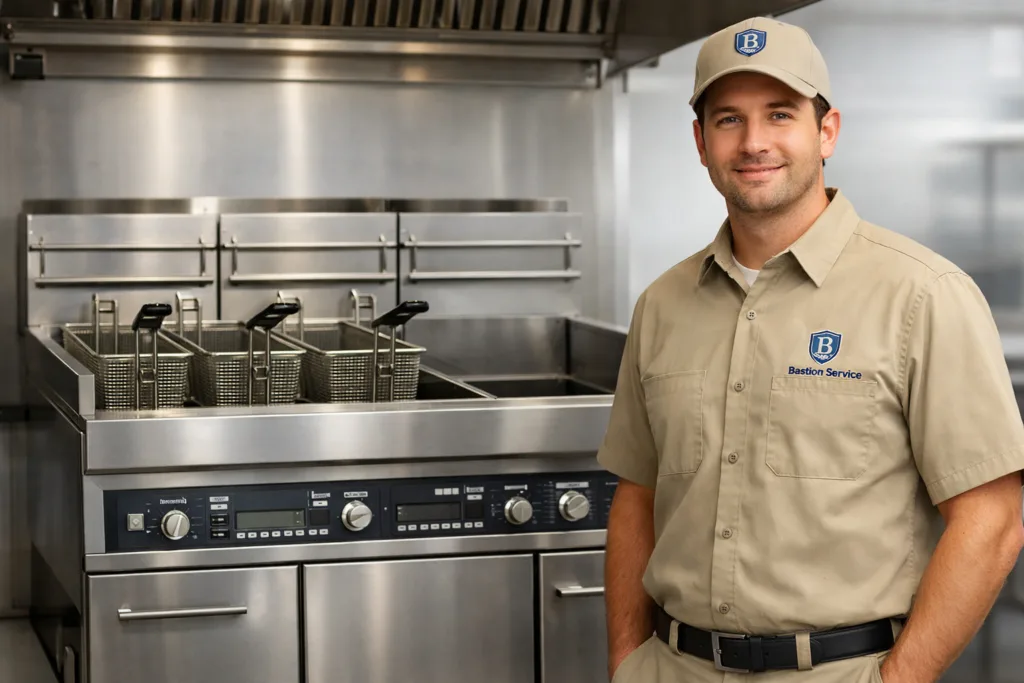




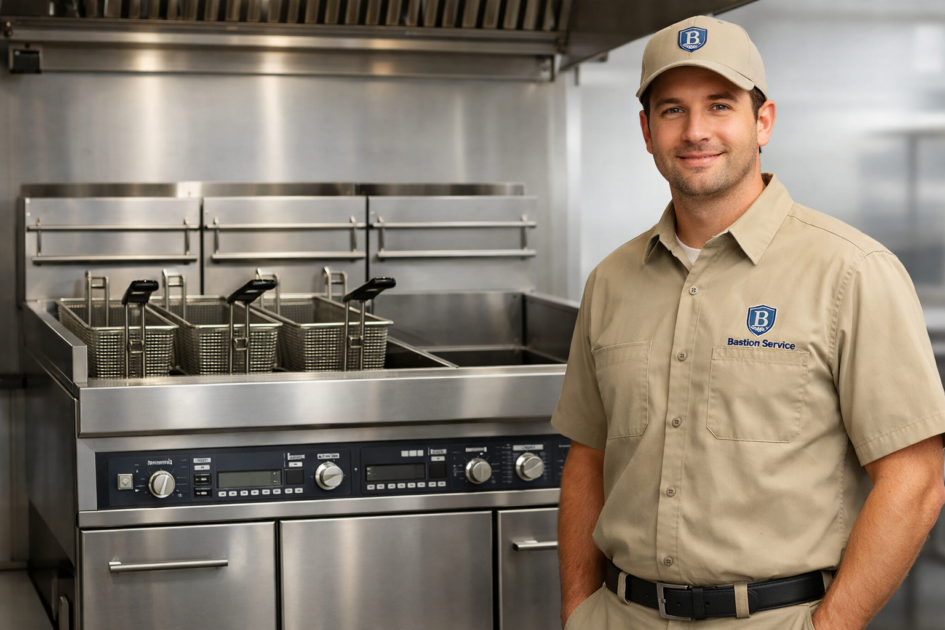
When Pitco cooking equipment starts missing temperature targets, recovering too slowly, or shutting down during service, the next step should be symptom-based repair scheduling rather than trial-and-error resets. For Beverly Hills kitchens, the real concern is how quickly a heat, ignition, or control problem turns into lost output, uneven food quality, and disruption across the line. A service visit should focus on identifying the failed system, confirming whether the unit can remain in use, and outlining the repair path that best protects daily operations.
For specific equipment paths in Beverly Hills, review Pitco Fryer Repair in Beverly Hills and Commercial Appliance Repair in Beverly Hills.
Bastion Service helps local businesses assess Pitco equipment problems that interfere with production, timing, and staff workflow. In many cases, what looks like a simple heating complaint is actually tied to ignition components, sensors, gas flow, safety limits, wiring, burner performance, or control failures. Getting that distinction right early helps managers make better decisions about same-day use, repair timing, and whether a unit should be temporarily taken offline.
Common Pitco cooking equipment problems that disrupt kitchen output
Even when a unit still powers on, performance issues often show up in ways that affect service long before complete failure. Operators may notice slower ticket flow, inconsistent cook results, unusual cycling, or repeated restart attempts. With Pitco cooking equipment, these symptoms usually point back to a specific system rather than a general loss of performance.
- Temperature drift that causes undercooked or overcooked product
- Slow recovery between batches that creates bottlenecks during rush periods
- Ignition failures, delayed startup, or intermittent lighting
- Unexpected shutdowns during active use
- Burners that run unevenly or fail to maintain stable heat
- Control issues, fault indications, or erratic cycling
- Oil-related leaks or operating conditions that raise safety concerns
These problems are more than maintenance annoyances. In a busy food-service setting, they affect consistency, throughput, labor coordination, and the ability to keep core menu items moving without interruption.
Heating and temperature control issues
One of the most common reasons businesses request Pitco cooking equipment repair is unstable heat. Equipment may run too hot, too cool, cycle at the wrong times, or fail to hold a set temperature through a full shift. That kind of behavior can be linked to probes, thermostatic controls, high-limit components, calibration issues, relays, or related electrical faults.
In practical terms, temperature problems usually appear first in product quality and timing. Staff may compensate by extending cook times, reducing batch size, or rotating work to another station, but those workarounds rarely hold up during peak demand. If the unit is scorching product, lagging below target temperature, or behaving unpredictably, repair should be scheduled before the issue creates larger service problems.
Signs the problem may be temperature-related
- Food color and texture become inconsistent from batch to batch
- Cook times lengthen without any menu change
- The unit overshoots heat and then drops sharply
- Operators notice frequent cycling or unstable readings
- High-limit trips or overheating complaints begin appearing
Slow recovery and reduced batch capacity
A Pitco unit that technically runs but recovers too slowly can be just as disruptive as one that fails to start. Recovery issues often show up when the equipment struggles after a heavy batch load and cannot return to operating temperature fast enough for the next order cycle. In Beverly Hills kitchens where speed and consistency matter, that can force menu pacing changes, longer ticket times, and unnecessary strain on surrounding stations.
Slow recovery may be related to burner performance, heat transfer issues, sensor faults, gas pressure concerns, or wear that has gradually reduced output. The longer this continues, the more likely staff will compensate in ways that hurt consistency or push other equipment beyond normal workload. If the line is slowing down because one unit cannot keep up, it is usually time to have the cause identified rather than waiting for a complete outage.
Ignition and startup failures
Startup trouble often begins as an intermittent issue. The unit may light after several attempts, require resets, lock out unexpectedly, or fail more often at opening than during the rest of the day. Those symptoms can indicate wear in the ignition system, flame-sensing trouble, gas delivery faults, wiring problems, or a failing control component.
These are not issues to normalize in a kitchen environment. Repeated ignition attempts and unreliable startup waste time, delay prep, and make operators uncertain about whether the equipment will stay online through service. When a unit starts inconsistently, diagnosis should determine whether it is safe to continue using and what repair is needed to restore dependable operation.
Startup complaints worth taking seriously
- Clicking or repeated lighting attempts before operation begins
- Intermittent failure to ignite at opening
- Lockouts that require operator intervention
- Burner flame that does not establish or hold properly
- Frequent resets just to keep the unit available
Shutdowns, burner irregularities, and control faults
Unexpected shutdowns during active use often point to a deeper reliability issue than a one-time interruption. A Pitco unit may heat normally at first and then drop out mid-cycle, stop responding to controls, or show signs of unstable burner operation. In many kitchens, this creates the kind of stop-and-start workflow that slows production and increases the risk of wasted batches.
Control-related failures can involve boards, relays, wiring, switches, safety circuits, or components that no longer respond consistently under load. Burner irregularities may also indicate airflow, gas, ignition, or heat regulation problems. The important step is to identify whether the shutdown originates from a safety function, a control issue, or a heat-production fault, because each repair path affects scheduling and parts planning differently.
Leaks, safety concerns, and when to stop using the equipment
Some symptoms call for faster action because continued use can make the final repair more serious or create unnecessary risk in the kitchen. Leaks, overheating, repeated limit trips, strong irregular odor, unstable flames, or shutdowns that become more frequent during operation should not be treated as routine wear. When operators are working around the issue instead of trusting the equipment, it is often a sign the unit should be inspected before being placed back into normal rotation.
Businesses should be especially cautious when the problem is no longer isolated to performance. If the equipment is leaking, running abnormally hot, or requiring repeated intervention just to finish a shift, the cost of delay is often greater than the cost of addressing the fault promptly.
Repair decisions based on symptoms, age, and downtime risk
Not every Pitco problem points to replacement. Many failures involve serviceable parts and can be resolved once the affected system is confirmed. At the same time, recurring ignition issues, repeated temperature complaints, ongoing shutdowns, or a history of similar repairs may indicate a larger reliability pattern that should factor into the decision.
For managers, the most useful evaluation is not simply whether the unit can be repaired, but whether the repair supports stable operation going forward. That means considering:
- How often the same symptom has returned
- Whether the equipment is still meeting production demands
- How disruptive the downtime is to menu execution
- Whether staff are relying on workarounds to keep service moving
- The condition of controls, burners, heat-related components, and overall wear
A proper diagnosis gives the business a clearer basis for deciding whether to proceed with repair, plan around parts, or prepare for a longer-term equipment change.
What a service visit should clarify
For Pitco cooking equipment repair, a useful service call should do more than confirm the obvious complaint. It should connect the symptom to the failed system, identify whether continued use is advisable, and help the business understand the likely scope of repair. That matters when one piece of cooking equipment affects prep timing, line capacity, labor flow, and customer service standards all at once.
When a Beverly Hills business is dealing with heat loss, ignition trouble, control faults, slow recovery, or repeated shutdowns, scheduling service early usually provides the best chance to contain downtime. The goal is to restore stable operation with a repair plan that fits the actual symptom pattern, the kitchen schedule, and the urgency of keeping production moving.


