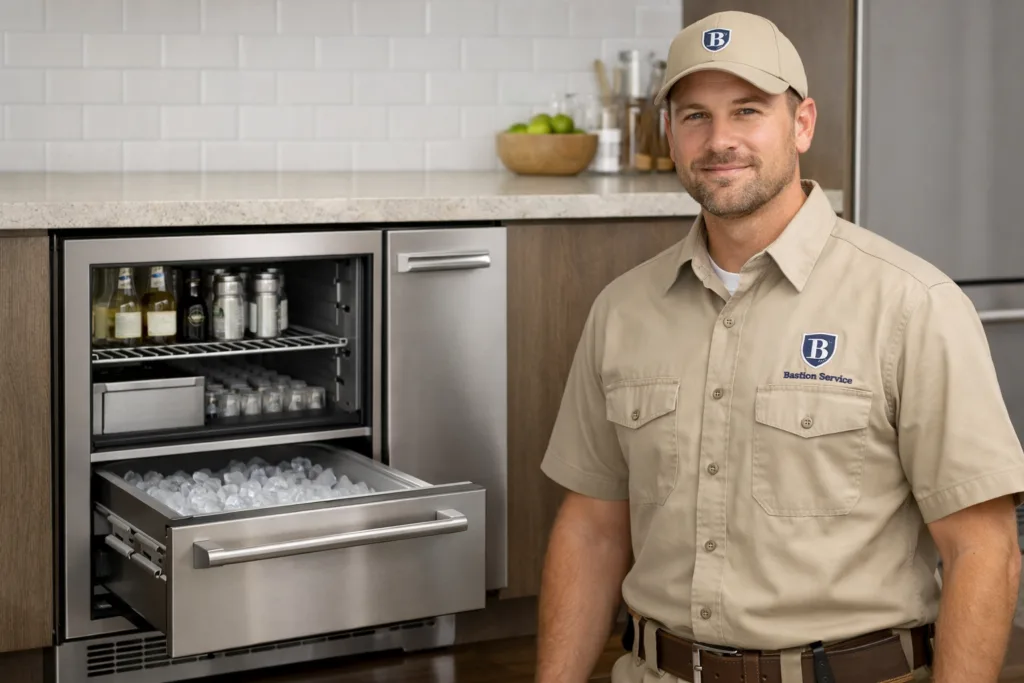





Perlick appliances often show the same few warning signs before a larger failure develops: temperatures drift, frost appears where it should not, water starts collecting, or the unit begins sounding different during normal cycles. For a homeowner, the most helpful approach is to match the symptom to the most likely system involved so the next step is based on evidence rather than trial and error.
For specific Perlick appliance paths in Marina del Rey, review Perlick Refrigerator Repair in Marina del Rey, Perlick Freezer Repair in Marina del Rey, and Perlick Ice Maker Repair in Marina del Rey.
What a proper diagnosis should clarify
Several Perlick problems can look identical at first. A refrigerator that feels warm may be dealing with restricted airflow, a fan issue, a sensor problem, dirty condenser surfaces, or a sealed-system fault. A wine cooler that no longer holds its range may have a control issue, a failing thermistor, poor door sealing, or declining compressor performance. An ice maker that stops producing may be affected by water supply, drainage, scale buildup, or an internal cooling problem.
The real value of diagnosis is separating a manageable repair from a more serious condition. That matters because continued operation can sometimes add stress to the compressor, create repeat icing, damage cabinetry with leaks, or leave food and beverages at unreliable temperatures.
How Perlick refrigerator problems usually appear
Refrigerator issues tend to show up in ways homeowners notice quickly: milk does not stay cold enough, items near the back freeze unexpectedly, the cabinet runs too long, or the unit becomes noisier than usual. These patterns usually point to a problem in one of a few areas.
- Uneven cooling: often linked to airflow restriction, fan trouble, sensor drift, or blocked vents.
- Constant running: may suggest dirty condenser surfaces, weak door sealing, control errors, or a cooling system working harder than normal.
- Water under the unit: commonly caused by a drain issue, condensation problem, or loose water connection.
- Clicking, buzzing, or new vibration: sometimes harmless during normal cycling, but persistent changes deserve inspection.
If food temperature no longer feels consistent from shelf to shelf, it is usually a sign that the issue is beyond a simple settings adjustment.
Freezer symptoms that should not be ignored
A Perlick freezer usually needs attention when food softens, frost returns repeatedly, or the interior shows signs of thawing and refreezing. Those symptoms can point to defrost component failure, evaporator airflow issues, door seal leaks, or control-related temperature swings.
Heavy frost is especially important to interpret correctly. It can develop because moisture is getting in through a poor seal, because the defrost cycle is not working properly, or because circulation inside the cabinet is restricted. The same visible frost pattern can come from very different causes, which is why guessing often leads to the wrong repair.
If frozen food is already softening, the concern is no longer convenience alone. At that stage, stable recovery becomes the main question.
Why Perlick ice makers often fail gradually
Ice makers rarely go from normal operation to complete failure without a transition period. Many first show slower production, smaller cubes, hollow cubes, poor taste, or occasional leaking before they stop making ice altogether.
Common causes include:
- Reduced water flow
- Mineral scale affecting internal passages
- Drainage restrictions
- Sensor or control problems
- Cooling performance that is no longer strong enough for normal ice formation
In Marina del Rey homes, moisture exposure and mineral accumulation can make preventive cleaning and inspection more important over time. If the machine is leaking, producing inconsistent batches, or cycling abnormally, waiting usually does not improve the outcome.
Wine cooler problems are often subtle at first
Perlick wine coolers often decline gradually, which makes early symptoms easy to overlook. A slight temperature drift, unexpected condensation, more frequent compressor cycling, or a change in internal airflow can all be early indicators that the unit is no longer maintaining stable storage conditions.
Homeowners may notice:
- Bottles feel warmer than expected
- The displayed temperature does not match actual cabinet conditions
- Humidity seems inconsistent
- Condensation appears around the door or inside the cabinet
- Fans or compressor sounds change noticeably
Because wine storage depends on consistency rather than just “cold enough,” even a small but persistent shift can justify service before the cooler stops altogether.
Signs the issue is getting worse, not better
Some appliance problems remain stable for a short period. Others tend to escalate. A Perlick unit is more likely to worsen when it runs constantly, develops repeating frost patterns, leaks onto surrounding surfaces, or cycles between normal and poor performance without holding a stable temperature.
That is especially true when homeowners find themselves repeatedly adjusting settings, resetting power, emptying ice buildup, or cleaning up water without any lasting improvement. Those are usually signs that the appliance is no longer dealing with a minor operating issue.
When it makes sense to stop waiting
Scheduling repair is usually the better choice when any of the following are happening:
- Temperature does not match the setting
- Cooling is inconsistent from one day to the next
- Water is pooling under or inside the appliance
- Frost keeps returning after being cleared
- Ice production has dropped sharply or stopped
- The appliance short cycles or runs nearly nonstop
- Noise, vibration, or startup behavior has changed
These symptoms matter not just because the appliance is inconvenient, but because they often indicate a component is working under strain.
Repair or replacement depends on the failure pattern
Not every Perlick problem points in the same direction. Many repairs make sense when the issue is isolated, the cabinet and interior are still in good shape, and the diagnosis shows a clear path to stable performance. That is often true for fan problems, drainage issues, door sealing faults, some control-related failures, and certain ice maker water system problems.
Replacement becomes a more serious consideration when there are multiple failures at once, repeat breakdowns over a short period, major cooling-system problems, or a repair that would not reasonably restore long-term reliability. The important part is making that decision after the cause has been identified, not before.
What homeowners in Marina del Rey should expect from service
Useful service should explain more than the symptom. It should identify the failing system, outline the recommended repair, and make clear whether the appliance is a good repair candidate. That applies whether the issue involves a Perlick refrigerator, freezer, ice maker, or wine cooler.
For households in Marina del Rey, the goal is simple: restore dependable food, ice, or beverage storage without wasting time on guesses. When the symptom pattern is understood clearly, the repair decision becomes much easier and much more cost-effective.