
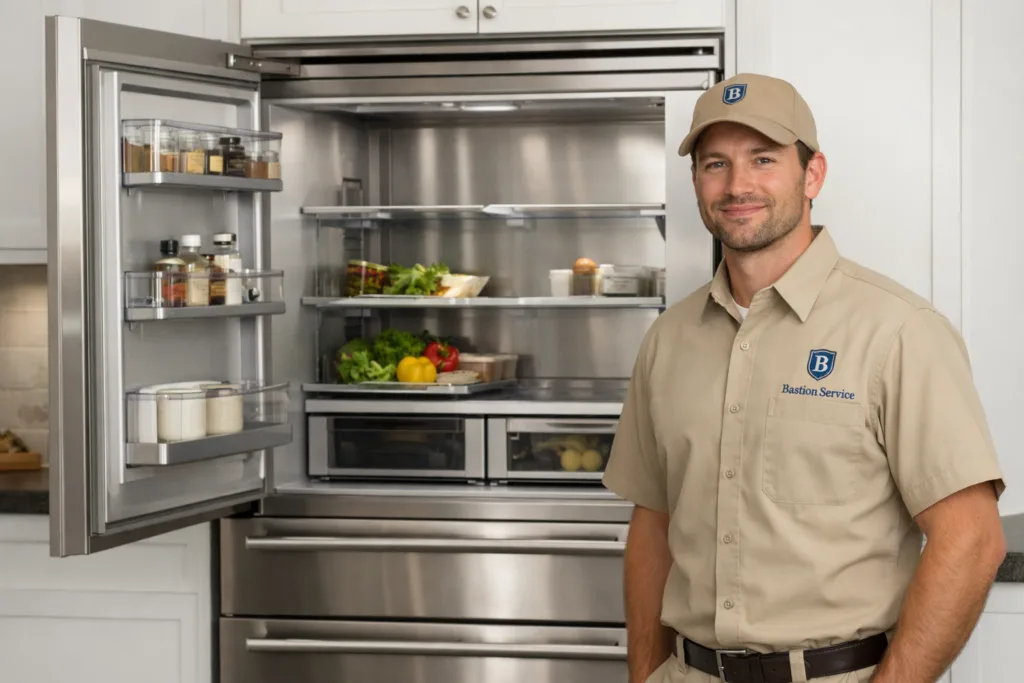




Temperature drift, leaking, frost, and unusual noise often point to a smaller system problem before they point to total appliance failure. With Marvel units, the same symptom can come from several different causes, so it helps to look at patterns such as when the issue started, whether it is constant or intermittent, and whether other changes appeared at the same time.
For specific Marvel appliance paths in Fairfax, review Marvel Refrigerator Repair in Fairfax, Marvel Freezer Repair in Fairfax, and Marvel Ice Maker Repair in Fairfax.
How to read the symptom before assuming the repair
Homeowners in Fairfax often notice the result first: food feels warmer, bottles are not staying at the set temperature, ice output drops, or moisture starts collecting around the unit. The part that seems most obvious is not always the part at fault. A cooling complaint may actually begin with poor airflow, a worn gasket, a sensor issue, drainage blockage, or a fan that is no longer operating at full speed.
Before service is scheduled, it is useful to note a few details:
- Whether the appliance is fully warm or only inconsistent
- Whether the problem is worse after the door is opened often
- Whether noise, frost, or leaking appeared at the same time
- Whether the control display is acting normally
- Whether the unit runs constantly or shuts off too soon
These details can help separate a door-seal or airflow issue from a control or sealed-system problem.
Marvel refrigerator problems that deserve attention early
A refrigerator that is no longer holding temperature evenly can be dealing with restricted condenser airflow, evaporator fan trouble, sensor drift, control failure, or a defrost issue that limits cold air movement. In many cases, homeowners notice one shelf freezing while another section turns warm. That uneven pattern usually means the appliance is still cooling, but it is no longer distributing air correctly.
Water under or inside the refrigerator does not always mean a major cooling failure. A blocked drain, excess condensation, or a gasket problem may be allowing moisture to collect where it should not. If the compressor seems to run longer than normal while temperatures still rise, that can indicate the refrigerator is working harder to overcome another underlying fault.
Common refrigerator warning signs
- Milk or leftovers warming before the control setting changes
- Freezing in one area and softness in another
- Frequent running with little recovery in temperature
- Puddles, interior moisture, or recurring condensation
- Buzzing, clicking, or new fan noise
What freezer symptoms usually suggest
Freezer trouble tends to show up fast because food quality changes quickly once temperatures rise. Soft items, frost around the door, ice buildup on interior panels, or drawers that become harder to open can all point to air leaks or defrost-related issues. If frost returns soon after cleaning, the appliance may be pulling in warm air through a sealing problem or failing to clear moisture during the defrost cycle.
A freezer that swings between too warm and too cold can be harder to diagnose from the outside. That kind of fluctuation may involve the control side of the appliance, a sensor reading problem, or inconsistent fan operation. When food appears to thaw slightly and then refreeze, it is usually best not to treat the issue as a minor inconvenience.
Signs the freezer should not be monitored for too long
- Soft frozen food or crystals forming on packaged items
- Heavy frost that keeps returning
- A door that no longer seals tightly
- Long run times followed by weak cooling
- Noticeable temperature swings from day to day
Ice maker issues are not always ice-maker-only problems
When a Marvel ice maker stops producing, makes very small cubes, leaks, or creates cloudy or misshapen ice, the cause may be in the water supply, fill path, valve, control system, or cooling performance of the surrounding appliance. That is why replacing the ice maker assembly alone does not always solve the complaint.
Slow production can be especially misleading. If the unit still makes some ice, many homeowners assume the mechanism is mostly fine, but reduced output may reflect temperature conditions that are slightly off rather than completely failed. Clumping can point to melt-and-refreeze behavior, while bad taste or odor may suggest water quality concerns or stale ice sitting too long because the production cycle has changed.
Wine cooler temperature drift and moisture problems
A wine cooler does not need to be fully warm to have a real performance problem. Even moderate drift can matter when storage conditions are supposed to remain steady. If the unit cycles more often, develops glass condensation, or struggles to stay near the selected range, the issue may involve airflow, controls, door sealing, or early component strain.
Homeowners sometimes first notice that bottles feel slightly warmer than expected even though the display still appears normal. In other cases, the cooler becomes louder, runs longer, or gathers moisture inside. Those signs often mean the appliance is compensating for a condition that has not yet turned into a complete breakdown.
Watch for these wine cooler symptoms
- Set temperature and actual cooling no longer match
- Interior humidity or condensation is increasing
- Operation is noticeably louder than before
- Cooling recovery after opening the door is slower
- The compressor seems to cycle too frequently
Why multiple symptoms often connect to one root cause
It is common for a single fault to create several household complaints at once. Poor condenser airflow can lead to warmer temperatures, longer run times, and lower ice production. A drain or defrost problem can show up as leaking, frost, and interior moisture. A weak fan motor may create noise first, then uneven cooling shortly afterward.
Looking at symptoms as a group is often more useful than reacting to each one separately. If a refrigerator is warm, noisy, and leaking, those issues should not be assumed to be unrelated. The pattern may point toward one system rather than three separate repairs.
When continued use can make the situation worse
Some appliances can limp along for a while, but that does not always make waiting a good idea. If a Marvel unit is running almost nonstop, rebuilding frost quickly, leaking repeatedly, or showing unstable controls, continued operation can add wear to major components. It can also make diagnosis harder if temporary thawing or intermittent recovery hides the original symptom pattern.
Service is usually worth scheduling sooner when:
- Food storage is being affected
- Ice production has dropped sharply
- A wine cooler cannot stay within its intended range
- The appliance is tripping power or restarting oddly
- Noise has changed from occasional to frequent
Repair or replacement: what usually drives the decision
Many Marvel appliance issues are repairable, especially when the fault is limited to a fan, sensor, control component, valve, drain, seal, or ice-maker-related part. For a built-in or carefully fitted household unit, repair is often attractive when the appliance still suits the space and the rest of the system is in solid condition.
Replacement becomes a more serious consideration when there are repeated major cooling failures, broader age-related wear, or sealed-system problems that significantly affect long-term value. The decision usually depends less on frustration from one bad day and more on the condition of the appliance as a whole, the expected repair scope, and whether reliable performance is likely after the work is done.
What Fairfax homeowners can do before the appointment
A few simple observations can make service planning easier. Keep the appliance closed as much as possible, protect food or beverages if temperatures are unstable, and write down any recent changes in sound, cycling, or display behavior. If leaking is present, note where water appears and whether it happens continuously or only after certain cycles.
For households in Fairfax, the most useful next step is usually not guessing at parts, but identifying whether the problem centers on cooling, airflow, drainage, water supply, or controls. That makes it easier to choose the right repair path for a Marvel refrigerator, freezer, ice maker, or wine cooler without turning a manageable issue into a larger one.





