
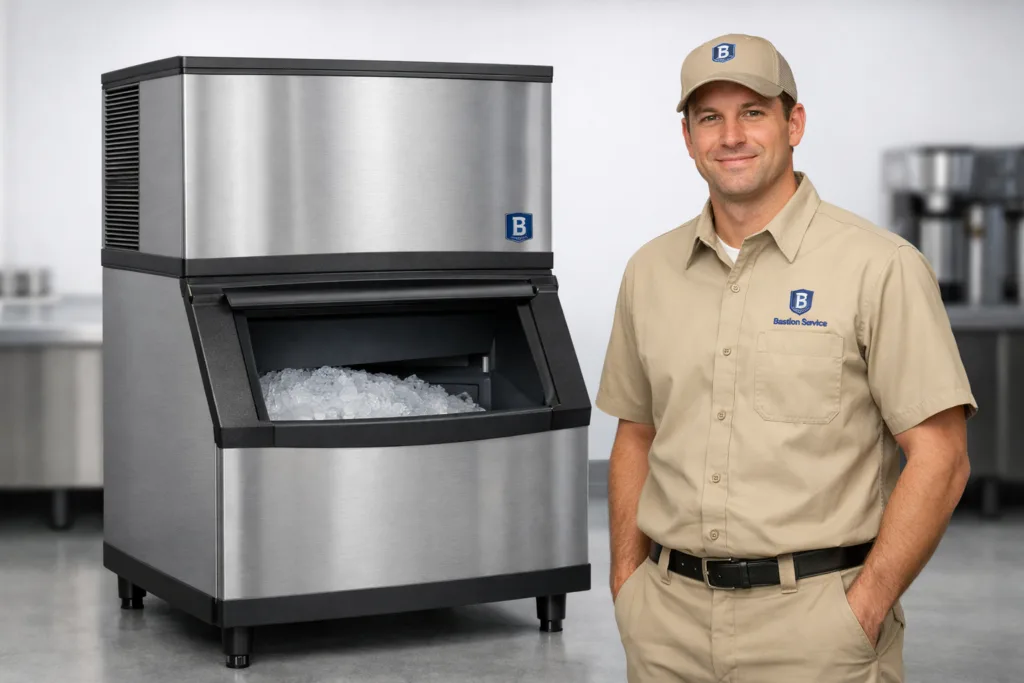




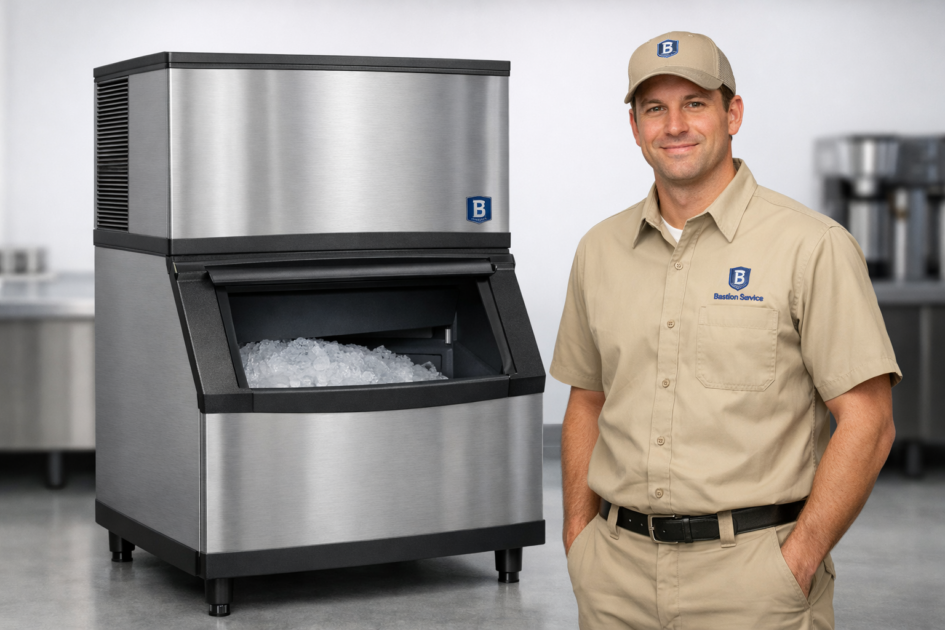
When a Manitowoc ice machine starts falling behind, leaking, or stopping mid-cycle, the priority is to identify the fault quickly and decide whether the unit can stay in use, needs immediate repair, or should be taken offline to prevent added damage. For businesses in Del Rey, ice problems can affect beverage service, food holding, prep flow, guest experience, and staff efficiency within the same day. Bastion Service handles symptom-based Manitowoc ice machine repair by tracing the issue to the actual cause before repair scheduling, parts decisions, or restart recommendations are made.
Related commercial service paths in Del Rey include Manitowoc Commercial Repair in Del Rey, Commercial Ice Machine Repair in Del Rey, and Hoshizaki Ice Machine Repair in Del Rey.
Common Manitowoc Ice Machine Problems That Need Service
Low ice production or slow recovery
If the bin is not filling at its usual pace, the problem may involve restricted water flow, mineral buildup, weak condenser performance, a failing water inlet component, or a control issue affecting freeze times. Some machines continue running while production steadily drops, which can make the problem easy to overlook until demand increases and output no longer keeps up.
No ice at all
A Manitowoc machine that has stopped making ice completely may be dealing with a power issue, control fault, sensor problem, water supply interruption, failed pump, or a refrigeration-related failure. In this situation, resets rarely tell the full story. If the machine powers on but never reaches a normal freeze and harvest sequence, testing is usually needed to avoid replacing the wrong part.
Thin, hollow, cloudy, or misshapen cubes
Changes in cube size or appearance often point to problems with incoming water, scale accumulation, uneven freezing conditions, or cycle timing. Ice quality issues are not only cosmetic. They can signal that the machine is running outside normal operating conditions, which may lead to lower output, clumping in the bin, or extra strain on internal components.
Leaks and drainage problems
Water around the machine may come from a clogged drain line, overflow condition, loose connection, cracked component, failed pump, or internal icing that sends water where it should not go. Even a minor leak deserves attention because it can create slip hazards, affect nearby surfaces, and lead staff to keep wiping up symptoms instead of solving the source.
Harvest cycle failures
If the machine freezes but does not release ice properly, the issue may involve thickness control, sensors, hot gas components, scale buildup, or board-related cycle problems. Harvest issues often show up as ice hanging in place, slabs dropping incorrectly, repeated retries, or shutdowns after incomplete cycles.
Machine shuts down, pauses, or needs repeated resets
Intermittent shutdowns can be tied to safety limits, overheating, electrical faults, sensor readings, airflow problems, or drainage conditions that trigger protective responses. A machine that works only after repeated resets is usually signaling a deeper fault rather than a one-time interruption.
Why Symptom Patterns Matter
Ice machines often show overlapping symptoms. For example, low production may look like a simple water problem but actually stem from restricted airflow or poor refrigeration performance. A leak may appear to be a drain issue while the root cause is an incomplete harvest cycle that creates excess ice in the wrong area. Looking at the full pattern helps determine whether the repair is straightforward, whether multiple conditions are present, and whether continued operation is likely to make the problem worse.
Useful service starts with details such as:
- Whether the machine makes some ice, no ice, or inconsistent batches
- How long the symptom has been happening
- Whether the unit leaks during fill, freeze, harvest, or shutdown
- If staff have noticed noise changes, alarms, or repeated resets
- Whether cleaning changed the symptom at all
Why Is My Manitowoc Ice Machine Not Making Enough Ice?
This is one of the most common service calls because reduced output can develop gradually. In many cases, the machine still appears active, but it is taking too long to freeze, not harvesting cleanly, or not receiving the water volume needed for full production. Dirty condensers, scale buildup, weak water flow, warm operating conditions, and failing control components can all reduce output without stopping the machine completely.
If your Manitowoc unit in Del Rey is not keeping up, the most important question is whether the problem is limiting production slightly or pointing to a larger failure in progress. A machine that struggles through cycles can continue losing capacity, create poor ice quality, and place extra stress on major components. That is why low production should be treated as a repair issue rather than just a performance complaint.
Problems That Often Get Misread as Cleaning Issues
Cleaning is important, but not every Manitowoc symptom is solved by descaling or sanitizing. Businesses sometimes assume that poor output, clumped ice, or irregular cycling means the machine just needs maintenance, when the actual cause is a failed sensor, weak pump, control problem, drainage fault, or refrigeration issue. Cleaning may improve conditions temporarily while the underlying fault remains.
Signs the problem may go beyond routine cleaning include:
- The machine was cleaned but output is still low
- Leaks return shortly after maintenance
- The unit powers on but does not complete normal cycles
- Ice quality changes happen suddenly rather than gradually
- Staff must reset the machine to keep it running
When Continued Operation Can Make Things Worse
Some ice machine problems are more than an inconvenience. Running a leaking unit, ignoring unusual noises, or forcing a machine through incomplete cycles can increase wear and turn a manageable repair into a more disruptive one. Water can affect surrounding areas, restricted airflow can push temperatures higher, and repeated failed cycles can stress components that are still serviceable.
It is usually time to stop normal use and schedule repair when:
- No ice is being produced during active demand periods
- Water is pooling around or under the unit
- The machine trips, shuts down, or restarts repeatedly
- Ice is clumping, melting, or dropping irregularly
- New grinding, rattling, or fan noise has appeared
Repair or Replace?
Many Manitowoc ice machine issues can be corrected with targeted repair, component replacement, drainage work, electrical diagnosis, or restoration of proper water flow and cycling. Replacement becomes a stronger consideration when the machine has ongoing reliability problems, multiple major faults, poor overall condition, or repair costs that no longer support dependable daily use.
The best decision usually depends on what failed, how the rest of the machine is performing, and whether repair is likely to restore stable output. For Del Rey businesses, the real measure is not just whether the unit can run again, but whether it can return to consistent operation without becoming a repeat source of downtime.
How to Prepare for a Service Visit
A few details can help speed up diagnosis and make repair planning more accurate. Before service, it helps to note when the machine last worked normally, whether the issue is constant or intermittent, and what staff have already tried. If the machine leaks only during certain parts of the cycle or production drops mostly during busy periods, that information can help narrow the fault faster.
It is also helpful to be ready with:
- The model information if available
- A description of the ice quality problem
- Any recent shutdowns, alarms, or reset attempts
- Whether the issue followed cleaning, plumbing work, or a drainage problem
- How urgently the machine affects current operations
Service Focused on Uptime and Next Steps
Manitowoc ice machine issues are easiest to manage when the repair decision is tied to the actual symptom pattern instead of guesswork. Whether the problem involves low output, no ice, leaks, clumped cubes, fill issues, or failed harvest cycles, the goal is to determine what has failed, what can be corrected, and how quickly the machine can return to reliable use. For businesses in Del Rey, scheduling service early often reduces downtime, protects surrounding work areas, and makes it easier to plan the next step with confidence.


