
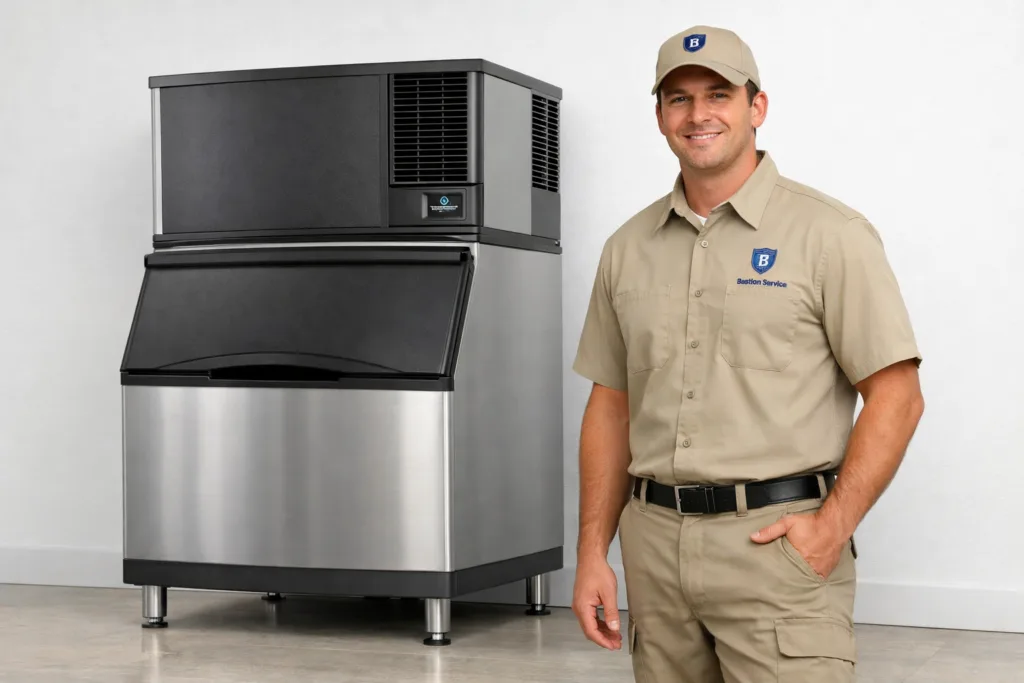




When a Manitowoc ice machine starts missing output targets, shutting down, leaking, or making poor-quality ice, the next step should be a service visit that identifies the cause and helps you decide how quickly repair needs to happen. For businesses in West Hollywood, ice problems can affect beverage service, food holding routines, sanitation, and day-to-day workflow, so it is important to address the symptom pattern before a partial issue becomes a full outage.
For specific equipment paths in West Hollywood, review Manitowoc Ice Machine Repair in West Hollywood and Commercial Appliance Repair in West Hollywood.
A repair appointment should do more than restart the machine. It should help confirm whether the problem is tied to water supply, drainage, scale buildup, harvest failure, refrigeration performance, sensors, pumps, or controls, and whether continued operation is likely to increase downtime. Bastion Service works with West Hollywood businesses that need Manitowoc ice machine repair based on actual machine behavior, parts needs, and realistic scheduling.
Common Manitowoc ice machine problems that interrupt operations
Ice machine issues often build gradually before they become obvious. A unit may begin with slower production, longer freeze cycles, or uneven ice formation, then move into overflow, failed harvest, or safety shutdowns. Catching those signs early can make repair planning easier and reduce the chance of losing ice production during business hours.
Low ice production or no ice
If the machine is making less ice than normal, producing smaller batches, or stopping production altogether, several systems may be involved. Water flow restrictions, inlet valve problems, scale accumulation, sensor faults, refrigeration issues, and temperature-related conditions can all reduce output. The key question is not just why output dropped, but whether the machine can keep running safely until repair is completed.
Low production also tends to create a misleading situation for managers: the unit still appears to be working, but it no longer supports normal demand. That usually means repair should be scheduled before the machine falls behind completely or stops mid-shift.
Poor ice quality, cloudy cubes, or irregular shape
Changes in ice appearance often point to a developing problem rather than a one-time variation. Cloudy cubes, thin ice, hollow ice, or uneven shape can result from scale, water distribution issues, freeze-cycle inconsistency, or component wear that affects how ice forms and releases. If presentation and drink quality matter to your operation, these symptoms deserve attention even when the machine is still producing.
Ice quality changes can also appear alongside reduced output or harvest trouble, which is why inspection is usually more useful than trying to treat each symptom separately.
Leaks, overflow, and drainage problems
Water around the machine, moisture in the bin, or repeated overflow should be treated as a repair issue, not just a cleanup issue. Clogged drains, cracked water lines, loose fittings, pump problems, or abnormal ice formation can all cause leaking. Beyond the machine itself, leaks can create slip hazards, affect surrounding surfaces, and complicate sanitation routines.
If the leak is recurring, the problem may be deeper than a visible connection point. A proper diagnosis helps determine whether the issue is isolated to drainage or part of a larger operating fault.
Harvest problems and incomplete ice release
When ice sticks to the evaporator, drops in partial sheets, or fails to release on time, the machine may begin cycling abnormally or shutting itself down. Harvest issues are often linked to scale buildup, water system imbalance, sensor trouble, or cooling performance problems. Repeatedly resetting the unit may get it running for a short time, but it usually does not resolve the cause.
Harvest problems matter because they affect both output and consistency. Even if some ice is still being produced, the machine may already be moving toward a larger stoppage.
Shutdowns, fault conditions, and intermittent operation
An ice machine that starts and stops unpredictably can be one of the most disruptive problems to manage. Intermittent operation makes planning difficult because the unit may appear normal for a period, then fail again during higher demand. Shutdowns can be triggered by protective controls, failed components, restricted water movement, or operating conditions the machine is not able to correct on its own.
When shutdowns become repetitive, it is usually more efficient to schedule service than to rely on resets. The machine may be preventing further damage, and ignoring that warning can lead to longer downtime later.
What a diagnosis should help you determine
Before approving repair, most businesses want to know three things: what is causing the issue, whether the machine can continue running for now, and what the repair path looks like. That is where diagnosis becomes especially valuable. Instead of treating only the visible symptom, the service process should identify the affected system and the likely risk of continued use.
For a Manitowoc unit, that may mean separating a water flow problem from a refrigeration problem, confirming whether scale has caused secondary component issues, or determining whether a control-related fault is causing intermittent shutdowns. That information helps with scheduling, parts planning, and decisions about whether temporary operational adjustments are realistic.
Signs the machine should not be left to “see if it clears up”
Some problems escalate quickly if the unit keeps running. Scheduling service sooner is usually the better choice when the machine is already showing any of the following:
- Active leaking or repeated overflow
- Very slow ice production during normal demand
- Repeated shutdowns or error indications
- Ice that is cloudy, thin, misshapen, or inconsistent
- Harvest cycles that stall, repeat, or release incompletely
- Visible scale buildup affecting normal operation
- Unusual noises during freeze or harvest cycles
These conditions often point to faults that will not improve on their own. Waiting can increase wear, create sanitation concerns, and make downtime harder to control.
Repair versus replacement considerations
Not every failing machine needs to be replaced, and not every repair is the best long-term move. The decision usually depends on the age of the equipment, the number of systems involved, the severity of scale-related damage, how often the unit has required service, and whether the current problem appears isolated or part of a broader decline.
If the issue is limited to a serviceable component or a contained operating fault, repair may restore stable production without major interruption. If the machine has multiple recurring failures, declining performance across several functions, or a history of repeated shutdowns, it may be time to weigh the repair cost against the value of continued operation.
Scheduling service around business needs in West Hollywood
Ice machine repair is not only about fixing the fault. It is also about managing downtime in a way that works for your operation. Businesses in West Hollywood may need appointments planned around customer-facing hours, prep periods, delivery schedules, or restricted access times. A well-planned visit should help clarify immediate operating risk, likely next steps, and whether the machine should remain in use while repair is arranged.
This is especially important when the unit is still partially functional. A machine that makes some ice can create the impression that service can wait, even though output, water handling, or harvest timing is already unstable. In many cases, diagnosing the machine while the failure pattern is still visible leads to a faster and more accurate repair decision.
Service-oriented support for Manitowoc ice machine issues
Manitowoc equipment is built for demanding use, but water flow problems, scale buildup, leaks, shutdowns, harvest issues, and ice quality concerns still need targeted repair when performance changes. If your machine is slowing down, leaking, producing poor ice, or cycling unpredictably, scheduling service now is usually the best way to limit downtime, protect daily operations, and move forward with a repair plan that fits your business.


