
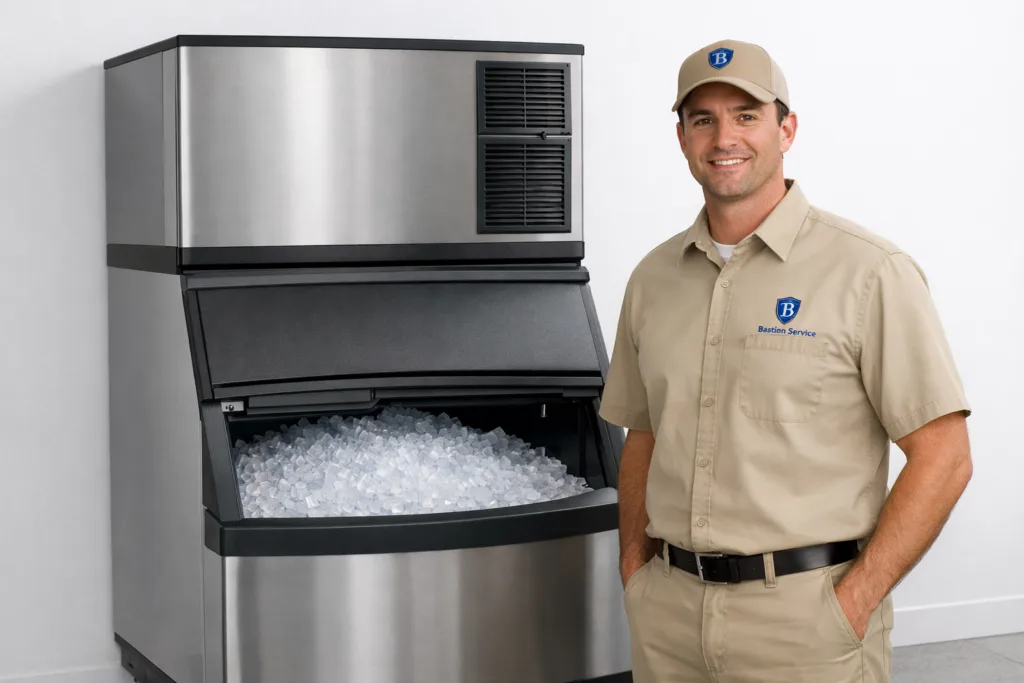




When a Manitowoc ice machine starts falling behind on production, leaking, holding water, or stopping mid-cycle, the issue can quickly affect drink service, food handling, and staff workflow. In many cases, the visible symptom is only the surface problem. Low output may trace back to restricted water flow, a sensor fault, scale buildup, drainage trouble, or a refrigeration-related issue, and each repair path has different downtime implications. For businesses in Mid-City, the most useful service visit is one that identifies the actual cause, determines whether the machine should stay in use, and helps schedule the next step around operating needs. Bastion Service provides Manitowoc ice machine repair in Mid-City with that service-first focus.
For specific equipment paths in Mid-City, review Manitowoc Ice Machine Repair in Mid-City and Commercial Appliance Repair in Mid-City.
What low ice production usually means
If the bin is not filling as expected, the machine may still be running but no longer completing cycles efficiently. Manitowoc units with low production often show one or more related symptoms: long freeze times, thin cubes, incomplete sheets, partial harvest, or inconsistent batch sizes. These patterns commonly point to water supply restrictions, inlet valve problems, dirty condenser conditions, scale on internal components, thermistor or sensor issues, or declining refrigeration performance.
For a business, low production is often the first warning before a full shutdown. A machine that is still making some ice can appear usable while quietly losing efficiency and stressing other components. Scheduling repair before the bin runs empty can help avoid a more disruptive outage during busy hours.
Water flow problems, leaks, and drainage faults
Slow fill, no fill, or interrupted cycles
When the reservoir is not filling correctly, the machine may short-cycle, stall between stages, or produce undersized ice. The underlying problem could be as simple as restricted incoming water or as specific as a failing valve, a control response issue, or scale affecting normal flow inside the unit. Because fill problems can create misleading secondary symptoms, proper testing is important before parts are replaced.
Leaks around the machine
Visible water near a Manitowoc ice machine should not be treated as a minor nuisance. Leaks can come from hoses, fittings, pump components, reservoir overflow, drain connections, or worn internal parts. In some cases, what looks like a leak is actually a backup caused by poor drainage. If water is reaching flooring, wall surfaces, or nearby equipment, the machine should be evaluated promptly to reduce the risk of further damage at the site.
Drain issues and standing water
Drain-related problems can interfere with normal harvest, cleaning cycles, and shutdown protection. If the unit shows standing water, repeated overflow, or recurring fault behavior, the repair may involve the machine, the pump, or the connected drain path. These issues are especially important in business settings because even a partially working machine can create sanitation and cleanup problems while still failing to maintain steady output.
Harvest problems and irregular ice formation
Harvest issues often show up as slab ice, cubes that do not release properly, broken or incomplete batches, or ice that varies from one cycle to the next. These symptoms usually indicate more than a simple adjustment. Common causes include scale on key surfaces, water distribution problems, evaporator-related wear, control timing faults, or refrigeration imbalance.
When harvest problems continue, the machine may cycle repeatedly without producing usable ice at normal levels. That extra strain can shorten component life and turn an intermittent complaint into a wider breakdown. In a business environment, repair usually becomes the more practical choice once staff are spending time working around unreliable output.
Scale buildup and ice quality concerns
Cloudy ice, unusual taste, residue, poor cube shape, or visible mineral buildup inside the machine can all point to more than routine cleaning needs. Scale can restrict water movement, interfere with sensing, reduce heat transfer, and contribute to harvest trouble. At the same time, poor ice quality may also be tied to water component wear, inconsistent fill behavior, or temperature-related performance problems.
A repair-focused inspection helps separate maintenance-related buildup from actual parts failure. That distinction matters because a business may need both corrective cleaning and component replacement to restore reliable performance. When quality problems appear alongside low production or shutdowns, it is usually worth addressing them together rather than treating them as separate complaints.
Shutdowns, error conditions, and intermittent operation
A Manitowoc ice machine that stops unexpectedly, restarts on its own, or repeatedly shows fault conditions usually needs direct testing rather than repeated resets. Intermittent operation can involve control board issues, water level detection problems, sensor faults, high-temperature conditions, condenser airflow trouble, or electrical component failure. These faults can be difficult to confirm without seeing how the machine behaves during actual cycles.
From an operations standpoint, intermittent faults are often more disruptive than total failure because they create uncertainty. Staff may not know whether the machine will make it through the next shift, and that makes planning difficult. Early repair service can improve troubleshooting accuracy while the symptom is still active and may help with faster parts decisions if replacement components are needed.
When the machine should not keep running
Some symptoms suggest that continued use may increase damage or create avoidable risk. These include active leaking, repeated shutdowns, severe scale combined with poor operation, abnormal noises, signs of overheating, or ice quality concerns that affect normal use. Running the unit under those conditions can place more strain on valves, pumps, controls, and other internal systems.
- Water pooling around the machine or reaching nearby surfaces
- Frequent stops during freeze or harvest cycles
- Ice that is discolored, misshapen, or inconsistent from batch to batch
- Unusual sounds during circulation, freezing, or release
- Repeated resets needed to get the machine running again
If one or more of these conditions is present, it is usually better to have the machine assessed before daily demand increases.
Repair or replace?
Not every Manitowoc breakdown points to replacement, and not every older machine is automatically a poor repair candidate. The better decision depends on the failed parts, the overall condition of the unit, the extent of scale or wear, the frequency of recent problems, and how essential that machine is to daily operations. A single isolated fault may make repair the sensible path, while stacked issues across water flow, controls, and ice quality may justify broader planning.
For business owners and managers, a diagnosis helps turn that decision into a budgeting and scheduling question instead of guesswork. Knowing whether the problem is limited or part of a larger pattern makes it easier to plan around downtime and avoid repeated disruption.
Scheduling service in Mid-City
When production drops, leaks appear, harvest becomes unreliable, or the machine starts shutting down without warning, early repair scheduling usually protects uptime better than waiting for a complete outage. Businesses in Mid-City often benefit from having the equipment evaluated while it is still showing the symptom, since that can make the source easier to confirm and the repair plan easier to organize. If your Manitowoc ice machine is affecting daily operations, the next practical step is to schedule service and address the problem before it spreads into a larger interruption.


