
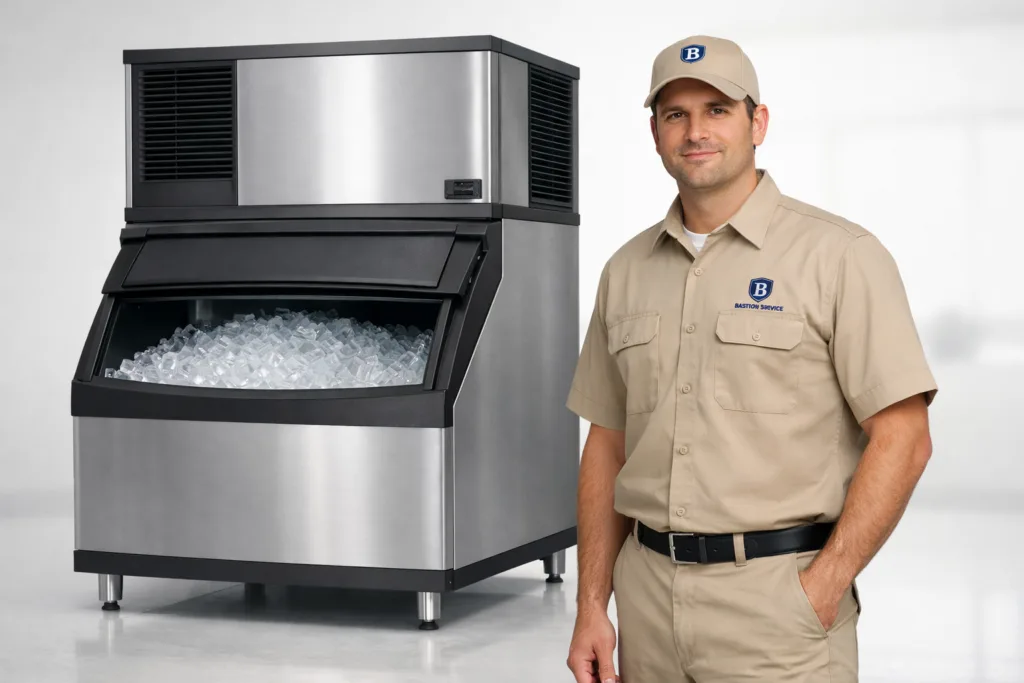




Ice machine problems rarely stay small for long. When a Manitowoc unit starts falling behind on production, leaking onto the floor, stopping mid-cycle, or dropping inconsistent ice, the priority is to identify the fault and decide how quickly service should be scheduled. For businesses in Marina del Rey, that means looking beyond the surface symptom and confirming whether the issue involves water supply, drainage, freeze performance, harvest function, scale buildup, controls, or refrigeration-related components.
For specific equipment paths in Marina del Rey, review Manitowoc Ice Machine Repair in Marina del Rey and Commercial Appliance Repair in Marina del Rey.
Bastion Service helps businesses in Marina del Rey evaluate Manitowoc ice machine issues with service planning focused on uptime, repair scope, and the practical next step for the equipment. In some cases, the unit can remain in limited use until repair is completed. In others, continued operation can increase downtime, create sanitation concerns, or turn one failing part into a larger equipment problem.
Common Manitowoc ice machine symptoms that need repair attention
Many ice machines continue running while performance gets worse. That often leads staff to adapt around the problem instead of addressing it early. A machine may still produce ice, but if output is down, ice quality is off, or the cycle behavior has changed, service is usually the better move before the unit stops completely.
Low ice production or slow recovery
If the bin is not filling on schedule or the machine cannot keep up with normal demand, several issues may be involved. Restricted water flow, mineral buildup, dirty heat-exchange surfaces, refrigerant-side performance problems, sensor faults, or harvest issues can all reduce output. Low production is one of the most common reasons businesses schedule Manitowoc ice machine repair in Marina del Rey because even a partial drop in performance can disrupt service flow.
Slow recovery should not be treated as normal aging. If a machine that used to meet demand now struggles during routine operating hours, the cause should be checked before staff begin overworking the unit or relying on workarounds that do not solve the actual fault.
Thin cubes, incomplete slabs, or poor ice quality
Changes in ice appearance often point to a machine operating outside normal conditions. Thin cubes, hollow or irregular ice, cloudy batches, soft ice, or sheets that do not form evenly can indicate problems with water distribution, freeze timing, scale buildup, water quality impact, or refrigeration performance. If ice is forming but not looking right, that is often an early sign that the machine needs more than a basic reset.
Harvest problems may appear at the same time. Ice can stick to the evaporator, release unevenly, or break apart during the drop. When that happens, the issue may involve scale, sensor readings, water flow, or components affecting the transition from freeze to harvest.
Leaks, overflow, or water around the machine
Water on the floor should be addressed quickly. A Manitowoc ice machine can leak because of drain restrictions, overflow conditions, cracked water lines, fill-related faults, internal ice formation in the wrong area, or a problem in the water management system. Even when the machine is still making ice, leaks can create slip hazards, damage nearby surfaces, and lead to sanitation concerns.
Overflow complaints also deserve prompt inspection because they may be tied to conditions that worsen during continued use. What looks like a minor puddle can be part of a larger drainage or freeze-cycle problem.
Unexpected shutdowns or intermittent operation
A machine that starts, stops, restarts, or locks out without warning is no longer reliable for daily operations. Shutdowns may be related to temperature conditions, water issues, electrical faults, control board problems, safety responses, or component failure during freeze or harvest. Intermittent operation is especially disruptive because the unit may appear to recover on its own, only to fail again during a busy period.
When shutdowns are recurring, service should focus on confirming why the machine is dropping out of normal operation rather than treating each stop as an isolated event.
Why one symptom can point to several different faults
Ice machines often show the same outward symptom for very different internal reasons. Low production might come from scale buildup, poor incoming water flow, condenser issues, weak refrigeration performance, or control-related timing problems. A leak might be a drain problem, a fill problem, or ice forming where it should not. Poor harvest can be caused by mineral deposits, sensors, temperature issues, or component wear.
That is why repair decisions should be based on testing and inspection, not assumptions. Replacing one part because it seems likely can waste time if the real issue is elsewhere in the system. A proper diagnosis helps determine whether the machine needs cleaning-related corrective work, part replacement, system repair, or a broader recommendation based on overall condition.
Signs the problem should not be postponed
Some symptom patterns are more urgent than others. Businesses should move faster on service scheduling when they notice:
- Water leaking or repeated overflow
- Sharp drops in daily ice output
- Ice that is soft, malformed, cloudy, or inconsistent
- Long freeze cycles or failed harvest cycles
- Repeated shutdowns, restarts, or fault behavior
- Visible scale buildup affecting normal operation
- Unusual noises during freeze, release, or refill
These conditions often get worse under normal demand. If the machine is already struggling, continued use can increase wear, reduce production further, and make the eventual outage harder to manage.
How scale buildup affects Manitowoc ice machine performance
Scale is one of the most common contributors to poor ice machine performance. As mineral deposits build up on internal surfaces, water flow and heat transfer can be affected. The machine may take longer to freeze, struggle to harvest correctly, produce inconsistent ice, or shut down because cycle conditions are no longer within normal range.
Scale-related problems are not limited to visible residue. A unit can have deeper performance issues tied to mineral accumulation inside the water system and on freeze surfaces even when the main complaint is simply low output or irregular cubes. If the symptom pattern suggests scale, service should determine whether the issue is primarily cleaning-related or whether deposits have already contributed to component problems that require repair.
Water flow and drainage problems can change the entire cycle
Manitowoc ice machine operation depends heavily on stable water movement. If incoming water is restricted, if distribution is uneven, or if drainage is impaired, the machine may produce less ice, form incomplete batches, overflow, or behave unpredictably between cycles. Water-related faults can also trigger secondary issues that resemble refrigeration or control problems.
Because of that, water flow and drain performance should be evaluated alongside the freeze and harvest process. A machine that appears to have an ice-quality complaint may actually be dealing with a water management issue that is affecting every stage of production.
Repair or replace: what businesses should weigh
Not every service call leads to the same recommendation. Repair is often the right choice when the problem is isolated, the machine remains structurally sound, and the expected result is a return to stable production. Replacement becomes a more serious consideration when the unit has repeated breakdowns, multiple failing systems, rising repair history, or performance limitations that no longer match business needs.
The key question is not only whether the Manitowoc machine can be fixed, but whether the repair meaningfully restores reliable operation. For businesses in Marina del Rey, that decision usually comes down to equipment condition, downtime impact, repair scope, and confidence that the machine will return to consistent ice production rather than cycling into another service event soon after.
What to expect from a service visit
A typical service appointment begins with the symptom history: what the machine is doing, when the problem started, whether the issue is constant or intermittent, and how production has changed. From there, the unit can be checked for water intake, drain behavior, freeze timing, harvest action, scale impact, leak sources, temperatures, and control response.
The goal is to identify the actual cause of the problem, explain the repair path in clear terms, and help the business decide how to handle the equipment in the meantime. That may include guidance on whether to reduce use, take the machine offline, protect surrounding areas from leaks, or plan service around operating hours to limit disruption.
If your Manitowoc ice machine is producing less ice, showing water flow problems, leaking, shutting down, or struggling through harvest cycles, scheduling service sooner usually leads to a better repair outcome than waiting for a full stoppage. For businesses in Marina del Rey, the most useful next step is to have the machine evaluated so the fault, urgency, and repair plan are clear before downtime expands into a larger operational problem.


