
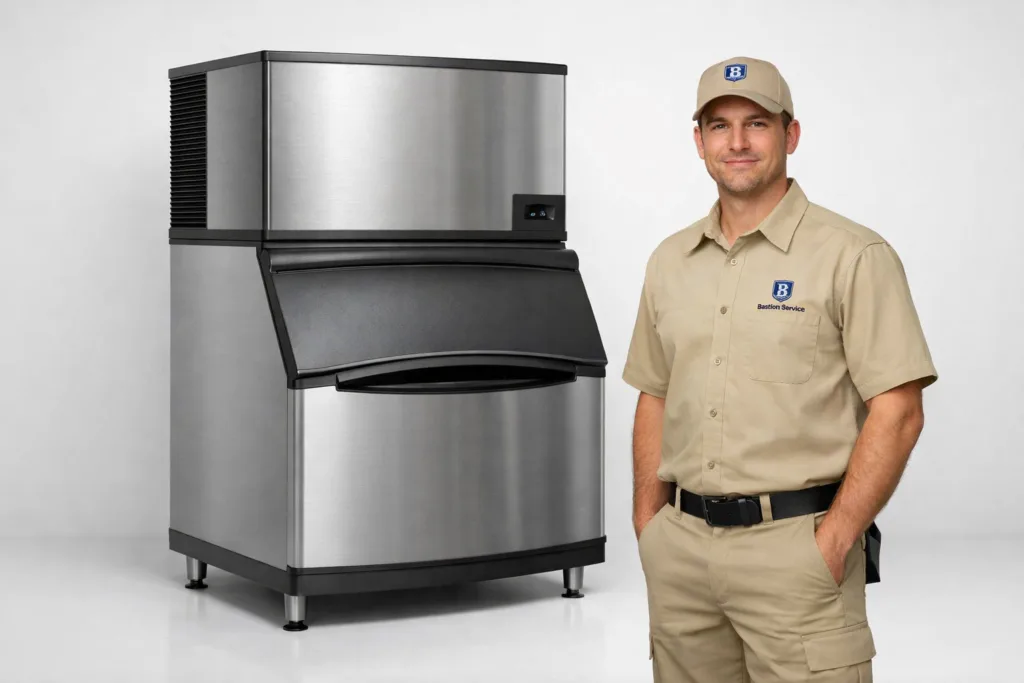




Ice machine problems can quickly disrupt beverage service, food holding, prep routines, and customer-facing standards. When a Manitowoc unit starts making less ice, leaking, shutting down, or producing poor-quality cubes, the fastest way to protect operations is to schedule service based on the actual symptom pattern rather than guess at the cause. Bastion Service works with Beverly Hills businesses to inspect the equipment, identify the fault, and map out the repair timing that makes the most sense for daily operations.
For specific equipment paths in Beverly Hills, review Manitowoc Ice Machine Repair in Beverly Hills and Commercial Appliance Repair in Beverly Hills.
What Manitowoc ice machine symptoms usually mean
Many performance issues look similar at first, but they do not always point to the same repair. A machine that is low on production may have a water supply restriction, scale buildup, a circulation problem, sensor trouble, drainage interference, or a cooling-related failure. A unit that leaks may have an external line issue, an internal overflow condition, or a problem tied to its freeze and harvest cycle. That is why symptom-based diagnosis matters before replacing parts or deciding whether the machine should remain in use.
Low ice production or slow recovery
If the bin is not filling as expected, batches are smaller than normal, or the machine cannot keep up during busy periods, there may be an issue with incoming water volume, filtration, scale on internal components, condenser performance, or controls that are no longer reading accurately. Slow production often starts gradually, which makes it easy for staff to work around it until supply becomes inconsistent. Early repair attention can prevent a production shortfall from turning into a full stoppage.
Poor ice quality, cloudy cubes, or irregular shape
Changes in ice appearance usually signal more than a cosmetic problem. Cloudy cubes, soft ice, incomplete cubes, or uneven sizing can indicate water distribution trouble, mineral buildup, freezing inconsistencies, or a harvest problem that is affecting the cycle. These symptoms matter because they often point to a machine that is no longer operating cleanly or efficiently. Left unresolved, ice quality issues can turn into repeated jams, poor output, and heavier internal buildup.
Leaks and drainage problems
Water around the machine should never be ignored. Leaks can come from supply lines, drain restrictions, internal overflow, worn connections, or cycle-related faults that allow water to move where it should not. In a business setting, even a minor leak can create slip risk, damage nearby surfaces, and suggest a deeper equipment problem. Service helps determine whether the source is plumbing-related, drainage-related, or directly tied to the ice machine itself.
Shutdowns, restart loops, or stopped cycles
When a machine powers down unexpectedly, stops mid-cycle, or requires repeated resetting, the issue may involve sensors, control board communication, thermistor readings, safety responses, or mechanical wear affecting normal operation. Repeated restarting rarely solves the underlying problem and can cost staff time while the machine becomes less reliable. If shutdowns are becoming part of the daily routine, the unit should be evaluated before the failure expands.
Harvest issues and ice release problems
A machine that freezes but does not release ice properly may be dealing with scale interference, sensor misreading, timing problems, or component wear that affects the transition from freeze to harvest. This often shows up as ice hanging up, incomplete release, long cycle times, or erratic batch timing. Harvest trouble is especially important to address quickly because it directly affects output and can place extra strain on the machine as it tries to complete each cycle.
Scale buildup and restricted water flow
Scale is one of the most common causes of Manitowoc performance loss. Mineral buildup can restrict water movement, reduce heat transfer, affect probe readings, interfere with harvest consistency, and gradually lower daily production. In some cases, the machine still appears to run, but it does so with increasing strain and declining ice quality. A service visit can determine whether the issue is limited to buildup or whether valves, pumps, probes, or related parts have already been affected.
Why professional diagnosis matters before repair decisions
Two machines can show the same symptom and need very different repairs. Low production might come from poor water feed, a scaled system, control issues, or a cooling-side fault. A leak might be external and simple, or it might be tied to an operational problem inside the unit. Proper diagnosis helps avoid unnecessary parts replacement and gives managers a better sense of urgency, expected repair scope, and whether short-term continued operation is realistic.
This also helps with scheduling. Some issues allow for limited use while waiting for repair, but others do not. If the unit is leaking, cycling unpredictably, or producing poor-quality ice, keeping it in service may increase damage or create sanitation concerns. Knowing where the fault actually sits makes it easier to decide whether to keep the machine running, reduce demand on it, or take it offline until repair is completed.
Signs the problem should not be ignored
- The machine needs repeated resets to start or continue a cycle.
- Ice output has dropped enough to affect beverage or kitchen workflow.
- Ice is cloudy, soft, incomplete, or inconsistent from batch to batch.
- Water is pooling near the machine or drain behavior has changed.
- The unit freezes but struggles to harvest or release ice properly.
- Scale buildup is visible or performance has declined after ongoing mineral exposure.
- Staff are spending time managing workarounds instead of normal operations.
These are usually signs that the machine needs more than routine observation. Waiting too long can turn a manageable repair into a longer outage, a larger parts need, or a broader interruption to service.
Repair or replace?
Many Manitowoc ice machine problems are repairable, especially when the issue is caught before it affects multiple systems. Water flow faults, drainage issues, scale-related performance loss, control problems, and harvest-related failures often make sense to repair when the equipment is otherwise in solid condition. Replacement becomes a more serious consideration when the unit has ongoing reliability problems, repeated major failures, or repair costs that no longer support the role it plays in the business.
The key is to base that decision on the current fault and overall equipment condition, not just on one difficult day of low ice availability. A proper evaluation helps separate an isolated repair from a machine that is reaching the point where further investment may not be practical.
Service planning for Beverly Hills businesses
For restaurants, hotels, bars, cafes, and other businesses in Beverly Hills, ice machine downtime affects more than convenience. It can disrupt service standards, prep efficiency, and staff workflow while forcing temporary solutions that add cost and labor. Repair planning should account for both the technical issue and the impact on day-to-day operations, especially when the machine supports high-volume or customer-facing service.
If your Manitowoc ice machine is producing less ice, leaking, shutting down, struggling to harvest, or showing signs of scale and water flow trouble, the next step is to schedule service and review the repair path before the issue spreads further. A focused inspection can confirm what failed, whether the unit should remain in use, and how to restore reliable ice production with as little disruption as possible in Beverly Hills.


