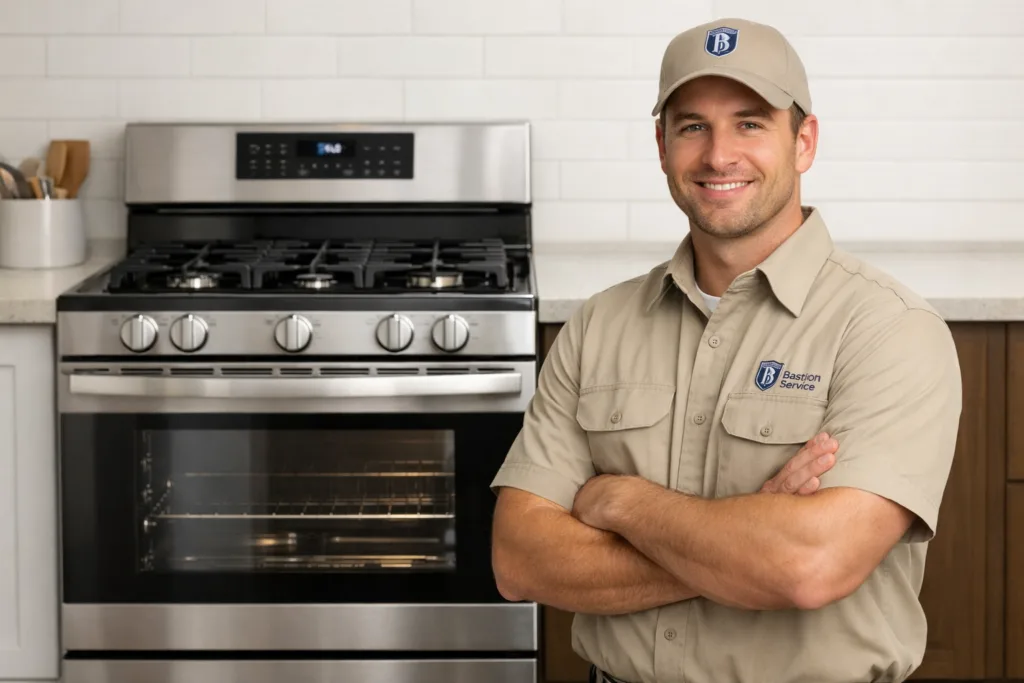
Cooking problems with an LG range often start small: a burner that clicks longer than usual, an oven that suddenly needs extra time, or temperatures that seem slightly off from one meal to the next. Those patterns matter because they help separate a simple burner or sensor issue from a deeper ignition, heating, or control fault.
Related LG and range service paths in Century City include LG Appliance Repair in Century City, Range Repair in Century City, and LG Refrigerator Repair in Century City.
How LG range problems usually show up
Ranges combine several systems in one appliance, so the symptom does not always point to a single obvious part. A cooktop issue may be limited to one burner assembly, while an oven complaint can involve the igniter, element, sensor, relay, or control. Looking at what fails, when it fails, and whether the problem is constant or intermittent usually gives the best starting point.
In Century City homes, homeowners often notice trouble in day-to-day use before a range stops working completely. Slower preheating, inconsistent burner performance, unusual clicking, or an unresponsive keypad are all signs that the appliance should be evaluated before the issue spreads or becomes a safety concern.
Common LG range symptoms and what they may mean
Surface burner will not ignite or heat
On gas models, a burner that clicks but does not light may be dealing with a dirty burner head, cap misalignment, moisture after cleaning, a weak spark, or a gas flow problem at that burner. If the clicking continues after ignition or starts on its own, the issue may involve the spark switch or ignition system.
On electric models, a cold burner can be caused by a failed radiant element, damaged receptacle, loose wiring, or a bad infinite switch. If one burner is affected but the rest of the range works normally, the fault is often localized rather than system-wide.
Oven does not heat or takes too long to preheat
This is one of the most common service calls. On gas ranges, a weak igniter can glow yet still fail to pull enough current to open the gas valve properly. That leads to delayed ignition, long preheat times, or an oven that never reaches the selected temperature. On electric models, a failed bake element, broil element, relay, or wiring problem can create similar complaints.
If the oven starts heating and then stalls, the problem may be tied to heat regulation rather than initial startup. That can point to the sensor, control board, or an intermittent connection that fails as the appliance warms up.
Uneven baking, hot spots, or inaccurate temperature
When food browns too quickly on one side, stays pale in the center, or cooks differently from rack to rack, the range may not be regulating heat correctly. A drifting temperature sensor, weak igniter, partially failed element, damaged gasket, or control problem can all cause uneven results.
These complaints are easy to dismiss as cookware or recipe issues, but when the pattern becomes consistent across different meals, the appliance itself is often the reason.
Clicking keeps going after the burner lights
Persistent clicking is not just annoying. It can signal a dirty ignition path, trapped moisture, a mispositioned cap, or a failing spark switch. If multiple burners begin clicking unexpectedly, the issue may be affecting shared ignition components rather than a single burner.
Display, keypad, or control panel problems
If the display is dim, blank, unresponsive, or changing settings on its own, the cause may involve the user interface, main control, power supply, or wiring harness. Control issues can also show up as cooking problems, such as an oven that will not start, cancels cycles unexpectedly, or does not maintain the set temperature.
Because LG ranges rely heavily on electronic controls, it helps to evaluate the full symptom pattern instead of focusing only on the panel or only on the heating complaint.
Door, latch, and self-clean related issues
A door that does not close fully can let heat escape and make the oven appear weak even when the heating system is functioning. Problems that begin after a self-clean cycle may involve heat-stressed latches, sensors, wiring, or control components. If the oven locks and will not return to normal use, the latch assembly or control logic may need attention.
Signs the range should not keep being used normally
Some issues are inconvenient, while others should be treated as urgent. Stop routine use and schedule service if you notice:
- Repeated failure to ignite
- Sparking, arcing, or signs of scorching
- Burners heating unpredictably
- The oven running far hotter than the set temperature
- Error codes that keep returning
- Breaker trips during operation
- Knobs, controls, or surrounding surfaces getting unusually hot
For gas models, a persistent gas smell is not something to monitor casually. If that occurs, stop using the appliance and follow appropriate safety steps before arranging repair.
Repair or replacement: what usually makes sense
Many LG range issues are worth repairing when the failure is limited to a burner component, igniter, heating element, sensor, latch, or control-related part and the appliance is otherwise in good shape. Repair becomes less attractive when there are several major failures at once, extensive wear, recurring electronic problems, or evidence that prior breakdowns are starting to stack up.
Age matters, but not by itself. A well-kept range with one defined fault can still be a good repair candidate, while a newer unit with multiple expensive failures may not be the best investment. The most useful approach is to weigh the exact symptom pattern, overall condition, and likely repair path.
What information helps speed up diagnosis
Before service, it helps to note a few details:
- Whether the issue affects the cooktop, oven, or both
- Whether the problem happens every time or only occasionally
- Any error code shown on the display
- Whether the issue started after cleaning, a power outage, or a self-clean cycle
- Which burner or oven mode is affected
- Whether preheating, ignition, or temperature holding is the main complaint
Those observations can make it easier to narrow down whether the problem is related to ignition, heating, sensing, wiring, or the electronic controls.
Focused help for homeowners in Century City
LG range repair in Century City is usually most effective when the service decision is based on the actual symptom rather than a guess at the part. A burner that will not light, an oven that heats inconsistently, or a control panel that behaves unpredictably may all look similar from the outside, but the repair path can be very different.
For homeowners in Century City, the goal is straightforward: restore safe, consistent cooking performance and determine whether the appliance is a good candidate for repair or nearing the point where replacement makes more sense.